
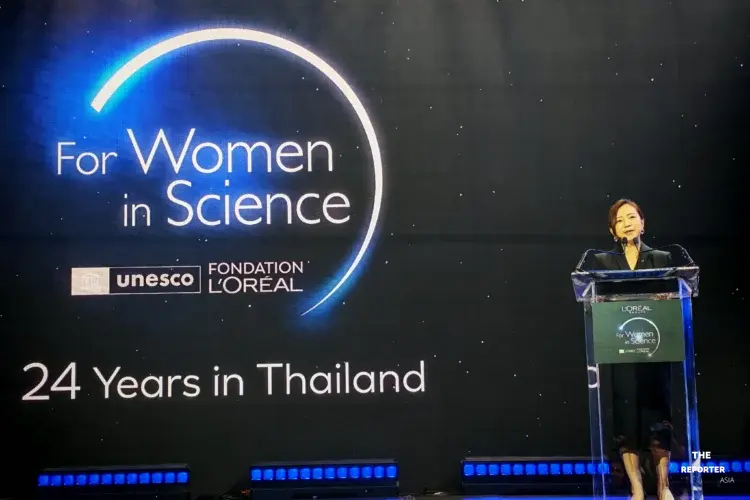
L’Oréal Groupe in Thailand has announced the recipients of the 2026 L’Oréal Thailand “For Women in Science” Fellowship Programme, granting research funds of 250,000 THB each and honorary plaques to four distinguished female researchers. Marking its 24th consecutive year, the initiative expanded its eligibility criteria by raising the maximum applicant age from 40 to 45 years to accommodate mid-career scientists leading high-impact studies across health, medicine, and sustainability.
Selected from more than 89 research proposals, the fellowship evaluates projects based on scientific merit, methodology, research ethics, and potential societal benefits. The selection process was conducted by an honorary jury comprising 12 prominent Thai scientists, chaired by Professor Dr. Yongyuth Yuthavong, former Deputy Prime Minister and former Minister of Science and Technology, alongside Vice President Prof. Dr. Pairash Thajchayapong.
Expanding Opportunities for Female Scientific Leadership
The decision to widen the age eligibility limit to 45 years addresses the need to support experienced female scientists at crucial phases of laboratory development and clinical translation. The submissions for 2026 reflected an increase in volume and topic diversity, spanning cellular therapies, computational nanocarriers, and electrochemical biosensors derived from agricultural biomass.
Mr. Patrick Girod, CEO of L’Oréal Thailand, Myanmar, Laos, and Cambodia, noted that the programme aims to translate academic discoveries into practical societal solutions. He stated that sustained support for female researchers builds a resilient scientific ecosystem and encourages broader participation, noting that the selected projects advance cancer therapeutics and resource valorisation directly linked to national development priorities.

Advancing Cellular Immunotherapy in Life Sciences
In the Life Sciences category, Assoc. Prof. Dr. Aussara Panya from the Department of Biology, Faculty of Science, Chiang Mai University, received the fellowship for her project on multiple myeloma. Her research evaluates the TriKE-CD47 protein, which connects patient-derived natural killer (NK) cells to malignant plasma cells while suppressing tumour immune-evasion signals. Following animal trials that indicated tumour suppression without severe adverse effects, the study is progressing to ex vivo evaluations with clinical samples to establish targeted immunotherapy profiles.
Also awarded in Life Sciences, Assoc. Prof. Dr. Methichit Wattanapanitch from the Faculty of Medicine Siriraj Hospital, Mahidol University, focuses on developing off-the-shelf cancer immunotherapies. Her team utilizes induced pluripotent stem cells (iPSCs) combined with CRISPR/Cas9 gene-editing technologies to engineer ready-to-use immune cells, addressing the production bottlenecks, high costs, and variable cell quality associated with personalized CAR T-cell therapies. The project is standardizing manufacturing protocols for scaled preclinical testing to expand domestic access to advanced biologics.
Mathematical Modelling and Green Electrochemistry in Physical Sciences
Within the Physical Sciences category, Assoc. Prof. Dr. Duangkamon Baowan from the Department of Mathematics, Faculty of Science, Mahidol University, was honoured for combining applied mathematics with nanotechnology. Her work employs heuristic algorithms and mathematical models to calculate the structural stability of carbon nanocarriers, such as nanotubes and graphene oxide, for targeted cancer drug delivery. This computational framework identifies optimal drug-carrier configurations before laboratory synthesis, reducing experimental trial-and-error, reagent consumption, and research expenditure.
Assoc. Prof. Dr. Kamonwad Ngamchuea from the School of Chemistry, Institute of Science, Suranaree University of Technology, received the award for her research applying electrochemistry to domestic agricultural biomass. The team processes cassava starch, lignin, and cellulose through mild reactions into conductive materials for portable sensors. These sensors detect critical health biomarkers in saliva, sweat, blood, and urine, integrating artificial intelligence algorithms for signal analysis to support point-of-care testing in an ageing society while advancing circular economic practices.
The L’Oréal-UNESCO “For Women in Science” initiative was founded globally in 1998 by the Fondation L’Oréal and UNESCO, supporting over 250 researchers annually across national and regional programmes. To date, more than 100 laureates have received international recognition, including seven scientists who later won Nobel Prizes. In Thailand, the programme has run continuously for 24 years, delivering individual grants of 250,000 THB to each selected fellow.
#LOreal #ForWomenInScience #FWIS2026 #ThailandScience #ResearchGrants