


Panduit hosted its annual Panduit Thailand Technology Day 2026 in Bangkok under the theme “Powering an AI-Driven Future,” bringing together business leaders, IT consultants, system integrators, and channel partners to address the critical infrastructure required for Thailand’s digital economy. The summit addressed the escalating computing requirements, rising power densities, and connectivity demands triggered by accelerating artificial intelligence adoption across enterprise operations.
Rising Data Demands Shape Thailand’s Digital Hub
Thailand continues to solidify its footprint as a strategic digital infrastructure hub across Southeast Asia. Industry research forecasts the domestic data centre market will expand from USD 1.45 billion in 2025 to USD 6.29 billion by 2031, driven by enterprise digital transformation, cloud ecosystem expansion, and persistent capital investment from hyperscale and colocation operators.
Simin Sirun, Business Director for ASEAN, India, and Korea at Panduit, noted that Thailand is at the forefront of digital infrastructure development driven by rapid cloud and AI deployment. As organizations scale digital capacities, the underlying physical infrastructure becomes central to sustaining reliability and performance across complex computing environments.
Next-Generation Power and Scalability Platforms
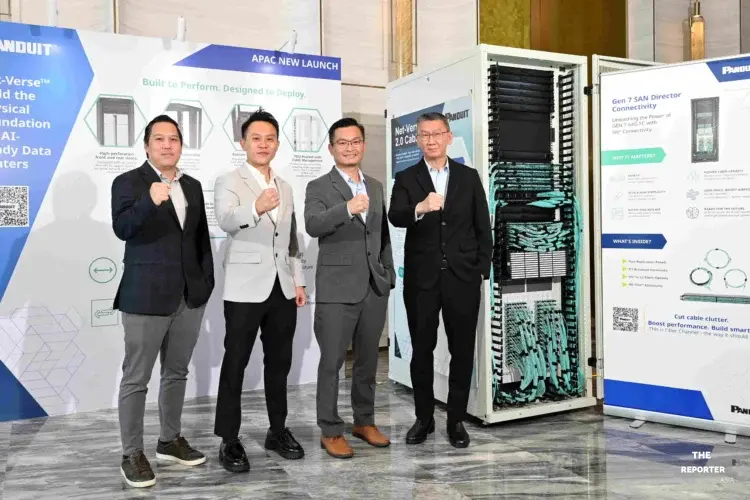
To counter increasing operational complexities, Panduit introduced four primary infrastructure platforms engineered to optimize power delivery and visibility. The EL2P Intelligent Power Distribution Unit (PDU) provides granular monitoring and intelligent distribution across high-density racks. For high-throughput storage networks, the Gen 7 SAN Director Connectivity delivers scalable fibre connectivity tailored to next-generation AI processing architectures.
The lineup also incorporates the Fault Managed Power System (FMPS), delivering controlled, safe power distribution for smart building endpoints and connected devices. Panduit also rolled out NetVerse™ 2.0, an upgraded infrastructure management platform that streamlines monitoring, connectivity management, and physical scalability across modern data centre footprints.
GPU Optimization and Architecture Domains
Addressing extreme GPU interconnect density, Panduit debuted its Very Small Form Factor (VSSF) fibre optic portfolio featuring MMC connectivity and shuffle cabling. The architecture supports advanced computing silicon, including NVIDIA Vera Rubin platforms, by maximizing fibre density and interconnect throughput within dense hardware clusters.
Panduit structured its technical framework across three distinct operational pillars. In Electrical Infrastructure, demonstrations highlighted safe cable routing, reliable terminations, grounding and bonding, and facility identification systems to ensure uninterrupted power safety. In Enterprise Network Infrastructure, discussions centered on high-performance copper and optical systems enabling smart buildings and workplace connectivity. Within Data Centre Network Infrastructure, the emphasis centered on structured cable routing, pre-terminated fibre assemblies, and GPU-ready designs.
Sirun emphasized that AI readiness depends on establishing the correct physical foundation before deploying advanced workloads. Organizations investing in high-density power, resilient cabling, and scalable management platforms will remain positioned to capture the operational advantages of artificial intelligence as enterprise adoption expands.
#Panduit #DataCentre #AIInfrastructure #ThailandTech #TheReporterAsia