

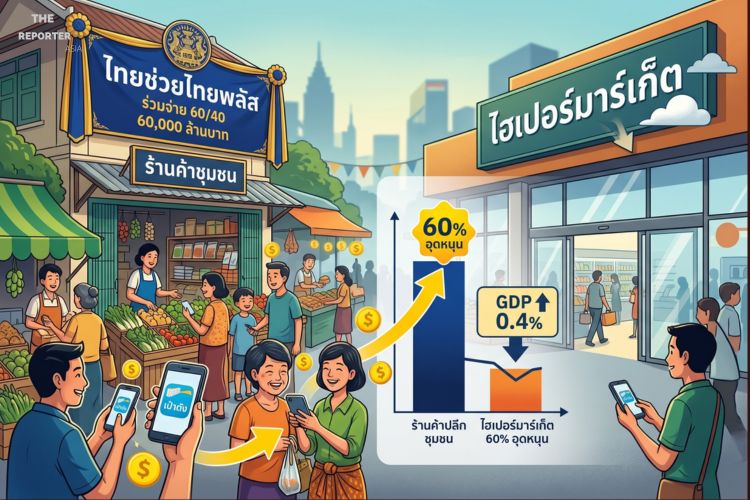
The Thai government’s newly launched “Thai Chuay Thai Plus” stimulus program will primarily function as a temporary consumption stabilizer, redirecting consumer traffic toward small grassroots merchants and traditional trade while exerting limited, short-term credit impact on major modern retailers.
Modest GDP Contribution and Household Relief Focus
The newly introduced “Thai Chuay Thai Plus” co-payment scheme is strategically designed by the government to alleviate pressing cost-of-living burdens for Thai citizens, particularly targeting vulnerable groups. Operating from June 1 to September 30, 2026, the program marks a proactive fiscal effort injected into the domestic market. However, macroeconomic projections indicate that the initiative will act more as an economic cushion than a powerful growth engine, preventing a downward spiral in consumer spending amid elevated household costs.
According to a comprehensive analysis by TRIS Rating, the scheme’s overall contribution to national economic growth is expected to remain modest, with an estimated incremental GDP growth of approximately 0.4%. Rather than generating entirely new, sustainable consumption demand, the financial injection will primarily serve to stabilize existing purchasing power. The temporary nature of the program ensures that while immediate relief is felt on the ground, it does not fundamentally alter long-term structural consumer behavior or macroeconomic trajectories.
The fiscal design of Thai Chuay Thai Plus involves a massive government budget of THB120 billion, significantly larger than previous interventions. Eligible Thai citizens aged 18 and older will benefit from a 60% government subsidy paired with a 40% consumer contribution, offering a total entitlement of THB4,000 per person distributed at THB1,000 per month. To ensure a steady flow of liquidity into the grassroots economy, a daily spending cap of THB200 is enforced, and unused monthly balances are strictly non-rollover, compelling active monthly participation.
Structural Shifts and Asymmetric Impact on Modern Retailers
The implementation of the 60-40 co-payment framework will trigger a temporary spending shift away from modern commercial channels and toward traditional trade networks. Because the program explicitly restricts the subsidy usage to small local merchants, community shops, and the broader network of “Thong Fah” (Blue Flag) retail stores, these entities will emerge as the direct, first-round beneficiaries. This targeted channeling aims to revitalize grassroots commerce and enhance liquidity among low-income shop owners.
Consequently, major modern trade operators are anticipated to experience a near-term softening in foot traffic and transaction volumes, particularly within everyday product lines. Mass grocery segments, daily essential items, and standard household staples will see a temporary diversion as price-sensitive shoppers maximize government subsidies at qualified traditional storefronts. Despite this reallocation of retail traffic, analysts emphasize that the diversion does not represent a permanent threat to the established modern retail ecosystem.
Importantly, credit rating experts clarify that this temporary disruption carries negligible risks for corporate financial health. The impending demand shift toward traditional trade is purely cyclical and policy-driven rather than structural. Across major sub-sectors—ranging from hypermarkets and wholesalers to convenience stores and specialized retailers—the overarching credit impact is projected to be limited and transitory, leaving long-term corporate profitability and fundamental credit ratings entirely intact.
Hypermarkets Face Brunt of Substitution Pressure
Among the various formats of modern retail, large-scale hypermarkets are positioned to bear the most direct pressure during the four-month active period of the scheme. These massive retail outlets are uniquely vulnerable because their core business models rely heavily on mass grocery sales and price-conscious consumers. Because lower-to-middle-income households are highly motivated to utilize the 60% government subsidy, hypermarkets will see immediate volume substitution in highly replaceable staple categories.
This temporary re-routing of consumer capital will likely manifest in softer quarterly sales figures and minor traffic declines for hypermarket operators through the summer months. The direct competition with subsidized local traditional stores forces hypermarkets to refine their near-term value propositions. Nevertheless, market experts reiterate that the downside risks to these retail giants remain strictly contained, mirroring trends observed during historical stimulus rollouts.
The historical performance of hypermarkets during the previous “Khon La Khrueng Plus” campaign in late 2025 demonstrates their inherent operational resilience. Major hypermarkets consistently maintain a deeply loyal consumer base that cannot be easily permanently diverted. Their long-term stability is safeguarded by an extensive and diverse product selection, highly aggressive corporate pricing strategies, bulk discounting, and seamless online-to-offline (O2O) convenience ecosystems that traditional shops cannot replicate.
Wholesale Resilience and Convenience Store Liquidity Gains
In sharp contrast to the hypermarket segment, cash-and-carry wholesale operators are projected to remain largely insulated from the negative side effects of the subsidy scheme. The business architecture of wholesalers relies predominantly on bulk sales executed with small independent retailers, local restaurants, and diverse commercial businesses. Because their primary revenue streams are decoupled from individual consumer retail choices, they face no direct substitution risks from the government’s policy.
In fact, the Thai Chuay Thai Plus scheme could ultimately deliver a mildly positive ripple effect upward to major wholesale operations. As thousands of participating small traditional merchants experience a surge in consumer traffic and rapid inventory turnover, they will be forced to restock their shelves aggressively. This commercial restocking wave will funnel massive inventory orders upstream to wholesale distribution hubs, effectively offsetting any minor softening in direct-to-consumer wholesale demand.
Concurrently, national convenience store chains are expected to navigate the co-payment period with a neutral to slightly positive operational outcome. Although convenience networks are excluded as direct subsidy redemption channels, they will benefit indirectly from the broad improvement in consumer liquidity. Enhanced cash flow within household budgets will likely free up disposable income for convenience-driven, top-up shopping and spontaneous impulse purchases. Their unmatched geographical accessibility and dominance in immediate-consumption items will preserve steady foot traffic.
Discretionary Retail and the E-Payment Infrastructure Future
Non-essential and discretionary retail segments—including fashion boutiques, cosmetics counters, electronics outlets, and specialty stores—face a neutral to marginally negative short-term outlook. During the active months of June through September 2026, consumer capital is expected to temporarily rotate heavily toward subsidized essential goods and daily necessities. This tactical rotation could minorly depress growth rates for non-essential retail categories as consumers optimize their monthly budgets around government support.
However, this minor compression will be brief, as discretionary spending patterns are fundamentally dictated by broader long-term economic indicators. Household income expectations, sustainable wage growth, employment security, and overall consumer confidence exert far greater influence on discretionary retail than short-term co-payment programs. Once the four-month fiscal cycle concludes, discretionary spending is anticipated to normalize rapidly back to its baseline trajectory without enduring any structural damage.
Ultimately, the technical execution of the Thai Chuay Thai Plus scheme underscores the accelerating digital transformation of the domestic economy. By mandate, the entire THB120 billion program is executed digitally via the state-backed “Pao Tang” application and its integrated “G-Wallet” e-payment platform. This extensive reliance on digital financial infrastructure not only ensures transparent, efficient, and trackable fiscal distribution but also permanently reinforces digital payment habits across both consumers and grassroots merchants nationwide, setting the stage for future financial technology integrations.
#ThaiChuayThaiPlus #CoPaymentScheme #ThaiEconomy2026 #RetailIndustry #ConsumerSpending #TRISRating #GrassrootsCommerce #TheReporterAsia