

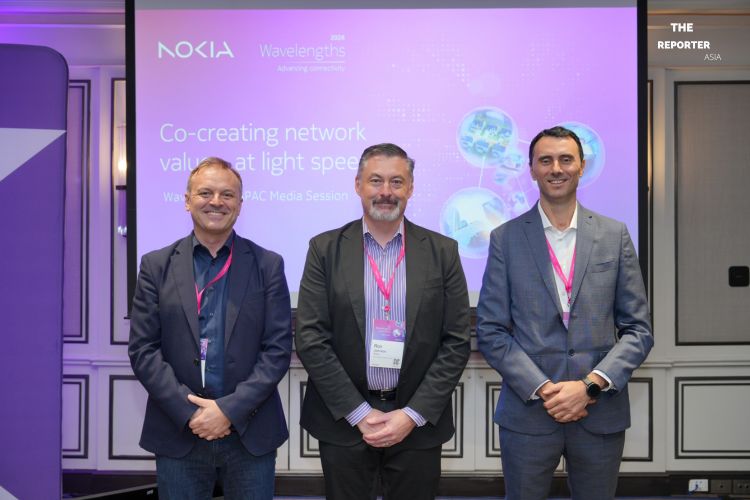
In a major technological leap, Nokia showcases high-capacity, energy-efficient optical infrastructure to power Asia Pacific’s booming digital transformation and hyperscale data centers.
The Dawn of the AI Infrastructure Era
The rapid proliferation of artificial intelligence technologies is fundamentally transforming global business operations and society at large. To support this massive surge in processing demands, infrastructure capabilities must evolve at an unprecedented pace. Technology leader Nokia has formally addressed this challenge by showcasing its latest high-speed optical networking innovations and AI-ready solutions. Unveiled during the prestigious Wavelengths APAC event held in Bangkok, Thailand, these developments form a critical part of Nokia’s global event series, which focuses specifically on exploring the future of hyper-connectivity, next-generation optical frameworks, and AI-driven networks.
As industries rapidly integrate machine learning and automated systems, legacy data ecosystems face immense challenges in bandwidth capacity and transmission speed. The presentation in Thailand served as a key regional milestone, positioning the country at the center of the ongoing technological shift. By bringing together major industry stakeholders, enterprise telecommunication providers, and technology experts, the event served as a major strategic platform to showcase how next-generation optical infrastructure can handle the immense computational workloads required by modern AI architectures.
The event focused heavily on how continuous infrastructural investment can actively drive national and regional progress. Upgrading network cores allows organizations to successfully transcend traditional data processing boundaries, preparing businesses to remain competitive. Crucially, the deployment of these next-generation optical solutions ensures that both sovereign networks and multinational enterprises operating across the Asia Pacific can seamlessly transition into a highly automated, intelligence-driven digital future.
Scaling Networks for the Hyperscale Supercycle
The exponential growth of modern AI applications relies heavily on the scalability, security, and efficiency of core transport networks. During executive briefings at the event, Nokia’s leadership team emphasized that the rise of large-scale infrastructure, including hyperscale data centers, distributed cloud environments, and complex AI ecosystems, demands a major overhaul of modern network backbones. They pointed out that networks are no longer simple communication pipelines, but have instead matured into the fundamental foundation driving the broader digital transformation across Thailand and the wider Asia Pacific region.
A major highlight of the event was an in-depth exploration of the “AI Supercycle” and the specific structural issues facing network operators today. Industry experts addressed the massive surge in bandwidth requirements, the physical limitations of current fiber optics, and the escalating energy costs associated with running massive, continuous data processing operations. To resolve these operational challenges, Nokia introduced its latest high-performance optical innovations, specifically highlighting the advanced ICE7 architecture and the cutting-edge PSE-6s coherent optics platform.

These proprietary technologies are designed to dramatically scale network capacities while maintaining exceptional energy efficiency and operational reliability. By integrating these solutions, service providers can confidently mitigate the severe bandwidth constraints brought on by intensive AI data sets. This technological progression provides the underlying architecture necessary for telecommunication companies and hyperscalers to expand their service portfolios, optimize their power consumption, and maintain seamless continuity in an increasingly data-heavy global market.
End-to-End Interconnectivity and Augmented Reality Insights
Beyond theoretical frameworks, the technology showcase featured comprehensive live demonstrations designed to illustrate the real-world applications of Nokia’s latest optical and automation systems. Attendees were given an extensive guided tour displaying an end-to-end network architecture that connects various user sectors globally. The showcase successfully proved how unified optical transport systems can seamlessly bridge residential services, mobile backhaul connectivity, enterprise networks, metropolitan connections, long-distance routes, and deep-sea submarine cables into a cohesive ecosystem.
A key highlight was the unveiling of Nokia’s next-generation Data Center Interconnect (DCI) solutions, engineered to optimize high-capacity linkages between distributed data center hubs and massive cloud service providers. Nokia demonstrated how its advanced Optical Line System (OLS) supporting the wide C+L frequency spectrum, combined with advanced coherent routing capabilities and 800G coherent pluggable modules, integrates into existing routing portfolios. This configuration allows data center operators to scale their networks smoothly while lowering overall complexity.
The technology exhibition also leveraged immersive Augmented Reality (AR) to give participants an inside look at the intricacies of high-speed data center optics. Through interactive AR simulations, attendees closely examined the internal mechanics of the cutting-edge ICE-X 800G ZR/ZR+ pluggable components and the OLS/RD66 C+L ROADM systems. The immersive display clearly illustrated Nokia’s research pathway toward reducing the power consumption of high-performance pluggable hardware using their specialized ICE-D technology, setting a new benchmark for sustainable infrastructure design.
“As AI adoption accelerates across industries, the need for high-performance, scalable and energy-efficient network infrastructure has never been more critical. From data center interconnect and subsea connectivity to next-generation optical networking innovations, Nokia is helping customers build the networks needed to unlock the full potential of the AI era while supporting Thailand and the region’s broader digital transformation ambitions.” — Vito Di Maria, Vice President of Optical Networks for Nokia Asia Pacific
Strategic Alliances and Telecommunications Opportunities
The sudden surge in global investments into specialized AI infrastructure presents a unique set of commercial and operational opportunities for traditional telecommunication providers. According to senior marketing executives at the event, the rapid deployment of artificial intelligence demands massive capacity upgrades and tighter partnerships across the digital ecosystem. Telecommunication companies must work hand-in-hand with hyperscalers and cloud infrastructure operators to build a more resilient, highly interconnected digital world.
This collaborative approach is essential for bridging the gap between localized data storage, specialized cloud applications, and end-users worldwide. By implementing agile, high-capacity interconnect solutions, service providers can position themselves as indispensable partners in the global AI supply chain. Moving forward, Nokia remains dedicated to driving these industry partnerships and delivering the advanced networking solutions required to secure a sustainable, intelligent, and interconnected global economy.
#Nokia, #WavelengthsAPAC, #OpticalNetworking, #AIInfrastructure, #DataCenter, #Telecommunications, #AsiaPacific, #DigitalTransformation, #TechInnovation, #Sustainability