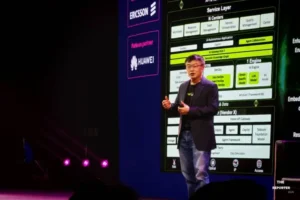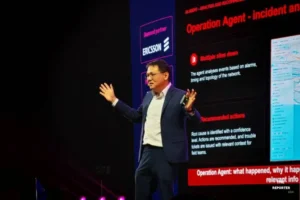

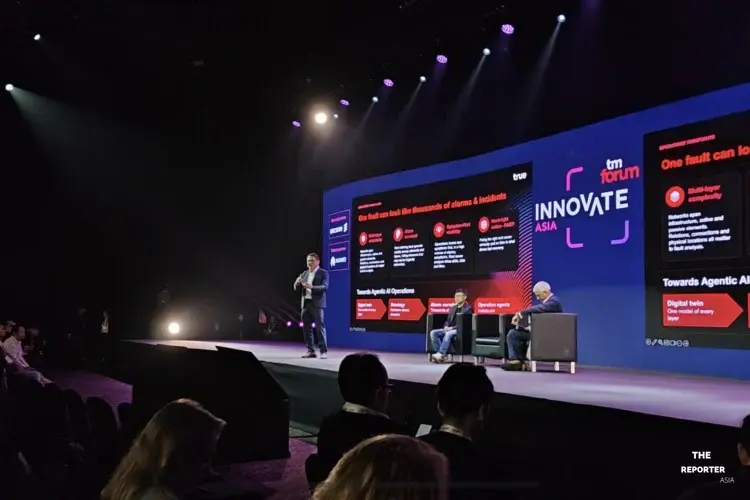
Technology leaders from True, AIS, and Telstra convened at a TM Forum panel moderated by George Glass, Chief Technology Officer at TM Forum, to outline architectural strategies for scaling Level 4 Autonomous Networks. The executives emphasized that achieving high-level network autonomy requires establishing Digital Twin foundations, trusted knowledge-centric architectures, and standardized Multi-Agent cross-domain collaboration.
True Deploys Digital Twins and Ontology for Root-Cause Analysis
Prathet Tankuranun, Chief Technology and Information Officer (CTIO) at True, detailed the operator’s progression from its internal Touch-Free Operation (TFO) program, which automated 9% of human interactions across 10 core operational processes in 2022, to earning TM Forum certification for four Level 4 Autonomous Network use cases. Among these certified applications are automated energy-saving capabilities and an AI-driven antenna up-tilt and down-tilt optimization system developed in partnership with Ericsson to compensate for coverage loss during cell outages.
To resolve the operational challenge of cascading alarm storms during network incidents, True has mapped its entire physical infrastructure—including DWDM, fiber optic routes, and cell sites—into a live Digital Twin environment. By constructing an Ontology that defines the relational connections between every network port and element, True enables its AI systems to filter through massive volumes of alerts, pinpoint true root causes such as distinguishing a power outage from a physical fiber cut, and simulate potential damage from secondary fiber cuts to prioritize field engineering dispatch.
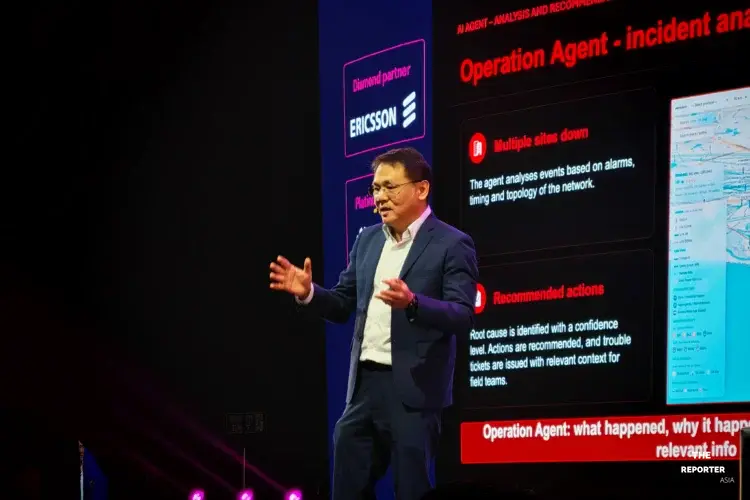
True also utilizes AI for IP Quality-based Routing, allowing the system to dynamically adjust link cost weights and reroute traffic toward higher-performing paths whenever packet loss or signal degradation occurs, even if the primary link remains physically active. Addressing the challenge of integrating new technologies with legacy systems resulting from corporate mergers, Prathet Tankuranun stated that a Digital Twin is no longer optional, describing it as the future of Operations Support Systems (OSS) and the essential data foundation for higher levels of network autonomy.
AIS Advances Cross-Domain Multi-Agent Standards
Wasit Wattanasap, Executive Vice President and Head of Nationwide Operations and Support Business Unit at AIS, highlighted the architectural evolution documented across TM Forum white papers co-authored by AIS in 2022, 2024, and the latest third version. The current architectural focus centers on transitioning from isolated single-domain automation to Cross-Domain and Multi-Vendor operations, which requires defining clear domain boundaries and enforcing communication strictly through standardized API Gateways rather than hard-coded integrations.
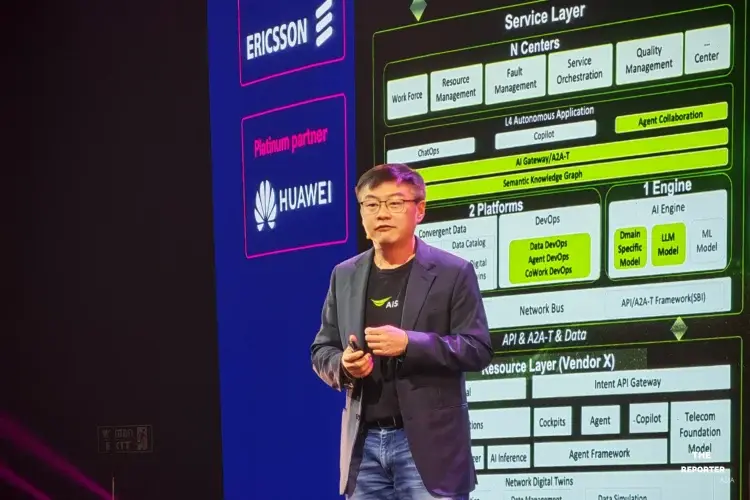
To manage complex multi-vendor environments, AIS has implemented a unified data governance platform alongside Intent-Driven Multi-Agent systems. Within this framework, specialized autonomous agents—such as a Customer Complaint Handling Agent, a Network Optimization Agent, and a Change and Impact Evaluation Agent—collaborate end-to-end to resolve service issues while evaluating potential downstream impacts before executing network modifications.
As a founding member of Open A, AIS is actively developing Agent-to-Agent (A2A) context packages to standardize how autonomous agents exchange operational context across domains. Wasit Wattanasap noted that advancing to higher autonomous levels cannot be achieved in isolation, emphasizing the need for industry-wide collaboration to co-create common standards, build shared platforms, and develop AI talent.
Telstra Shifts Focus Toward Knowledge-Centric Architectures
Fiona Mahoney, Principal Enterprise Architect at Telstra, joined the session remotely to address the challenge of maintaining operational trust as AI models become commoditized and network changes accelerate by up to 20 times. Telstra proposes shifting the architectural center of gravity from static workflow orchestration to a Knowledge-Centric model designed to enable Grounded Cognitive Agency, where autonomous agents interpret human or system intent at runtime using verified contextual knowledge.
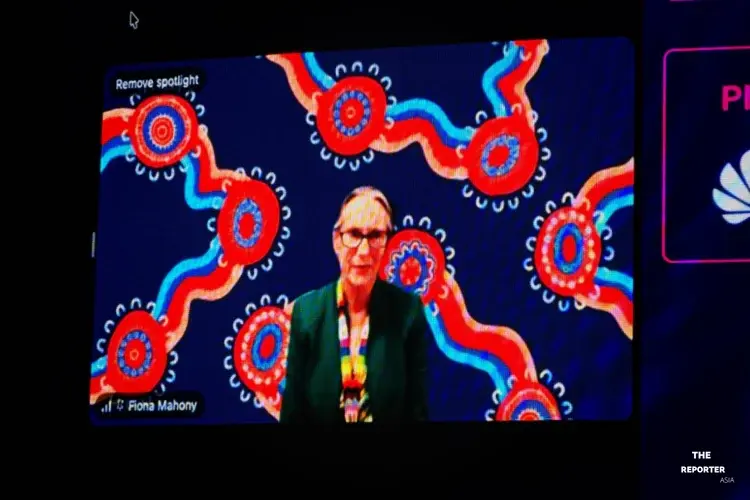
To ensure autonomous decisions are safe and auditable, Telstra categorizes knowledge assets by Provenance, which tracks data lineage and temporal records, and Epistemic Warrant, which justifies the reliability of foundational rules, empirical telemetry, and derived reasoning. Because telecommunications networks span heterogeneous vendor domains, Telstra advocates for a federated approach utilizing a Semantic Layer and a shared Upper Ontology to translate proprietary schemas into common formats without centralizing all raw data.
Through this architecture, AI agents evaluate proposed action plans against corporate policies, safety constraints, and optimization criteria prior to live execution, feeding operational outcomes back into the knowledge plane to close the autonomous loop. Fiona Mahoney concluded that while individual agents may evolve over time, persistent, standardized knowledge frameworks will serve as the enduring foundation required to safely scale autonomous operations across the telecommunications industry.
#True #AIS #Telstra #TMForum #AutonomousNetwork #DigitalTwin #AI #Telecom #TheReporterAsia