
As tectonic shifts in global trade routes, industrial overcapacity, and rapid artificial intelligence integration reshape Southeast Asia’s competitive landscape, business leaders face an urgent strategic dilemma: retreat into protectionism or aggressively re-engineer human capital. Siam Cement Group (SCG), one of the region’s premier industrial conglomerates with over a century of heritage, is choosing the latter. By systematically connecting cross-border industrial diplomacy with aggressive artificial intelligence upskilling, the enterprise is executing an ambitious talent transformation strategy designed to convert macroeconomic volatility into sustainable regional competitiveness.
Navigating Economic Integration: Turning Influx Into Mutual Prosperity
The macroeconomic gravity of Southeast Asia is experiencing an unprecedented structural realignments driven by accelerating trade between ASEAN and China. For industrial powerhouses across the region, China’s industrial overcapacity and export dynamics present both severe competitive pressure and immense potential. Rather than viewing this massive economic integration as a disruptive market threat, SCG is deliberately framing it as an invaluable springboard for enterprise modernization, strategic raw material sourcing, and two-way market penetration.
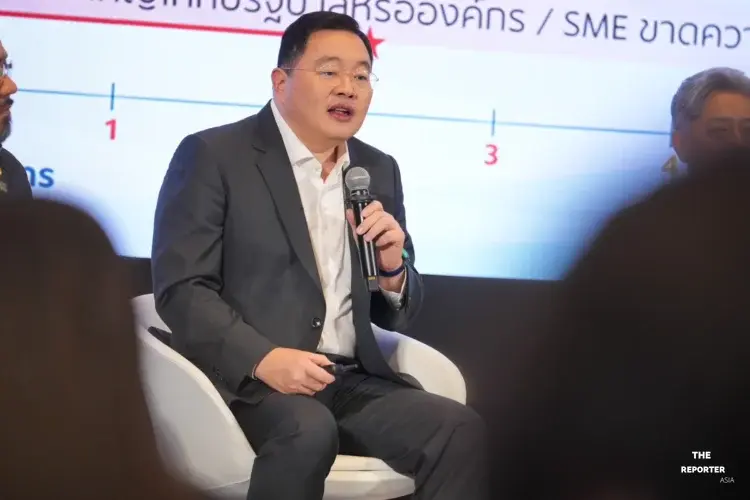
During an intimate executive farewell session wrapping up the inaugural China Excellent Internship Program (CEIP)—which integrated nine select undergraduate and graduate students from China alongside Thai students studying in mainland Chinese universities—Thammasak Sethaudom, President and Chief Executive Officer of SCG, underscored the absolute necessity of adopting a long-horizon perspective. Addressing participants across diverse business units, Thammasak made it clear that passive business models cannot survive the velocity of regional economic realignment.
“If you look at the economic integration between ASEAN and China, it is definitely a threat if we do nothing, but if we adapt, it becomes an immense opportunity. In the Chinese language, threat and opportunity are two sides of the exact same coin. If you look at it merely as a threat, you will see no possibilities; but if you treat it as an opportunity, you can leverage competitive sourcing to optimize cost positions while simultaneously unlocking the vast Chinese market for high-value exports.”
— Thammasak Sethaudom, President & CEO, SCG
The Enterprise of Opportunity: Catalyzing Cross-Border Talent Pipelines
A core pillar of SCG’s human capital architecture is transforming the enterprise into what leadership terms an “Enterprise of Opportunity” (องค์กรแห่งโอกาส). Instead of relying on mandatory, compliance-driven corporate training modules that employees view as exhausting overhead, the conglomerate is creating dynamic internal marketplaces where young talent is actively incentivized to seize emerging challenges. This includes expanding specialized salary progression frameworks and fully funded scholarship pathways for personnel mastering Chinese language, cross-border commercial strategy, and Asian supply chain integration.
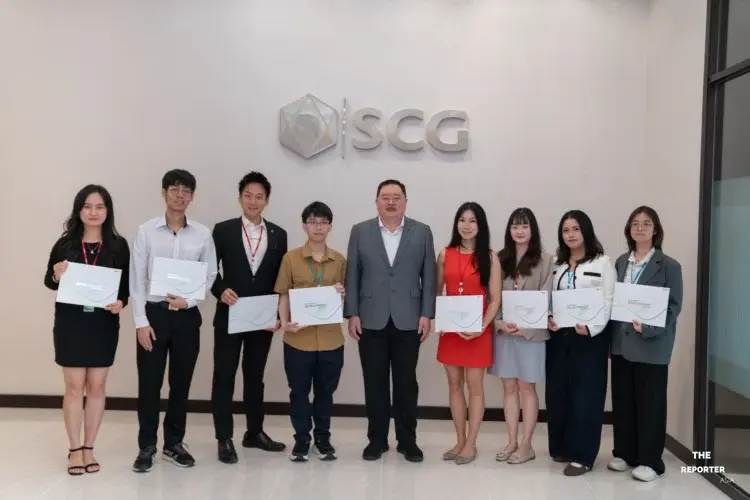
The China Excellent Internship Program (CEIP) represents a practical operationalization of this philosophy, embedding emerging talent into complex frontline projects spanning corporate venture capital (SCG AddVentures), chemical innovation (SCGC), solar energy solutions (ONEX), and advanced packaging operations (SCGP / Thai Containers Group). By placing young professionals directly inside units undergoing live corporate consolidation, digital restructuring, and cross-border joint ventures, SCG is building an agile leadership cadre capable of navigating complex multicultural negotiations and technical supply workflows.
“We cannot do sustainable business with China if we do not have people who truly understand their language, cultural nuances, and business networks. While typical business plans look at three to twelve months, developing people requires a five- to ten-year long game. Whether these brilliant young minds stay to lead SCG or move on to empower the broader regional economy, our fundamental commitment remains creating an environment overflowing with clear opportunities.”
— Thammasak Sethaudom, President & CEO, SCG
The Responsible AI Architecture: Decoding the Three-Tier Workforce
Beyond cross-border trade readiness, SCG is executing an enterprise-wide artificial intelligence transformation aimed at driving hyper-speed productivity while proactively managing workforce disruption. Acknowledging that modern physical AI, industrial robotics, and automated production lines can compress conventional factory staffing requirements by up to 90%, the enterprise focuses heavily on newly emerging job categories to achieve a balanced economic transition. To build operational clarity, leadership has structured its workforce development model into three distinct operational layers:
-
Deep AI Capabilities (10% – 15%): Highly specialized data scientists, algorithm engineers, and mathematical modelers developing proprietary Agentic AI architectures, cloud backbones, and foundational machine learning infrastructure.
-
AI Transformers (40% – 50%): Cross-functional business innovators who understand operational domain workflows and reimagine processes, translating cutting-edge AI agent capabilities into concrete, high-impact business bottom-line results.
-
AI Day-to-Day Users (Remaining Workforce): Core enterprise operational teams leveraging dynamic multi-agent workflows at extreme speed and precision to execute daily commercial and manufacturing tasks.
“Physical automation and AI may eliminate legacy manual tasks, but our strategic duty is creating the high-value roles that replace them. We estimate a critical demand for over 2,000 AI Transformers in the coming years—professionals who do not need deep algorithm coding skills, but who possess the strategic acumen to dismantle old processes and extract tangible economic value from autonomous AI agents. This philosophy underpins our commitment to Responsible AI.”
— Thammasak Sethaudom, President & CEO, SCG
Industrial Agentic Workflows: Orchestrating Autonomous Multi-Agent Ecosystems
SCG’s technological roadmap has already generated over 100 million baht in quantifiable enterprise value across 570 bottom-up AI initiatives, serving as the launchpad for a massive top-down organizational deployment. The future operational model replaces traditional linear handoffs with autonomous multi-agent systems, where single human executives manage pods of five to ten specialized AI agents operating 24/7 at speeds up to 100 times faster than human legacy processing.
Because rapid algorithmic evolution makes autonomous agents obsolete within months, SCG is creating dedicated operational divisions known as “AI Facilitators”. These specialized units are tasked with evaluating model drift, conducting automated performance scorecards, and executing continuous retraining loops without halting critical daily operations. This ensures that enterprise workflows maintain peak performance while safeguarding operational integrity and data sovereignty.
“In the near future, you will not simply send emails to colleagues; you will orchestrate fleets of AI agents functioning as tireless digital personnel. But because agentic technology shifts every month, our AI Facilitators must continuously audit, upgrade, and benchmark agent performance to maintain hyper-speed enterprise efficiency without operational downtime.”
— Thammasak Sethaudom, President & CEO, SCG
Lifelong Learning Discipline: Transcending Volatile Industrial Cycles
Navigating this hybrid era of shifting geopolitics and algorithmic disruption demands personal adaptability that transcends corporate job descriptions. Reflecting on an executive career spanning more than three decades—progressing from a cement production engineer into electrical maintenance, project development, information technology, business development, Chief Financial Officer, and ultimately Group President and CEO—Thammasak pointed out that lifelong learning is an indispensable survival skill.
While previous generations navigated steady industrial tailwinds, current professionals must master new domain knowledge at ten times the speed. SCG’s core leadership framework emphasizes that career resilience is not determined by raw academic pedigree, but by consistent, self-driven learning discipline. By aligning human potential with structural geopolitical and technological tailwinds, the enterprise aims to future-proof its workforce across ASEAN and beyond.
“If you pigeonhole yourself into your initial degree, you get stuck the moment industrial models evolve. Success in this disruptive era is not a function of high IQ, but of learning discipline. In an economy powered by intelligent agents and global integration, those who structure their daily learning habits will continuously convert volatility into lasting leadership.”
— Thammasak Sethaudom, President & CEO, SCG
#SCG #EnterpriseOfOpportunity #AITransformation #HumanCapital #ThammasakSethaudom #ChinaASEAN #CEIP #AgenticAI #ResponsibleAI #FutureOfWork #BusinessStrategy