
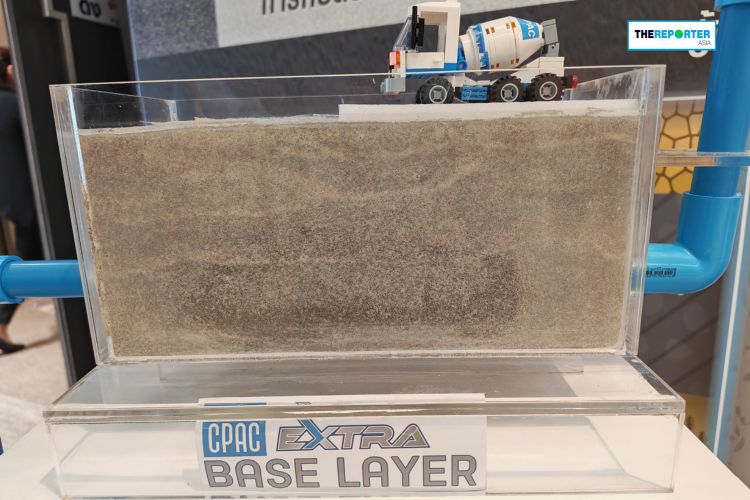
The catastrophic Samsen road collapse near Vajira Hospital was a stark reminder of Thailand’s fragile urban infrastructure. But the crisis also served as a proving ground for a new SCG innovation: CPAC Extra base layer. This material, which enabled a record two-week repair, is not just a patch; it’s a foundational game-changer poised to disrupt the entire economics of construction in Thailand, shifting the industry’s focus from material cost to total project value.
Bangkok, Thailand – When a massive sinkhole abruptly swallowed a large section of Samsen Road, it triggered more than just a traffic nightmare. It set off a wave of public concern over the integrity of infrastructure hidden beneath the city’s surface. The cause, a ruptured underground water pipe, had relentlessly eroded the soil, creating a treacherous, deep void.
For the engineering teams dispatched to the site, this was no ordinary repair job. The challenge was not merely to “fill the hole” but to do so in a way that would guarantee it would never happen again.
A source within the engineering team, speaking to reporters, highlighted the critical risk: “Using traditional methods like compacted sand or crushed rock was simply too dangerous. The continuous presence of groundwater would have eventually washed away the new material, leading to a repeat collapse.”
The mission required a solution that was both rapid and permanent. The decision was made to deploy a new, specialized engineering material from SCG: CPAC Extra base layer. Approximately 1,000 cubic meters of this material were used to fill the void beneath the road’s base layer.
“The formula was adjusted to be ‘thicker’ (Viscous liquid), ensuring it could flow into and completely fill every subterranean crevice,” the source explained.
The key property that made this material the only viable choice was its “Water Stability.” Unlike soil or sand, once the CPAC Extra base layer sets, it becomes inert to the erosive power of water. Water can permeate through it, relieving hydrostatic pressure, but it cannot dislodge or wash the material away. This stability provided the long-term assurance the city needed.
The result was a logistical and engineering triumph. A complex subterranean repair that could have taken months was completed, and the road reopened to traffic, in approximately two weeks. This success, however, was merely the public debut of a technology designed for a much broader revolution.
The “Three-Layer Problem”: Deconstructing Old Economics
The success at Samsen threw a harsh spotlight on the profound inefficiencies of traditional foundation work, a process that construction veterans often refer to as a “nightmare” of cost and quality control.
For decades, standard concrete road construction has relied on a laborious, three-part process:
- The Subbase Layer: The initial load-bearing layer.
- The Base Layer: The primary structural layer.
- The Sand Compaction Layer: A final layer to ensure level and stability.
For project managers and chief financial officers, this three-stage process represents a significant and unpredictable drain on resources:
- Massive Machinery Requirements: It demands a fleet of heavy, specialized machines—graders, loaders, and multiple compactors—working in sequence, often in tight spaces.
- High Labor Costs: The process is labor-intensive, requiring skilled operators and ground crews for extended periods.
- The Quality Control (QC) Gamble: Achieving consistent, uniform compaction across a large area is notoriously difficult. A single weak spot can compromise the entire structure.
- The “Rain Delay” Financial Sinkhole: This is the biggest uncontrolled variable. A single heavy rainstorm can ruin a day’s worth of compaction, forcing teams to remove the saturated material and start over, torching budgets and timelines.
“The conventional wisdom was to accept these inefficiencies as the cost of doing business,” commented a senior civil engineer. “We spent more time fighting the weather and re-doing work than on new construction. It’s a system that is fundamentally broken in a tropical climate.”
This is the precise problem CPAC Extra base layer was engineered to solve. It proposes a radical transformation of the entire workflow: “One Layer Replaces Three.”
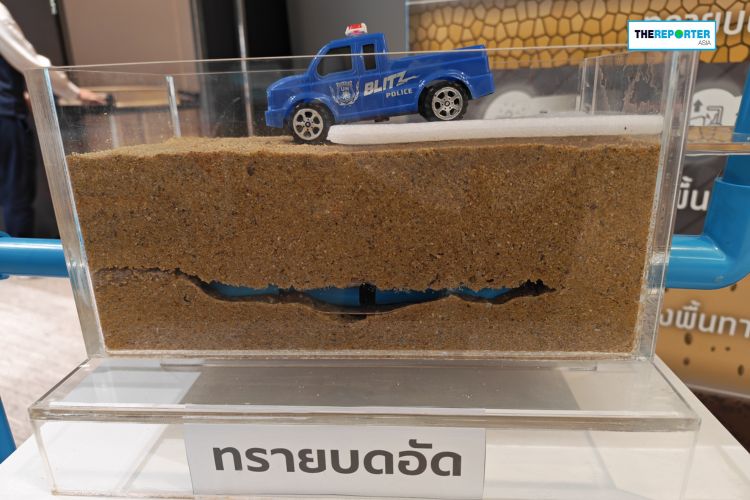
By simply pouring this single material, contractors can now create a foundation that performs the function of all three traditional layers combined. This isn’t just an iteration; it’s a complete process transformation that directly impacts the economic calculus of a project.
The Technology: A Deeper Look at the “Game Changer”
What allows this single layer to outperform three? The innovation lies in its unique composition, balancing strength, permeability, and—critically for urban environments—re-engineerability.
1. Low-Carbon Cement: The ESG Value Proposition
The core of the material is its binder: Low-Carbon Cement. This is a strategic choice by SCG, tapping directly into the global megatrend of Environmental, Social, and Governance (ESG) investing. As pressure mounts on heavy industries to decarbonize, using a low-CO2 material is no longer a “nice to have”; it’s a financial and regulatory imperative. For developers, this translates to better ESG scores, access to green financing, and a more robust corporate reputation.
2. Porous Cement Structure: Strength and Permeability
This is not a solid, impermeable block of concrete. The material is designed with a “porous” internal structure. These interconnected micro-voids are intentional, serving two key functions:
- Load Bearing: It provides structural strength far exceeding that of compacted soil, distributing loads evenly and preventing settlement.
- Water Permeation: It allows water to pass through, mimicking natural ground conditions and preventing the build-up of hydraulic pressure that can destroy roads from below.
3. Excavatable / Re-engineerable: The “Hidden” Billion-Baht Feature
Perhaps its most brilliant design feature for a business audience is its “excavatable” nature. While the material sets and becomes incredibly stable (often within 6-8 hours), it is not as hard as structural concrete.
This is a critical distinction. In a city like Bangkok, the ground beneath the roads is a complex web of utilities—water, power, and fiber optics. The single biggest fear of utility providers is having to cut through a thick slab of reinforced concrete for a simple repair.
CPAC Extra base layer is strong, but it can be “dug out” (re-engineered) with standard excavation equipment if future utility access is required. This provides the long-term flexibility that asset owners (like municipalities) crave, dramatically lowering the total cost of ownership over the 50-year life of the asset.
The New Economic Calculus: Total Cost of Ownership (TCO) Wins
For the C-suite, the first question is always: “Is it more expensive?”
The blunt answer is: “Yes, but that is the wrong question.”
The “material cost trap” is comparing the price per cubic meter of CPAC Extra base layer against the price of bulk soil or aggregate. In this comparison, the new material will always lose.
The correct, modern business analysis focuses on Total Cost of Project and Work Process Cost. Here, the new material is the undisputed economic winner, generating value in four distinct ways:
1. The Value of Speed: Time is Money
The three-layer method takes days, or even weeks, of grading, watering, compacting, and testing. CPAC Extra base layer can be poured and is ready for the next stage of construction (e.g., pouring the concrete surface) within 24 hours.
In development, speed is revenue. Opening a road, a residential project, or a factory weeks or months ahead of schedule means revenue streams are activated sooner, loan interest is reduced, and market advantage is secured.
2. Radical Reduction in OPEX: Slashing Process Costs
This is the most direct saving. By eliminating two-thirds of the foundation process, you eliminate the associated operational costs:
- Fewer Machines: The fleet of graders, loaders, and multiple compactors is reduced to potentially just one finishing compactor (or “รถม่วก”). This equals massive savings in fuel, machine rental/leasing, and maintenance.
- Fewer People: Labor costs are slashed. A smaller, more efficient team can accomplish the work in a fraction of the time.
3. De-Risking the Project: The Price of Predictability
The new material effectively “buys” predictability. Because it is a chemical-setting material, it is largely indifferent to weather. Contractors can pour it and know that in 24 hours, it will be ready. It completely removes the “rain delay” variable from the equation, a risk that has plagued Thai construction for decades. This financial certainty is invaluable for large-scale project financing.
4. The ESG Dividend: Turning CO2 Reduction into a Tangible Asset
The economic benefits of ESG are now concrete. Using a Low-Carbon Cement product and simultaneously eliminating hundreds of diesel-burning machine-hours (from the reduced fleet) provides a powerful, quantifiable reduction in a project’s CO2 footprint. This is a direct, reportable win for sustainability reports and investor relations.
When the massive savings in time, labor, machinery, and fuel are offset against the higher material cost, the total project cost becomes highly competitive, or even cheaper. The project then also benefits from superior speed, quality, and green credentials—a value proposition that is impossible to ignore.
The Real Market: Beyond the Sinkhole
While the Samsen emergency was its high-profile debut, the true market for CPAC Extra base layer is far larger and more strategic.
- Standard Infrastructure: Its primary application is as the new standard for road and foundation work, designed to prevent sinkholes and erosion before they ever start.
- Pipe Laying & Urban Infill: This is a key growth market. In Bangkok’s narrow sois (alleys) and dense urban communities, bringing in heavy compaction machinery is often impossible. This material can be delivered by smaller vehicles, poured around new pipes, and set quickly. It provides a superior “Pipe Bedding” that locks utilities in place, preventing the shifting and leaking that caused the Samsen collapse in the first place.
The Verdict: A Foundational Shift for Thai Construction
The planned official launch of CPAC Extra base layer in late 2025 (November/December) is more than a new product release. It is a signal of a paradigm shift.
It challenges the entire construction value chain—from designers and architects to contractors and project owners—to evolve beyond a “lowest material cost” mindset. The new competitive landscape will be defined by Total Cost of Ownership, speed-to-market, and sustainability.
The Samsen sinkhole repair was a powerful demonstration. The real story, however, is the quiet revolution this material brings to every new road, utility trench, and building foundation in Thailand. It proves that investing in the right technology doesn’t just solve a problem; it redefines the entire equation of how we build.
#CPAC #CPACExtrabaseLayer #SCG #Innovation #ConstructionTech #Economics #ThailandConstruction #Infrastructure #ESG #Sustainability #LowCarbonCement #TotalCostOfOwnership #TCO #Disruption #BusinessNews #Samsen #Sinkhole #RiskManagement #CivilEngineering #RealEstateDevelopment