


In an era where the digital economy is besieged by increasingly sophisticated cyber threats, the paradigm of corporate security is undergoing a seismic shift. Palo Alto Networks, the global leader in cybersecurity, has unveiled a new suite of AI-driven solutions designed to transition organizations from a “reactive” defense posture to a fully “autonomous” and proactive strategy.
TheReporterAsia – Erik Papir, Senior Director of ASEAN Technical Solutions at Palo Alto Networks, presented a compelling vision of the future in Bangkok, introducing “Agentic AI”—a technology set to redefine the operational economics of Security Operations Centers (SOCs) and cloud computing globally.
The Dawn of Agentic AI: The New Digital Workforce
The centerpiece of this strategic announcement is the shift towards an “Agentic Approach.” In the current business landscape, traditional AI tools often function merely as advanced chatbots—answering queries but leaving the execution to humans. Papir introduced Cortex Agentix, a solution that functions as a “Command Center” for AI Agents. These are not passive tools; they are intelligent agents capable of thinking, planning, and executing complex tasks autonomously.
For business leaders and investors, the value proposition lies in the drastic reduction of operational friction. Papir illustrated this with a common yet devastating scenario: a Ransomware attack.
“In the past, security teams would spend hours manually investigating malware, hunting for indicators, and running command lines,” Papir noted. “With the Agentic Assistant, this process is compressed from hours into mere seconds through Natural Language Prompts.”
A Case Study in Efficiency: The “Jay Miller” Incident During a live demonstration, the capabilities of Cortex Agentix were showcased to highlight its impact on operational continuity:
-
Dynamic Planning: The AI autonomously generated a risk assessment plan immediately upon threat detection.
-
Data Synthesis: It read threat blogs, summarized risks, gathered Indicators of Compromise (IOC), and cross-referenced them with the organization’s entire dataset.
-
Precise Identification: The system matched a malware hash to a real-time event, identifying the compromised user, “Jay Miller,” who was attempting to access over 250 hosts in a single day—a clear anomaly.
-
Autonomous Response: Understanding the context, the AI allowed administrators to issue “Isolate Host” and “Disable User” commands instantly.
For the C-Suite, the result is a fundamental change in the Mean Time to Respond (MTTR). Reducing investigation time from hours to minutes is not just a technical victory; it is a critical factor in mitigating financial loss and preserving brand reputation.
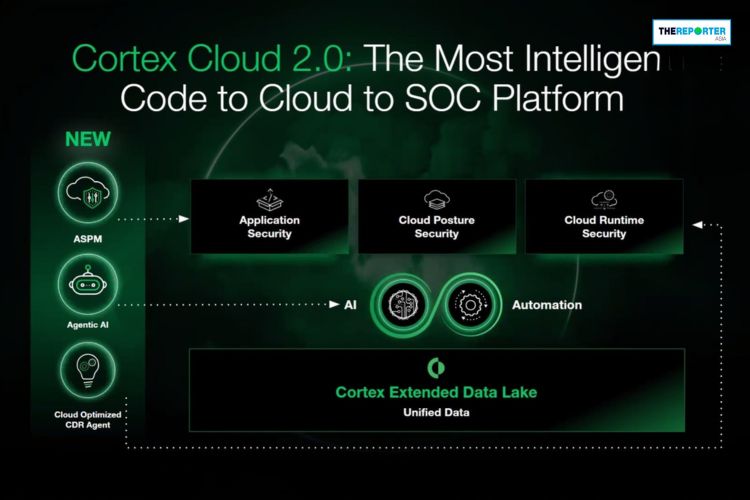
Cortex Cloud 2.0: Breaking the Silos of Cloud Economy
Beyond Agentic AI, Palo Alto Networks addressed the fragmentation plaguing modern cloud infrastructure with the launch of Cortex Cloud 2.0.
The current industry standard often suffers from operational “silos”—where Application Security (AppSec), Cloud Security Posture Management (CSPM), and Runtime Security operate in isolation. This fragmentation creates blind spots that allow vulnerabilities to slip into production environments, creating costly retroactive fixes.
Cortex Cloud 2.0 is engineered to solve this via three economic pillars:
-
The “Shift Left” Revolution (ASPM): By revolutionizing Application Security Posture Management, the platform empowers developers to identify and fix vulnerabilities during the coding phase. This proactive approach prevents “technical debt” and security risks at the source, significantly lowering the cost of remediation.
-
Scale through Automation: Leveraging AI and automation at an unprecedented scale allows security teams to offload repetitive tasks, freeing high-value human capital to focus on strategic initiatives rather than routine monitoring.
-
Cloud-Optimized CDR Agent: A new detection and response agent designed to consume fewer resources while delivering maximum protection, optimizing cloud compute costs.
The platform features a modernized interface that provides a unified “single pane of glass” view for Cloud, Kubernetes, and Data Environments, with agentless API connections achievable in minutes.
Prisma AIRS 2.0: Securing the AI Era
As organizations rush to integrate Generative AI to gain a competitive edge, a new risk has emerged: “Shadow AI.”
Papir highlighted a concerning reality shared by a CISO of a major ASEAN enterprise: “We don’t know which AI apps or agents are running in our system, what data they connect to, or what access rights they possess.” This lack of visibility poses a severe governance and compliance risk.
Prisma Airs 2.0 is positioned as the industry’s most comprehensive AI Security Platform, addressing the “Shadow AI” economy through five critical layers:
-
AI Model Scanning: Prevents model tampering and malicious script injection.
-
Posture Management: Eliminates excessive permissions and potential data leaks.
-
AI Red Teaming: A highly anticipated feature that simulates attacks to find weaknesses before adversaries do.
-
LLM Security: Protects against Prompt Injections, toxic content, and AI Hallucinations.
-
AI Agent Security: Secures agents created via Low-code/No-code platforms.
In the demonstration, the system detected an unvetted AI model and immediately flagged a Deserialization vulnerability, allowing the organization to close the breach point before any intellectual property was compromised.
Economic Impact: The ROI of Autonomous Security
The adoption of these technologies is not merely an IT upgrade; it is a strategic economic enabler.
-
Drastic Reduction in MTTR: Palo Alto Networks emphasizes that AI can reduce Mean Time To Respond by up to 98%. In the context of the digital economy, where downtime costs can run into millions of dollars per hour, this efficiency translates directly to the bottom line.
-
Workforce Transformation: Far from replacing human workers, this technology redefines the role of the security analyst. The shift moves personnel from being “Reactive Investigators” to “AI Team Leaders.” This upskilling allows organizations to utilize their talent for proactive resilience strategy rather than data chasing.
-
Human-in-the-Loop Governance: Despite the autonomous capabilities, the platform maintains a “Human Vital Mechanism.” Organizations retain the flexibility to determine which decisions the AI can make independently and which require human approval, ensuring that corporate governance remains intact.
Conclusion and Outlook
The launch of Cortex Agentix, Cortex Cloud 2.0, and Prisma Airs 2.0—slated for release in early 2026—signals that AI has evolved from a buzzword to a critical “Strategic Enabler” for business continuity.
For government agencies and enterprises, the message is clear: the threat landscape has changed, and the defense mechanism must evolve in tandem. Palo Alto Networks advises organizations to begin assessing the readiness of their SOCs and current security strategies immediately. Utilizing services like Unit 42 to analyze and plan for this transition will be essential for those wishing to leverage Agentic AI effectively.
In a volatile global economy, the ability to automate defense is no longer a luxury—it is a requisite for survival.
#PaloAltoNetworks #CortexAgentix #AIsecurity #Cybersecurity #DigitalEconomy #CloudSecurity #PrismaAirs #TheReporterAsia #BusinessNews #TechInnovation #EnterpriseTech