

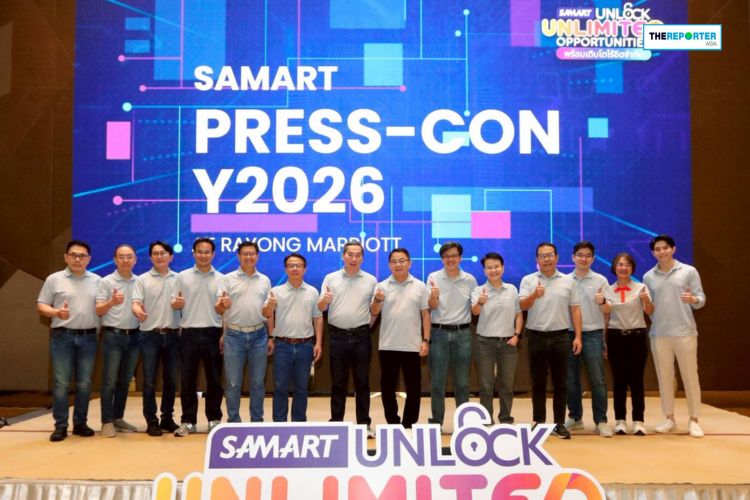
In a decisive move that signals a robust resurgence in the Thai technology and infrastructure sectors, Samart Corporation Public Company Limited has officially declared its strategic roadmap for the fiscal year 2026 under the ambitious theme of “Unlock Unlimited Opportunities.” This strategic declaration is not merely a corporate slogan but a calculated financial trajectory, as the conglomerate sets a formidable revenue target of 14,000 million Baht for the year.
Bangkok, Thailand – This projection represents a significant leap forward, aiming for a growth rate that positions the company to achieve its best financial performance in a decade, driven by a solidified backlog of projects valued at nearly 16,000 million Baht as of the end of 2025. The announcement underscores a pivotal shift in the Thai economic landscape, suggesting that legacy technology firms are successfully pivoting towards modern digital solutions and sustainable infrastructure, creating a fertile ground for international collaboration and investment.
The confident outlook presented by the executive team, led by Mr. Watchai Vilailuck, Executive Vice Chairman of Corporate Strategy, leverages a multi-pronged approach designed to capitalize on the rebounding global economy and the specific digital transformation needs of the ASEAN region. The group’s strategy is anchored in three core pillars: Unlimited Solutions, Unlimited Collaborations, and Unlimited Opportunities, which collectively aim to propel the organization beyond traditional boundaries. By focusing on mergers and acquisitions (M&A) as a key accelerator, Samart Group is actively seeking to integrate new technologies and expand its market footprint, signaling to foreign investors that the company is open for high-level strategic partnerships. This aggressive stance on M&A indicates a maturity in the Thai market, where established players are looking to cross-pollinate with global tech firms to bypass incremental growth and achieve exponential scalability in sectors ranging from energy to advanced digital services.
Furthermore, the projected increase in net profit, estimated to grow by no less than 75% compared to the previous year, highlights operational efficiencies and a successful restructuring of the group’s diverse business portfolio. The company plans to participate in bidding for new major projects worth over 30,000 million Baht throughout the year, with an expectation to secure a total backlog exceeding 20,000 million Baht by year-end. This aggressive bidding strategy, particularly in government and state enterprise sectors, reflects a broader trend of increased public spending on digital infrastructure in Thailand.
For international observers and potential partners, this signals a robust pipeline of government contracts that require sophisticated technological implementation, adhering to global standards of transparency and efficiency, thus opening doors for foreign technology providers to supply or partner with local giants like Samart to fulfill these large-scale national requirements.
Digital ICT Solutions: Aligning with Global Cloud and AI Standards
The spearhead of Samart Group’s revenue generation remains its Digital ICT Solutions arm, led by Samart Telcoms Public Company Limited (SAMTEL), which has set a revenue target of 6,500 million Baht for the year. This segment is capitalizing on the global megatrend of digital transformation, specifically aligning with the Thai government’s “Cloud First” policy which mirrors international best practices for public sector IT infrastructure.
By moving away from on-premise hardware towards flexible cloud solutions, SAMTEL is positioning itself as a critical enabler of the state’s modernization, mirroring the digital governance models seen in advanced economies like Singapore or Estonia. The company is not just selling hardware but providing comprehensive solutions that include Cyber Security, Enterprise Resource Planning (ERP), and banking solutions, ensuring that Thai infrastructure meets the rigorous security standards demanded by global connectivity.
A prime example of this alignment with global standards is SAMTEL’s implementation of the ERP system for the Provincial Electricity Authority (PEA), described as the largest of its kind in Southeast Asia. This project demonstrates the capacity of Thai firms to handle massive, complex data migrations and system integrations that rival utility management systems in Europe or North America. The integration of AI technologies into these systems further enhances efficiency, automating routine tasks such as billing and verification with high precision, which is a standard expectation in modern global business operations. For foreign tech firms, this illustrates that the Thai market is ready for advanced AI and machine learning applications, moving beyond basic digitization to intelligent process automation.
Moreover, the focus on Banking Solutions and Core Banking systems, such as those implemented for the Government Housing Bank (GHB), showcases the sector’s resilience and adherence to high-security financial protocols. The shift towards “Public Outsourcing Services” models allows for long-term revenue streams and continuous system upgrades, creating a stable environment for technology partners. This business model evolution from one-off project sales to recurring service revenue is consistent with global SaaS (Software as a Service) trends, making the financial health of Thai ICT firms more predictable and attractive to foreign investors looking for sustainable returns in the Southeast Asian tech market.
Aviation and Tourism: Capturing the Asian Travel Rebound
In the Utilities and Transportations sector, Samart Aviation Solutions (SAV) is poised to be a major growth driver, targeting a 30% revenue increase to 2,600 million Baht. This optimism is deeply rooted in the post-pandemic recovery of global tourism, particularly the resurgence of travelers from China and the opening of new flight routes from Vietnam. As the sole provider of air traffic control services in Cambodia through its subsidiary CATS, SAV benefits directly from the region’s “Open Skies” momentum. The steady increase in flight movements, which have surpassed 100,000 flights annually and are growing, reflects the broader economic recovery of the ASEAN region. This unique monopoly position offers a stable cash flow that is rare in the volatile aviation industry, providing a secure base for expansion into related airport technologies.
The strategic expansion into airport-related technologies, such as Foreign Object Debris (FOD) detection systems, highlights a move towards enhancing aviation safety to meet strict international standards. By partnering with global technology providers to implement these systems in Thai and regional airports, SAV is bridging the gap between local infrastructure and global aviation safety requirements mandated by organizations like ICAO. The focus on upgrading air traffic control systems and expanding services to new international airports, including the new Phnom Penh International Airport, demonstrates a commitment to supporting the region’s ambition to become a world-class logistics and tourism hub. This presents a significant opportunity for foreign aerospace and aviation tech companies to introduce cutting-edge safety and logistics solutions to a market that is actively upgrading its capabilities.
Furthermore, the financial resilience of the aviation business, despite regional geopolitical nuances, proves the robustness of the sector. Even with temporary airspace restrictions in certain border areas, commercial operations have remained largely unaffected, and revenue continues to grow in US Dollar terms. This stability is crucial for attracting foreign partnerships, as it mitigates the perceived risk of investing in emerging markets. The company’s plan to diversify income by selling airport solutions and equipment across Cambodia, Laos, and Myanmar further cements its role as a regional aviation hub. For international players, partnering with an entity that holds a 49-year concession and deep government ties in neighboring countries offers a strategic entry point into the rapid development of Indochina’s aviation infrastructure.
Public Safety and Digital Communications: The Modernization of Emergency Services
Samart Digital Public Company Limited (SDC) represents a compelling turnaround story, shifting from a period of restructuring to a “Momentum of Growth” with a targeted revenue of 900 million Baht, a 57% increase from the previous year. The core of this revival lies in the Digital Trunk Radio System (DTRS), which is replacing obsolete analog systems for Thailand’s Ministry of Interior and the National Institute for Emergency Medicine.
This transition is not merely a technological upgrade but a critical harmonization with global public safety standards. In developed nations, emergency response units utilize dedicated, resilient digital networks that allow for precise location tracking and clear communication during disasters. SDC’s implementation of similar systems in Thailand ensures that local emergency response capabilities are brought up to international par, saving lives by ensuring ambulances are routed to the nearest capable hospitals efficiently.
The expansion of this digital network to cover border security and local administration demonstrates the versatility and necessity of secure communication infrastructure. With geopolitical tensions and border control being global concerns, the deployment of robust communication lines for police and military units is paramount. SDC’s collaboration with National Telecom (NT) to improve network coverage in remote border areas signifies a public-private partnership aimed at national security. For foreign defense and communication firms, this highlights a growing market for specialized, secure communication devices and network infrastructure that can operate in rugged environments. The move to onboard users like the Highway Police and Tourist Police further expands the ecosystem, creating a comprehensive safety net that supports the country’s tourism image.
Interestingly, SDC is also innovating in the consumer space by blending technology with local culture through its “Mu-te-lu” (spiritual and astrology) applications. While this may seem niche, it taps into the global “Spiritual Tech” trend, where mindfulness and astrology apps have seen massive traction among younger demographics worldwide. By exploring immersive experiences in prime retail locations like Ratchaprasong, combining digital art with spiritual beliefs, SDC is creating a unique “Phygital” (physical plus digital) product that has export potential to markets with similar cultural affinities. This diversification shows that Thai tech companies are capable of innovating unique value propositions that merge deep-seated local traditions with modern digital delivery platforms, offering a fresh perspective for potential content partners or platforms looking for localized Asian content.
Green Energy and Infrastructure: Powering the Future Economy
The utility and construction arm, primarily driven by TEDA, plays a crucial role in supporting Thailand’s energy transition, boasting a backlog of over 3,800 million Baht. As the world moves towards carbon neutrality, Thailand is upgrading its power grid to accommodate renewable energy sources. TEDA’s expertise in constructing High Voltage Substations and transmission lines for the Electricity Generating Authority of Thailand (EGAT) is vital for this transition. The construction of digital substations and underground cables aligns with the global push for smart grids and resilient urban infrastructure. This sector offers immense opportunities for foreign engineering firms and green energy technology providers to supply advanced components and expertise required to modernize the national grid.
In addition to traditional power infrastructure, the group is aggressively exploring opportunities in renewable energy and the “Green” economy. The executive vision explicitly mentions an interest in solar energy and environmental solutions, reflecting a strategic pivot towards sustainability that aligns with global ESG (Environmental, Social, and Governance) investment criteria. This opens a clear channel for international green tech companies to partner with Samart to implement solar rooftops, energy storage systems, or waste-to-energy projects in Thailand. The planned M&A activities in the energy sector suggest that the group is looking to acquire or partner with established players to fast-track its capabilities in this high-growth area.
The technological application in government revenue collection, specifically the Direct Coding system for excise tax on beer and beverages, further illustrates the group’s capability in “GovTech”. By marking billions of products with secure codes to prevent tax evasion, Samart provides a solution that enhances fiscal transparency. This technology is scalable and replicable in other developing economies facing similar tax collection challenges. It serves as a case study for foreign governments or tech partners looking for proven solutions in regulatory technology. The successful printing of over 14 billion codes demonstrates the industrial scale at which these solutions operate, proving that Thai technology can handle high-volume, mission-critical government operations reliably.
Investment Outlook: Thailand as a Strategic Tech Gateway
The converging strategies of Samart Group’s subsidiaries paint a picture of a conglomerate that has successfully navigated the challenges of the pandemic and economic slowdowns to emerge stronger and more diversified. The clear focus on high-growth sectors—Cybersecurity, Cloud, AI, Aviation, and Green Energy—makes the group a microcosm of the broader Thai economy’s modernization efforts. For foreign investors, the “Unlock Unlimited Opportunities” theme serves as an invitation to engage with a partner that has deep local roots, government connections, and a clear vision for adopting global standards. The target of reaching a 14,000 million Baht revenue milestone is supported by tangible backlogs and a realistic assessment of market needs, reducing the speculative risk often associated with emerging market tech stocks.
The emphasis on M&A as a core strategy for 2026 is particularly relevant for international businesses. It suggests that Samart is not just looking for organic growth but is willing to use its capital to acquire capabilities that it lacks. This creates a favorable environment for joint ventures where foreign firms bring the technology (IP), and Samart brings the market access and implementation capability. Whether it is in the field of advanced game development with partners like Tencent, or aviation safety with European tech providers, the door is open for cross-border collaboration.
Ultimately, Samart Group’s projection of its best performance in a decade is a bellwether for the Thai tech sector. It signals that the period of stagnation is over and that the market is hungry for innovation that meets international quality standards. By bridging the gap between local infrastructure needs and global technological advancements, Samart is positioning itself—and by extension, Thailand—as a formidable player in the ASEAN digital economy. The alignment of its business units with global megatrends ensures that its growth is sustainable, offering a “blue ocean” of opportunities for partners ready to ride the wave of Southeast Asia’s digital and infrastructural renaissance.
#SamartGroup #ThaiEconomy2026 #DigitalTransformation #ASEANBusiness #TechInvestment #SmartInfrastructure #AviationRecovery #GreenEnergy #CloudFirst #CyberSecurity