

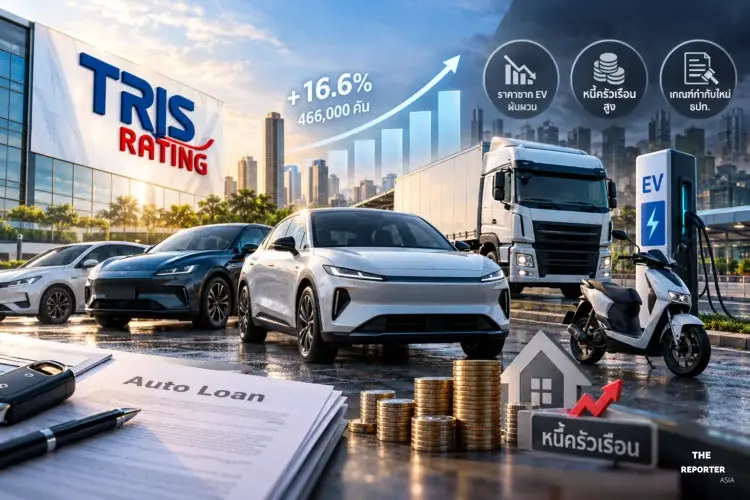
Thailand’s auto hire-purchase industry is poised for an uneven, gradual recovery through 2027 as financial institutions prioritize stringent underwriting over aggressive loan expansion, according to a research report released by TRIS Rating. While passenger vehicle and commercial truck financing are staging modest rebounds, motorcycle lending continues to lag vehicle sales amid persistently high household leverage and conservative credit standards.
TRIS Rating analysts, including Jittrapan Pantaleard and Siriwan Weeramethachai, noted that although overall credit growth remains restrained, lenders are benefiting from widening margins, stabilized asset quality, and lower funding costs backed by the Bank of Thailand’s policy rate holding steady at 1.0%. However, tighter central bank regulations, aggressive electric vehicle price wars, and potential fallout from recent domestic floods remain critical factors shaping industry profitability.
Divergent Momentum Across Passenger Cars and Commercial Fleets
Domestic passenger vehicle sales expanded 16.6% year-on-year during the first eight months of 2026 to approximately 466,000 units, accelerating sharply from a 2.2% decline in February to a 25.6% gain in August. The expansion was predominantly fueled by alternative-energy vehicles, with battery electric vehicles (BEVs) and hybrid electric vehicles (HEVs) capturing roughly 78% of all new passenger car deliveries during the eight-month period. This surge has been reinforced by the government’s EV 3.5 scheme, which offers consumer subsidies of THB 50,000 per passenger BEV equipped with battery packs of at least 50 kilowatt-hours.
Despite stronger showroom turnover, commercial banks and captive finance companies are limiting credit growth to prime borrowers to mitigate collateral risks stemming from volatile used car values and steep EV discounting. Bank of Thailand data shows that commercial banking auto loan portfolios contracted 1.6% quarter-on-quarter to THB 739.4 billion at the end of the second quarter of 2026. Although special mention (Stage 2) loans dropped 3.5% quarter-on-quarter to THB 97.3 billion, they still accounted for 13.2% of total automotive debt, reflecting continued borrower stress even as the non-performing loan ratio held steady at 1.95%.
Commercial truck financing is displaying firmer recovery traction following multi-year contractions, buoyed by a 7% year-on-year increase in new commercial truck registrations during the first eight months of 2026. Freight demand across logistics, public infrastructure construction, and fleet replacement has helped lift secondary market values for used Euro 3 commercial trucks, reducing repossession losses for specialized lenders. Meanwhile, commercial electric truck adoption remains nascent; data from the Federation of Thai Industries shows only 124 BEV units were sold in the 5-to-10-tonne truck segment in the first eight months of 2026, representing barely 1% of total segment deliveries.
Tight Underwriting Constrains Motorcycle Leasing Growth
Motorcycle hire-purchase portfolios are growing at a subdued pace despite a 6.9% year-on-year increase in motorcycle sales through August 2026, which outpaced the 1.7% growth recorded in 2025. High household debt levels and economic uncertainty have prompted financiers to reject vulnerable borrowers or demand upfront down payments as high as 30%. Simultaneously, electric motorcycles accounted for merely 1.6% of total new motorcycle sales in the first seven months of 2026, with lenders hesitant to finance unproven brands due to battery replacement risks and secondary market resale uncertainty.
Profitability across motorcycle leasing operators has settled into a normalized band after extensive balance sheet cleanups and the maturation of non-performing legacy contracts. Operating upside remains capped by regulatory interest rate ceilings and historically low funding spreads, leaving lenders with narrow avenues for additional operational cost reductions. Even so, firm used motorcycle prices and reduced repossession inventories continue to cushion recovery yields across the sector.
Regulatory Overhaul and Weather Risks Shift Market Dynamics
The Bank of Thailand has systematically expanded its regulatory perimeter over hire-purchase and leasing activities, introducing comprehensive consumer protection and responsible lending requirements. Directives in effect since December 2025 capped default interest rates at 5% annually on overdue principal and established tiered early settlement interest discounts of up to 100%. Additional transparency and disclosure rules covering both individual and corporate borrowers took effect on 1 June 2026, requiring substantial capital investment into underwriting technology, reminders, and loan restructuring frameworks.
These compliance mandates disproportionately impact smaller regional operators while strengthening the competitive moats of established firms that possess sophisticated risk-management infrastructure. Concurrently, recent seasonal flooding is creating manageable credit pressure; TRIS Rating projects that temporary relief programs, including installment holidays and tenure extensions, will prevent short-term liquidity bottlenecks from escalating into widespread default cycles, well below the systemic shocks observed during the 2011 floods.
Capital Buffers Anchor Issuer Credit Ratings
TRIS Rating confirmed that risk-adjusted capital ratios for rated automotive financiers remain robust, backed by lower credit provisions, disciplined pricing spreads, and stable capital generation. The rating agency maintains investment-grade and speculative-grade credit ratings across seven major issuers, led by Toyota Leasing (Thailand) at AAA with a Stable outlook, Ayudhya Capital Auto Lease at AA+ with a Stable outlook, and Ratchthani Leasing at A- with a Stable outlook.
Other monitored leasing companies include Next Capital at BBB- with a Positive outlook, S 11 Group at BBB- with a Stable outlook, Micro Leasing at BB with a Stable outlook, and Mida Leasing at B+ with a Negative outlook.
#TRISRating #AutoFinance #HirePurchase #ThaiEconomy #AutomotiveNews #EVThailand #CommercialTrucks #FinancialMarkets