

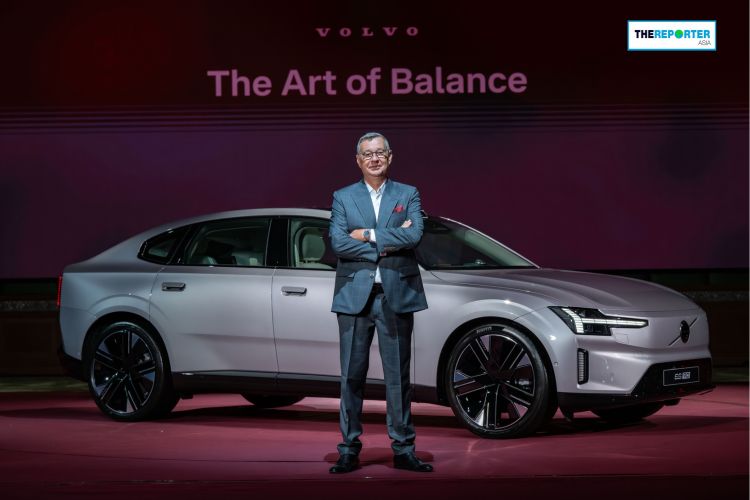
Volvo‘s strategic launch of the flagship ES90 EV at 2.99 million Baht challenges a contracting economy, as MD Chris Wailes confronts “extremely high” loan rejection rates and “illogical” PHEV taxes, betting on technology and value over participation in a destructive price war.
BANGKOK, THAILAND – In one of the boldest strategic maneuvers seen in the Thai automotive sector this year, Volvo Car (Thailand) has officially launched its new flagship electric sedan, the Volvo ES90, at a stunningly aggressive starting price of 2.99 million Baht. This move sends a powerful shockwave through the premium EV market, directly challenging competitors and defying a harsh economic landscape plagued by sluggish growth and, more critically, a severe credit crunch.
The launch is far more than a new product release; it’s a calculated statement of intent. As the Thai auto market grapples with what many concede is a “not in good shape” environment, Volvo is sidestepping the industry’s brutal price wars. Instead, the Swedish automaker is executing a multi-pronged strategy: launching a high-technology, high-value product at a disruptive price point, while simultaneously protecting existing customer value and publicly challenging government policy.
Speaking at the launch, Chris Wailes, Managing Director of Volvo Car (Thailand) and Malaysia, provided a sharp analysis of the market’s true ailment. He argues the core problem isn’t a fundamentally broken economy, but a liquidity crisis at the consumer level, driven by “extremely high” loan rejection rates from financial institutions. Amidst this backdrop, the ES90 arrives as Volvo’s high-stakes bet that innovation, strategic pricing, and a clear-eyed long-term strategy can triumph over short-term market hysteria.
The ES90: A “3-in-1” Segment-Bending Vehicle
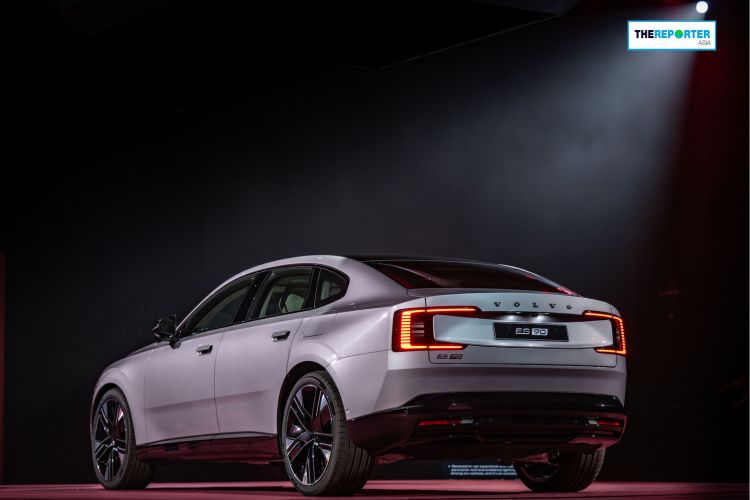
Volvo’s primary weapon in this fight is the ES90 itself, a vehicle that fundamentally defies traditional categorization. Positioned as a true premium EV, it’s built on the “3-in-1” concept, meticulously designed to fill a “white space” in the market by merging three distinct vehicle types.
- Sedan Luxury: It retains the elegant, prestigious silhouette and comfort of a flagship executive sedan.
- Fastback Versatility: It incorporates a fastback design with a large rear tailgate, offering practicality and cargo flexibility that traditional sedans lack.
- SUV-like Ground Clearance: In a move of particular genius for the Thai market, the ES90 features a “Higher Ground Clearance.”
This third point is a critical differentiator. Wailes specifically highlighted its relevance: “If you look at what we need in Thailand during the rainy season, we need higher ground clearance because we get floods. The ES90 has that. It’s the only sedan with this feature.”
This design blend—part executive cruiser, part practical fastback, part flood-capable crossover—makes the ES90 a unique proposition. It targets the executive who desires the prestige of a sedan but faces the practical realities of urban flooding and family needs, a niche that rivals have overlooked. It aims to capture market share not just from other EVs, but from traditional premium sedans and even 5-seater SUVs.
The 500 TFLOPS “Brain”: A Software-Defined Powerhouse
Underpinning the ES90 is Volvo’s next-generation SPA 2 (Scalable Product Architecture 2) platform. This architecture facilitates a complete shift, turning the ES90 into a “Software Defined Vehicle” (SDV) built on the company’s ‘Superset Tech Stack’.
The heart of this system is its “brain,” the most powerful core computing system Volvo has ever deployed. It utilizes a Dual NVIDIA Drive AGX Orin configuration, giving it a staggering processing capability of 500 TFLOPS (500 trillion floating-point operations per second).
To put this in perspective, this level of processing power rivals high-end supercomputers from just a few years ago and dwarfs the computational power found in current consumer electronics or even rival vehicles. This immense power is not for gimmickry; it is the foundation for the next generation of automotive technology. It allows Volvo to push the boundaries of:
- Active Safety: Processing vast amounts of data from LiDAR, radar, and cameras simultaneously for unparalleled collision avoidance.
- AI and Machine Learning: Enabling the car to learn, adapt, and improve its systems over time.
- User Experience (UX): Running a sophisticated, responsive, and deeply integrated system (like the built-in Google services) without lag.
- Future-Proofing: Allowing for significant over-the-air (OTA) updates that can add new features, enhance performance, and improve safety long after the car has left the showroom.
This “Software Defined” approach means the car’s value is no longer static; it can evolve, a crucial concept for retaining long-term residual value.
Performance, Range, and the 800V Advantage
The ES90’s technological prowess extends to its powertrain. It is built on an 800-volt architecture, a technology typically reserved for high-performance super-EVs like the Porsche Taycan.
The 800V system is a strategic engineering choice. By doubling the voltage (compared to the common 400V standard), it allows for the same amount of power (Power = Voltage x Current) to be delivered with half the current. Lower current dramatically reduces heat loss (Heat = Current² x Resistance), which in turn enables two critical advantages:
- Sustained Fast Charging: The system can accept ultra-high-speed charging without overheating. Volvo claims the ES90 can add 300 kilometers of range in just 10 minutes (at a 350kW DC fast-charging station).
- Greater Efficiency: Less energy is wasted as heat, improving overall efficiency and range.
Volvo pairs this architecture with its own in-house developed battery management software, squeezing out a maximum range of 755 kilometers (under NEDC standards). Despite its focus on luxury and range, the Ultra Single Motor Extended Range model launching first is impressively quick, achieving 0-100 km/h in 6.6 seconds.
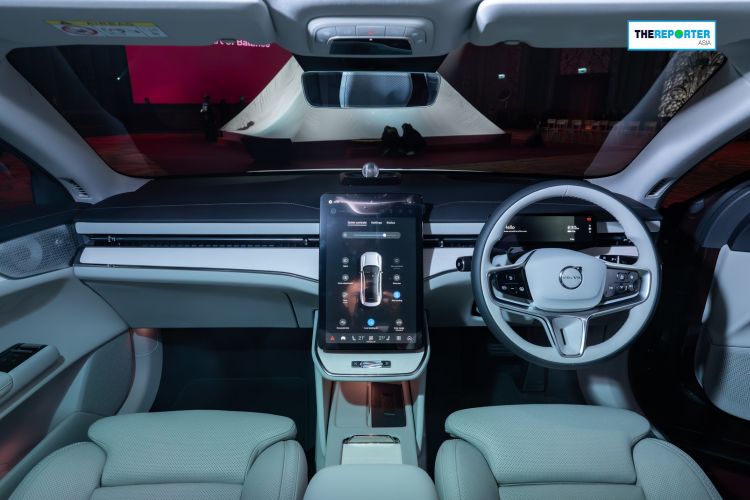
Inside, the luxury commitment is absolute. The ES90 features a spacious, quiet cabin with luxurious rear seats, advanced Pilot Assist (next-gen ADAS), and a 360-degree 3D camera. A standout feature is the Electrochromatic panoramic roof—a first for any Volvo—which can tint or clear at the touch of a button, eliminating the need for a physical sunshade. This is complemented by an immersive Bowers & Wilkins sound system with Dolby Atmos, tuned by the legendary Abbey Road Studios.
Strategic Analysis: Pricing Amidst “Extremely High” Loan Rejections
The 2.99 million Baht price tag is the masterstroke. It’s a price that is simultaneously premium yet deeply disruptive, landing far below initial market expectations for a flagship of this technological caliber.
Chris Wailes provided a candid and sharp analysis of the economic environment that makes this pricing so critical. He dismissed the idea that Thailand’s economy is in a “terrible state” compared to other nations, even accounting for private debt.
The real culprit, he argues, is the credit market. “What’s not helping on the automotive side is the restriction on people’s ability to borrow money,” Wailes stated bluntly, labeling the current loan rejection rates as “extremely high.”
This insight from the front lines is critical for any business leader in Thailand. The problem isn’t just low consumer confidence; it’s a structural bottleneck where financial institutions have tightened lending criteria so severely that it’s choking off demand for durable goods.
The 2.99M price, therefore, is a scalpel. It’s designed to slice just underneath the financing barrier that plagues the 3.5M+ segment, making it an attainable aspiration for a larger pool of affluent professionals and executives who can still secure credit. It’s a direct challenge to competitors, forcing them to justify their higher price tags against a technologically superior, segment-bending, and sharply priced alternative.
“We Will Not Play”: Volvo’s Rejection of the Price War
As the mass market and even premium segments are dragged into a vicious price war, Wailes was unequivocal: Volvo will not participate.
“The easiest way, if you want to go out and ‘buy market share,’ is to use price,” Wailes explained. “But it’s not always the best way for the long term.”
This stance is rooted in a core business philosophy: protecting the customer. “In my position, what I have to consider is the customer who has already bought our car. Is it the right thing for me to just go and change all the pricing, which directly impacts their residual value? I have to balance the offer, the package, and make sure we are competitive. That doesn’t necessarily mean we have to drop the price. It might mean we hold the price, but we ‘add’ something else.”
This is a crucial strategy for the premium sector, where Total Cost of Ownership (TCO) and residual value are paramount considerations for business and fleet buyers. A price war decimates the used car market, angering the loyal customer base that forms the bedrock of a premium brand. Volvo’s strategy fosters trust and brand equity—a long-term intangible asset—over the volatile, short-term gains of volume.
A Case Study in Customer Management: The EX90 Upgrade
Volvo is already putting this “add value” strategy into practice. Wailes admitted he was “surprised” by market feedback that the price for the larger 7-seater EX90 SUV was too high, especially since he notes it’s “a million Baht cheaper” than some 5-seater rivals.
But instead of reacting with discounts, Volvo’s response was a masterclass in customer retention. Wailes announced: “We will give a free upgrade for their Core Compute System to match the ES90.”
This move is brilliant. It costs Volvo margin, but it does so while reinforcing its image as a technology leader. Existing EX90 order holders are not just placated; they are delighted, receiving a massive 500 TFLOPS tech upgrade for free. This builds immense brand loyalty and turns potential detractors into evangelists, all without compromising the EX90’s pricing structure. Wailes did, however, confirm they are “looking for opportunities next year for the EX90 to add new variants… If we can bring in a lower entry [model] at a reduced price, we will.”
Navigating Headwinds: The “Illogical” PHEV Tax
Wailes also leveled direct, pointed criticism at the government’s new excise tax structure, which has increased taxes on Plug-in Hybrid Electric Vehicles (PHEVs). Given Volvo’s current 80% BEV / 20% PHEV sales split, the policy is a significant headwind.
He stressed that while the 100% BEV goal is unchanged, PHEVs are a critical “transition” technology for customers “not yet ready” to go fully electric, often due to infrastructure or lifestyle concerns.
“It doesn’t help sales,” Wailes said of the new tax. “Asking customers to immediately jump from ICE to full EV is a very challenging thing. So, increasing the tax on [PHEV] cars seems ‘counter-intuitive’ to the government’s direction of pushing people towards electrification. It’s not very logical. But we have to deal with it.”
How will Volvo deal with it? Again, by shielding the customer. “I personally don’t feel it’s fair to pass this differential in cost to the customer. What I’m focused on is not the MSRP… it’s the ‘price the consumer pays.’ If I can hold that price point level, that’s the goal.”
This is another calculated business decision: absorbing a tax hike to maintain market momentum and customer trust, rather than passing on a policy-driven cost increase.
Outlook: A Calculated Bet on a 2026 Recovery
In a final note of pragmatic caution, Wailes confirmed that other capital expenditures are being scrutinized. A planned Body & Paint center project has been “postponed,” not canceled. “I postponed it because of the current economic situation. It’s ‘very expensive’ right now. I need to ‘redirect those funds’ elsewhere, which is the sales-related part.”
This redirection of capital underscores the entire strategy: all resources are focused on navigating the current storm and winning the customer.
Volvo’s market outlook remains cautious. Wailes expects Q4 2025 and the first half of 2026 to remain challenging—”same, same”—with a real recovery only expected to begin in the second half of 2026.
The launch of the Volvo ES90 at 2.99 million Baht is therefore not a simple product launch. It is a comprehensive case study in how to launch a premium product in a recession. Volvo is waging a sophisticated campaign, armed with disruptive technology (500 TFLOPS, 800V), segment-bending design (high-clearance sedan), and a disciplined, customer-first financial strategy (no price wars, absorbing taxes) to challenge a market defined by tight credit and illogical policy.
#VolvoES90 #VolvoCarThailand #ChrisWailes #EV #ElectricVehicle #ThaiAutoMarket #PremiumEV #ES90 #Volvo #EconomicAnalysis #AutomotiveStrategy #PHEVtax #LoanRejection #ThailandEconomy #BEV #VolvoEX90 #PriceWar #BusinessStrategy #500TFLOPS #800V