

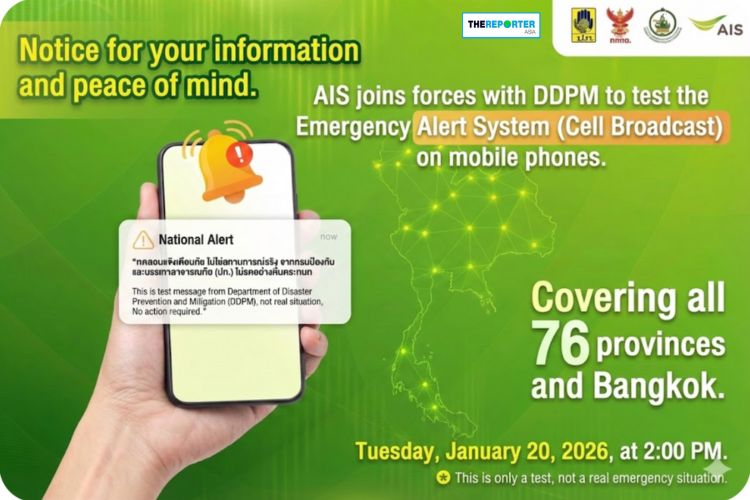
Advanced Info Service (AIS) has officially announced a collaborative initiative with the Department of Disaster Prevention and Mitigation (DDPM) to conduct a comprehensive, nationwide test of the “Cell Broadcast” emergency alert system. Scheduled for January 20, 2026, at precisely 2:00 PM, this test represents a critical leap forward in utilizing 5G technology not just for commerce, but for the fundamental protection of human life and national assets across all 76 provinces and the Bangkok Metropolitan Area.
This massive technical undertaking is designed to ensure that the national emergency infrastructure is robust enough to deliver life-saving information with unprecedented speed and surgical precision. By leveraging the unique capabilities of Cell Broadcast technology, the authorities can bypass traditional network congestion that often occurs during crises, ensuring that every compatible device within a specific geographic radius receives an alert simultaneously. For the Thai economy, this system serves as a vital digital insurance policy, potentially saving billions of baht in property damage and economic disruption by providing citizens with the precious minutes needed to seek safety or secure their livelihoods before a disaster strikes.
As the clock strikes 14:00 tomorrow, millions of mobile screens across the kingdom will illuminate with an automatic notification accompanied by a distinct auditory signal, even if devices are set to silent or Do Not Disturb modes. It is paramount that the public understands this is a controlled simulation and not a signal of an actual impending catastrophe. The message will clearly state in Thai that it is a “Disaster Warning Test, Not a Real Situation from the DDPM,” explicitly advising the population to remain calm. This exercise is as much about psychological preparedness for the public as it is about technical validation for the engineers at AIS and the officials at the Ministry of Interior.
The Economic Significance of Digital Disaster Mitigation
The integration of Cell Broadcast technology into Thailand’s national fabric is a move that resonates far beyond simple public safety, marking a sophisticated evolution in the country’s digital economy. From an investment perspective, a nation equipped with a world-class early warning system becomes a more attractive destination for foreign direct investment and international tourism. When global stakeholders see a country investing heavily in disaster resilience, it lowers the perceived risk profile of the region, ensuring that supply chains and infrastructure are better protected against the unpredictable nature of climate-related events or public emergencies. AIS is effectively transforming the mobile phone from a mere communication tool into a localized siren that safeguards the continuity of the Thai economy.
Furthermore, the economic efficiency of Cell Broadcast technology compared to traditional SMS-based alerts is staggering when scaled to a population of over 70 million. Traditional SMS systems can suffer from “bottleneck” delays because they require the network to identify each individual phone number and send messages one by one, which can take hours during a large-scale emergency. In contrast, Cell Broadcast acts like a radio station, beaming the signal to every tower in a target area simultaneously without needing to know the specific phone numbers. This efficiency ensures that the “golden hour” of disaster response is maximized, which is a key metric for economic recovery post-disaster, as rapid response directly correlates to lower long-term fiscal impact on the state budget.
AIS’s role as the primary facilitator in this test underscores its strategic shift toward becoming a “Cognitive Tech-Co,” or an intelligent digital infrastructure provider. By managing a network that supports 51.5 million subscribers, AIS is providing the essential backbone for the government’s digital governance initiatives. This partnership with the DDPM demonstrates how private sector innovation can be harnessed for public utility, creating a synergy that strengthens national stability. As Thailand moves toward a more digitized future, the ability to communicate instantly with the entire populace becomes a cornerstone of a resilient and modern digital state, protecting the workforce and the physical assets that drive the nation’s GDP.
Technical Requirements and Cybersecurity Awareness
To participate in this vital national safety check, AIS subscribers are encouraged to ensure their mobile devices are updated to the latest software standards. The Cell Broadcast system relies on modern operating system protocols, specifically requiring Android version 11 or higher, or iOS version 18 or higher, to function at peak efficiency. While the alert is designed to appear automatically on most modern screens, these updates ensure that the device’s firmware can correctly interpret the emergency signal and bypass system overrides like silent mode. Importantly, AIS has clarified that citizens do not need to download any additional applications or register on any websites to receive these alerts, as the technology is natively integrated into the cellular network architecture.
In an era where digital threats are as prevalent as physical ones, AIS is taking proactive steps to protect its users from potential exploitation during this test. The company has issued a stern warning that the official test message will absolutely not contain any links, URLs, or requests for personal information. This is a critical distinction, as cybercriminals often use high-profile public events to launch phishing attacks or “smishing” campaigns. By establishing this clear “no-link” policy from the outset, AIS and the DDPM are setting a gold standard for secure government-to-citizen communication, ensuring that the system meant to protect the public does not inadvertently become a tool for financial fraud.
If a user receives a message tomorrow that purports to be a disaster alert but asks for a click or a login, they are urged to ignore it immediately and report the incident to the authorities. The simplicity of the genuine alert—a text-only pop-up—is its greatest security feature. By educating the public on what to expect, AIS is building a “digital firewall” of awareness. This educational aspect of the test is just as important as the signal strength itself, as it fosters a culture of digital literacy where citizens can distinguish between legitimate state communications and the deceptive tactics of bad actors who might attempt to capitalize on the momentary surprise of the alert.
AIS and the Vision of a Cognitive Tech-Co
The execution of this nationwide test is a direct reflection of AIS’s broader vision to transcend the traditional boundaries of a telecommunications provider. With a total customer base of 51.5 million and a dominant position in the 5G market with 1,460 MHz of spectrum, the company is no longer just selling airtime; it is building the nervous system of the Thai digital society. This transition into a “Cognitive Tech-Co” involves using massive data sets and intelligent automation to provide services that are proactive rather than reactive. The Cell Broadcast test is a perfect example of this intelligence in action—using location-based data and high-frequency spectrum to provide a life-saving service that is invisible until it is absolutely necessary.
This commitment to national infrastructure is also evident in AIS’s diverse business portfolio, which includes the AIS 3BB FIBRE3 high-speed internet service reaching over 5.2 million households. By integrating emergency alert capabilities across both mobile and potentially fixed-line digital touchpoints in the future, AIS is creating a holistic safety net for the Thai people. The investment in 5G technology, which now covers a vast majority of the population, is the primary enabler of these advanced alert systems. This infrastructure provides the low-latency and high-reliability connection required to ensure that when the government pushes the “alert” button, the response is instantaneous across the entire geography of the kingdom.
Looking ahead, the success of the January 20 test will pave the way for a more sophisticated national warning hierarchy, where different types of alerts—from weather warnings to public health notices—can be tiered and targeted. AIS remains dedicated to supporting the government’s digital roadmap, reinforcing the idea that a strong digital economy is built on a foundation of safety and trust. As the company continues to innovate in areas like enterprise services and digital lifestyle platforms, its core mission remains the enhancement of the quality of life for all Thais. This test is a testament to that mission, proving that in the digital age, the most valuable service a company can provide is the peace of mind that comes from being informed and protected.
#AIS #CellBroadcast #ThailandEmergencyAlert #DDPM #DigitalEconomy #5GTechnology #PublicSafety #TechNewsThailand #AIS5G #DisasterPrevention