

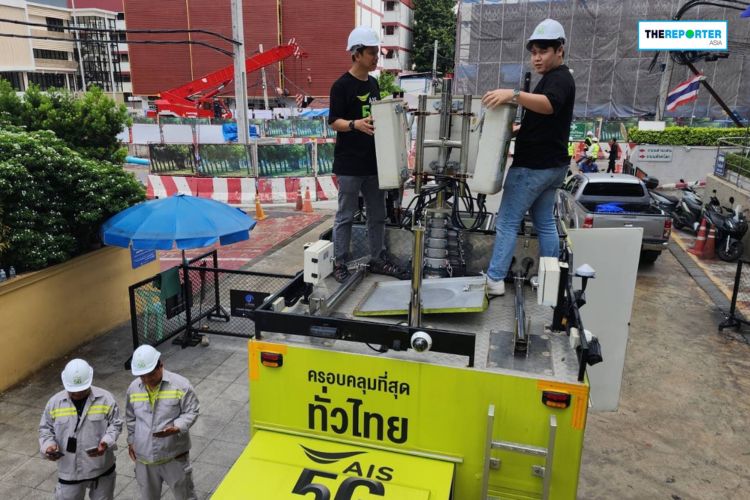
Advanced Info Service (AIS), Thailand’s leading mobile operator, executed a rapid and strategic deployment of its network resources following a major road collapse in Bangkok. The incident, which occurred in front of Vajira Hospital, a critical medical facility, presented a significant test of urban infrastructure and crisis management. By immediately dispatching a mobile base station and reinforcing its 4G and 5G networks, AIS not only ensured vital communication lines remained open for emergency services but also provided a powerful demonstration of its network resilience, a key competitive differentiator in the modern digital economy.
On a seemingly ordinary day in the bustling heart of Bangkok, a sudden infrastructure failure sent shockwaves through the Samsen Road area. A large section of the road directly in front of Vajira Hospital collapsed, creating a deep and wide chasm that immediately severed physical access and crippled essential utilities. The collapse brought down electrical poles and, critically, damaged a significant number of subterranean and aerial communication cables, threatening to create a digital blackout in a zone where reliable communication was most needed.
For the business community, this event serves as a stark reminder of the fragility of urban infrastructure and the cascading effects such failures can have on operational continuity. The immediate vicinity of the collapse—housing a major hospital, residential communities, and various businesses—faced the imminent threat of losing mobile phone and internet connectivity. In an era where digital communication is the backbone of emergency response, medical coordination, and public information dissemination, the potential for network failure represented a crisis within a crisis.
It was in this high-stakes environment that the response of telecommunications providers came under intense scrutiny. The ability to rapidly restore and maintain network integrity would not only be a public service but a definitive showcase of technological capability, strategic preparedness, and corporate responsibility.
AIS’s Strategic Three-Pronged Approach to Network Restoration
Advanced Info Service (AIS) immediately activated its crisis management protocols, recognizing the critical role its network would play in the coming hours and days. The company’s primary objective was clear: to guarantee seamless, high-quality communication for rescue teams, hospital staff coordinating patient care, and the public. To achieve this, AIS engineers implemented a precise, three-phased operational plan.
1. Immediate On-Site Assessment and Intelligence Gathering: Within moments of the incident being reported, AIS dispatched a specialized team of network engineers to the perimeter of the collapse. Their first task was not merely to observe but to conduct a rapid, comprehensive impact assessment. This involved identifying the specific points of failure within their physical cable infrastructure, measuring the signal degradation in the affected “dead zones,” and mapping the surge in network traffic as first responders and onlookers converged on the scene. This initial intelligence-gathering phase was crucial for deploying resources effectively, ensuring that the solution was tailored to the unique topographical and logistical challenges of the disaster site.
2. Deployment of a Mobile Base Station (Cell-on-Wheels): To counteract the damage to its fixed infrastructure, AIS deployed a “Cell-on-Wheels” (COW) unit. This mobile base station is a critical asset in any telecom’s crisis response arsenal. Essentially a fully functional cell tower on a truck, the COW was strategically positioned to broadcast powerful and stable 4G and 5G signals directly into the operational heart of the incident. This mobile solution bypassed the damaged physical lines entirely, creating a robust bubble of connectivity. The deployment of a 5G-capable unit was particularly significant, offering the high bandwidth and low latency required for modern emergency applications, such as high-definition video streaming from drones or real-time data transfer from medical equipment.
3. Reinforcement of the Surrounding Network Grid: Recognizing that a single mobile unit might be strained by the extraordinary demand, AIS simultaneously executed the third prong of its strategy: enhancing the capacity of its permanent base stations in the surrounding areas. Engineers remotely monitored network load and proactively optimized these nearby towers. This involved reallocating spectrum, increasing the power output of specific sectors facing the incident zone, and balancing the user load to prevent network congestion. This network-wide reinforcement created a resilient “safety net,” ensuring that the spike in usage from emergency personnel and the public did not degrade service quality in the broader neighborhood.
A Holistic Vision: Securing Both Mobile and Fixed-Line Broadband
AIS’s response extended beyond the immediate needs of mobile users at the scene. The company also demonstrated a broader understanding of the incident’s impact on the local community by intensifying its monitoring of the AIS 3BB FIBRE3 home broadband network.
With road closures and public transport disruptions, many residents in the surrounding area were likely confined to their homes, leading to a surge in demand for reliable fixed-line internet for remote work, communication with family, and access to news updates. By ensuring the stability of its fiber network, AIS supported community-level business continuity and minimized the overall disruption to daily life. This dual-focus approach—addressing both the mobile needs at the epicenter and the fixed-line needs of the surrounding community—highlights a comprehensive strategy aimed at maintaining the entire digital ecosystem during a crisis.
In conclusion, the road collapse in front of Vajira Hospital was more than a localized infrastructure failure; it was a real-world stress test of the digital infrastructure that underpins a modern metropolis. AIS’s response was not merely a technical fix but a strategic execution that underscored the critical importance of a resilient, adaptable, and intelligently managed telecommunications network. For business leaders, it reinforces the non-negotiable value of a robust digital backbone, proving that in times of crisis, connectivity is the currency of control, coordination, and community resilience.
#AIS #AIS5G #BangkokCollapse #CrisisManagement #Telecommunications #NetworkResilience #DigitalInfrastructure #BusinessContinuity #5GforGood #InfrastructureCrisis #VajiraHospital