
A challenging economic landscape is taking shape for the latter half of 2025, with Citibank economists forecasting a significant deceleration in global growth amid persistent trade frictions. For Thailand, the outlook is particularly fraught with challenges, as the Kingdom grapples with a trifecta of pressures on its key economic pillars: slowing exports, a narrowly focused investment recovery, and a tourism sector that continues to lag behind its regional competitors. The latest projections paint a picture of moderated growth and underscore the critical need for strategic navigation by business leaders and policymakers alike.
The first half of 2025 offered a deceptive sense of stability, with the global economy posting a resilient GDP growth of 2.4%. This performance, however, masked underlying vulnerabilities that are now coming to the forefront. According to Johanna Chua, Head of Emerging Market Economics and Chief Asia Economist at Citigroup, this early resilience was largely a temporary phenomenon.
“The global economy has remained resilient despite volatility, particularly from U.S. trade policy… This is largely because most countries, apart from China, have yet to respond to U.S. tariffs,” Chua explained. She noted that proactive measures by businesses, such as “front-loading” orders to get ahead of new tariffs and absorbing initial cost increases, delayed the inevitable impact on consumers. Furthermore, sectors insulated from direct trade disputes, like AI-related investments and the robust electronics and semiconductor industries, continued to bolster exports globally.
Many emerging markets, including Thailand, also benefited from narrower current account deficits, which provided a temporary “cushion to global growth”. However, these buffers are now fading. As the full weight of trade policy and economic shocks begins to settle, Citi forecasts a sharp slowdown in global GDP growth to just 1.5% in the second half of 2025. A subsequent recovery is anticipated, with growth projected to rebound to 2.9% in the first half of 2026 and 2.8% in the second half.
Adding another layer of complexity is the currency market. “The U.S. dollar is expected to weaken in 2H25, which may encourage capital inflows into emerging markets but could pose challenges for Asia and Thailand where currencies are strengthening while exports remain under pressure from tariffs,” Chua added. The silver lining for emerging economies is that inflation remains remarkably low compared to the global average of around 3%, granting central banks significant “room for monetary policy easing to support economic activity”.
Thailand’s Economic Crossroads: A Prolonged Slowdown Ahead
While the global picture sets the stage, the forecast for Thailand zooms in on specific domestic and external pressures. Citibank projects the nation’s GDP growth at 2.2% in 2025, before decelerating further to 1.6% in 2026. This trajectory points towards a challenging period for Thai businesses and the broader economy.
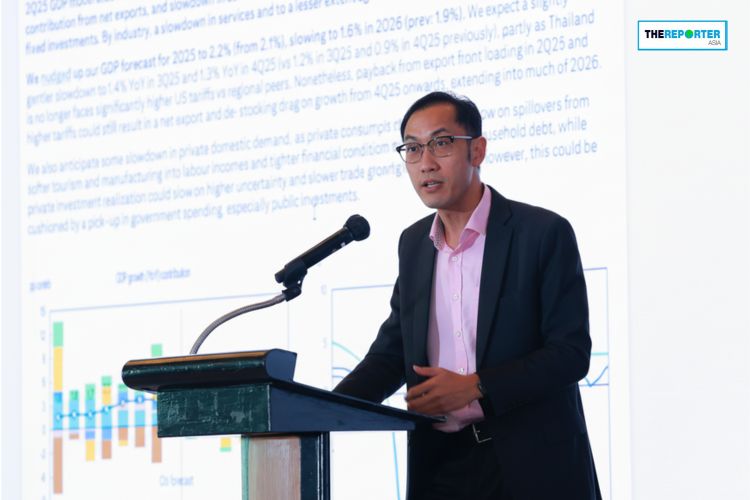
Wei Zheng Kit, Head of ASEAN Economics at Citigroup, warns that the slowdown could be more drawn-out than previously anticipated. “The economy likely to see a more prolonged slowdown over the next few quarters as front-loading fades and tariffs weigh on private domestic demand,” he stated.
The Faltering Export Engine
Exports, the traditional backbone of the Thai economy, are flashing warning signs. While growth in July was deceptively stable due to the last vestiges of front-loading, clearer signs of a slowdown are emerging in the second half of the year. Kit noted that the “extent of August export payback was stronger for Thailand vs other ASEAN peers,” suggesting a more pronounced reversal of pre-tariff inventory building. This, combined with a shrinking trade surplus, likely points to a much smaller contribution from net exports—or potentially even a drag on GDP—in the third quarter. Compounding this issue is a concurrent fall in manufacturing and agriculture production, which may signal a “sharper de-stocking drag” as businesses reduce inventories in the face of weakening demand.
A Narrow and Cautious Investment Recovery
On the investment front, the recovery is present but fragile and highly concentrated. Kit observed that private investment is “showing signs of a narrowly based recovery, particularly in machinery and equipment, driven by projects approved in 2023–2024”. This indicates that investment is not broad-based across the economy but is instead linked to specific, previously greenlit projects.
Longer-term investment prospects are clouded by deep-seated structural issues. Thailand’s lower labor productivity compared to regional peers has placed the country at a significant cost disadvantage. These structural impediments continue to weigh on the nation’s attractiveness for sustained, long-term investment, posing a critical challenge for future competitiveness.
Tourism’s Struggle to Keep Pace
The tourism sector, once a beacon of hope for post-pandemic recovery, remains a point of concern. The recovery is described as “fragile,” with persistent concerns over tourist safety and the strengthening Thai baht weighing heavily on arrivals. The baht’s appreciation makes Thailand a more expensive destination for international visitors, directly impacting competitiveness.
The data starkly illustrates this underperformance. As of June 2025, Thailand’s tourist index has yet to return to pre-COVID levels. This stands in sharp contrast to regional competitors like Singapore, Indonesia, and Vietnam, which have already seen their tourism numbers exceed pre-pandemic benchmarks, highlighting a potential loss of market share for Thailand.
Policy Constraints and the Path Forward
With economic headwinds intensifying, the focus shifts to the policy levers available to the Thai government and the Bank of Thailand (BoT). However, the room for maneuver appears limited.
On the fiscal front, spending for the 2026 fiscal year is expected to be “less expansionary” as the government prioritizes fiscal consolidation, aiming to narrow the fiscal deficit to 4.3% of GDP. This fiscal prudence, while sound from a debt management perspective, “remains a key constraint to large-scale stimulus”. A significant stimulus package would likely require raising the public debt ceiling above its current 70% of GDP threshold, a move that would require careful consideration.
Given these fiscal limitations, the burden of supporting growth falls more heavily on monetary policy. “Under these fiscal limitations, Citi expects the BoT to maintain a dovish monetary policy stance given growth headwind, below-target inflation, and a stronger baht,” Kit concluded. A dovish stance implies the central bank will likely lean towards keeping interest rates low, or potentially cutting them, to stimulate economic activity in the face of slowing growth and a currency that is appreciating too quickly.
For business leaders, this complex forecast calls for agility and strategic foresight. Navigating the coming quarters will require a sharp focus on operational efficiency, careful management of currency exposure, and an astute awareness of the shifting dynamics in both domestic and international markets.
#EconomicOutlook #ThailandEconomy #GlobalGDP #Citibank #TradeWar #ExportSlowdown #ThaiTourism #FiscalPolicy #MonetaryPolicy #ASEANEconomy #Investment #EconomicForecast