

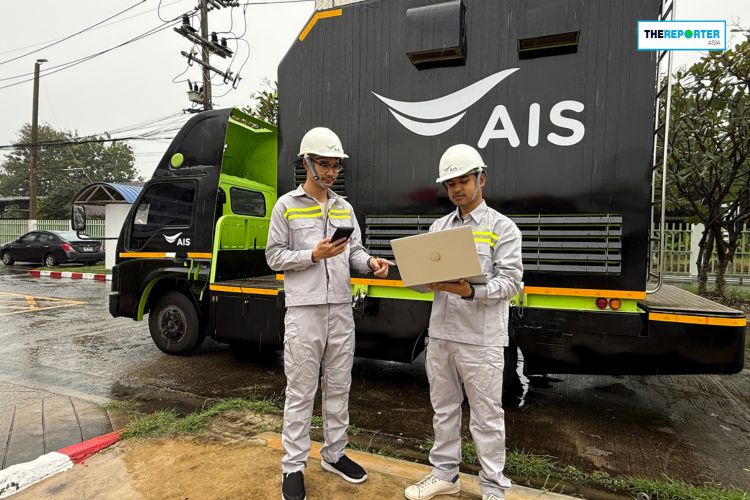
Thailand’s premier digital infrastructure provider, AIS, has activated its highest-level Business Continuity Management (BCM) protocol in response to the imminent threat of Typhoon Kalmaegi. This mobilization transcends a standard weather advisory; it represents a critical stress test for Thailand’s economic resilience and a strategic defense of the nation’s digital “lifeblood.”
As the Thai Meteorological Department issues stark warnings for Typhoon Kalmaegi’s landfall between November 7-9, 2025—projecting severe rainfall and flooding across key economic zones in the Northeast, East, Central, and North—the focus shifts to the nation’s critical infrastructure. In today’s economy, digital connectivity is no longer a convenience but a fundamental utility, as essential as power and water.
AIS, recognizing its role as the custodian of this digital foundation for over 51.5 million customers, has escalated its preparedness to “maximum measures.” This comprehensive strategy involves the full mobilization of engineering teams, advanced technology, and a pre-emptive risk management framework. For the Thai business community, this response is not just about maintaining mobile signals; it’s about safeguarding supply chains, ensuring operational continuity for enterprises, and reinforcing the stability of the entire digital economy against a large-scale disruptive event.
The Economic Storm: Why Kalmaegi is a National-Scale “Stress Test”
From an economic perspective, Typhoon Kalmaegi is far more than a meteorological event; it is a direct “Stress Test” on Thailand’s core industrial and agricultural engines. The regions in the storm’s projected path are not peripheral; they are the very heart of the nation’s production and logistics networks.
- Industrial Disruption: The Eastern and Central regions host major industrial estates, automotive manufacturing hubs, and petrochemical plants.
- Agricultural Heartlands: The Northeast and Central plains are the nation’s “food basket,” critical for both domestic consumption and exports.
- Logistics Corridors: These regions form the primary arteries for road and rail transport, connecting domestic markets and linking to global supply chains via key ports.
The Thai Meteorological Department’s warning of “flash floods, forest runoff, and overflowing riverbanks” translates directly into the language of business risk: supply chain disruption, production downtime, and consumption shocks.
In this high-stakes environment, the resilience of the communication network becomes the central nervous system for national response and economic continuity. A failure in connectivity during such a crisis would be catastrophic, paralyzing government command-and-control, severing business BCM triggers, and leaving citizens isolated.
AIS’s declaration of a maximum-level response is, therefore, an act of economic defense. It is a public commitment to protect the “Connectivity Continuity” that underpins every facet of the modern Thai economy, from a mobile banking transaction to the server coordinating a factory’s logistics.
Unpacking the Strategy: AIS’s Four Pillars of Resilience
AIS’s response is not improvised; it is the activation of a deeply embedded, systemic Business Continuity Management (BCM) framework. This “four-pillar” strategy provides a comprehensive defense-in-depth, addressing technology, power, people, and partnerships. For business leaders, it serves as a case study in best-practice crisis management.
1. The Command & Control Pillar: Proactive Network Management
The first pillar is about operational readiness and technological superiority. The goal is to move from a reactive to a predictive and proactive stance.
- Human Assets: AIS has placed its “rapid response teams” of highly-specialized engineers and technicians on high-alert standby within the designated risk zones. These teams are the “first responders” for the network, tasked with immediate intervention.
- Technological Flexibility: The company has prepared its fleet of “Cell-on-Wheels” (COWs), which are essentially mobile base stations. This is a critical investment in “network flexibility.” If a primary tower is compromised by flooding or power loss, a COW can be deployed to the area, creating a “bubble” of connectivity to restore service rapidly.
- Centralized Intelligence: The entire operation is orchestrated from the 24/7 Network Operation Center (NOC). This “mission control” hub monitors network traffic, system health, and environmental data in real-time. It allows AIS to anticipate potential failure points, such as signal degradation or hardware stress, before they lead to an outage.
- Crisis Escalation: AIS has confirmed its readiness to immediately establish a “War Room” as the situation evolves. This escalates the command structure, bringing together key decision-makers from engineering, operations, and corporate affairs to “accelerate network restoration.” In business terms, this strategy is laser-focused on one metric: minimizing “Downtime.” Every second of network downtime has a quantifiable economic cost; this pillar is designed to mitigate that loss.
2. The Lifeline Pillar: Total Energy Redundancy
In any disaster scenario, the single greatest point of failure for a telecommunications network is the electrical grid. A signal tower may be perfectly intact, but without power, it is useless.
AIS has identified this as a primary vulnerability and engineered a robust solution. The second pillar is the “guarantee of power.”
- Strategic Reserves: The company has confirmed the preparation and positioning of “sufficient backup generators and fuel reserves.”
- Precision Deployment: Critically, this is not a blanket policy. These assets are being pre-positioned based on a “precise risk assessment,” with the highest concentration in “designated high-risk areas.” This demonstrates an intelligent allocation of resources (Resource Allocation) rather than a wasteful, scattershot approach.
- The Economic Investment: From a financial perspective, this represents a significant ongoing “Operational Expenditure (OPEX)” in fuel and maintenance, as well as a “Capital Expenditure (CAPEX)” in a massive inventory of generators. This is the “cost of resilience.” AIS is effectively investing its own capital to create a power infrastructure that is independent of the primary grid during a crisis. For its enterprise customers, this investment translates into a “Service Guarantee”—a promise that AIS connectivity will outlast other failing utilities.
3. The Human Capital Pillar: Protecting Invaluable Assets (ESG in Action)
A sophisticated network is worthless without the skilled engineers who maintain it. Sending teams into a typhoon-affected area is inherently dangerous. AIS’s third pillar demonstrates a mature understanding that its “Human Capital” is its most valuable and irreplaceable asset.
- Safety as Priority: The company has enforced strict safety protocols for all on-ground staff. This includes the “provision of complete safety equipment”—from safety suits and life vests to dedicated boats and emergency medical gear.
- Sustainable Operations: The mandate is clear: “to work in high-risk areas with the utmost safety.” This is not just a “feel-good” policy; it is a core component of “Good Governance” and the “Social” aspect of ESG (Environmental, Social, and Governance).
- The Business Case for Safety: Investors and enterprise partners increasingly view companies that endanger their key staff as high-risk. By prioritizing the safety of its engineers, AIS ensures the “sustainability” of its crisis response. It builds employee loyalty and ensures that its expert teams are confident, protected, and capable of executing their mission without compromising their well-being. This is a hallmark of a responsible, long-term-focused organization.
4. The Alliance Pillar: Proactive Public-Private Partnership (PPP)
In a large-scale disaster, no single entity can succeed alone. “Working in Silos” is a recipe for failure. AIS’s fourth pillar is the strategic and “proactive coordination with government agencies.”
- Integrated Response: AIS is actively collaborating with the Department of Disaster Prevention and Mitigation (DDPM) and respective provincial governments. This establishes a “Public-Private Partnership (PPP)” in national disaster management.
- Strategic Objective: The primary tactical goal of this partnership is to “prepare and secure the network in evacuation centers.” These centers are the most critical nodes for public safety and governmental coordination. Ensuring they have stable, high-capacity connectivity allows evacuees to contact family and enables officials to manage aid distribution and emergency response effectively.
- Shared Intelligence: This partnership is a two-way street. The government provides AIS with real-time “Situational Awareness,” allowing AIS to deploy its COWs and engineering teams with surgical precision. In return, AIS provides the “critical connectivity infrastructure” that the government needs to function. This synergy is a powerful force multiplier for the entire national response effort.
The “Cognitive Tech-Co”: The Business Payoff of Resilience
This comprehensive response to Typhoon Kalmaegi is more than a crisis plan; it is the physical manifestation of AIS’s core business strategy to evolve into a “Cognitive Tech-Co.”
As of September 2025 data, AIS is responsible for a staggering 51.5 million customers. Its actions during this storm are a direct promise of assurance to each segment:
- For 46.3 Million Mobile Users: It is the confidence that in a crisis, their access to news, emergency services, and mobile banking will remain intact.
- For 5.2 Million AIS 3BB FIBRE3 Home Internet Users: It is the assurance that “Shelter-in-Place” or “Work From Home” (WFH) mandates will not mean “Work-offline.” The stability of the fixed broadband network becomes the backbone of household and business continuity.
- For Enterprise Clients: It is the ultimate proof of partnership. It demonstrates that AIS is not merely a vendor but a trusted ally that underpins its clients’ own BCM plans.
This entire operation is built on a foundation of massive technological investment, particularly AIS’s industry-leading 5G spectrum portfolio of 1460 MHz. This raw capacity is what allows AIS to offer the redundancy and performance needed to withstand a system-wide shock.
In conclusion, as Typhoon Kalmaegi approaches, AIS is not just “keeping the lights on.” It is actively “walking the talk” of its Cognitive Tech-Co vision, demonstrating that “standing by the people of Thailand” is an operational mandate.
For the business community, the message is clear: the strength of Thailand’s digital economy is not just a fair-weather phenomenon. It is a resilient infrastructure, forged by investment and proven in crisis. AIS’s actions this week are a benchmark case study in how a modern digital guardian protects the nation’s economic future.
#AIS #TyphoonKalmaegi #BCM #DigitalEconomy #ThailandEconomy #RiskManagement #NetworkResilience #SupplyChain #AIS3BBFIBRE3 #CognitiveTechCo #ESG #CrisisManagement #DigitalInfrastructure #Thailand #KALMAEGI