
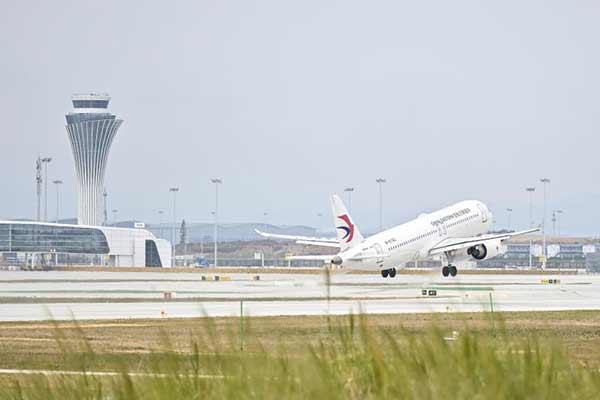
Guangzhou’s vision to dominate the next era of global aviation took a monumental leap forward today. The official commissioning of Guangzhou Baiyun International Airport‘s (CAN) state-of-the-art Terminal 3 (T3), marked by the inaugural flight of a domestically-produced C919 aircraft, propels the facility into a new “five runways and three terminals” operational era.
This multi-billion-dollar expansion is not merely an infrastructure upgrade; it is a calculated strategic move to cement Guangzhou’s status as a comprehensive international aviation gateway and the core logistics engine of the world’s most dynamic economic zone, the Guangdong-Hong Kong-Macao Greater Bay Area (GBA).
A “Quantum Leap” in Hub Capacity
The launch event was steeped in symbolism. The first departure, China Eastern Airlines flight MU6308, bound for Beijing Daxing International Airport, was operated by the COMAC C919. This deliberate choice underscores China’s dual ambitions: to lead in global aviation logistics while simultaneously championing its own rapidly advancing aerospace manufacturing industry.
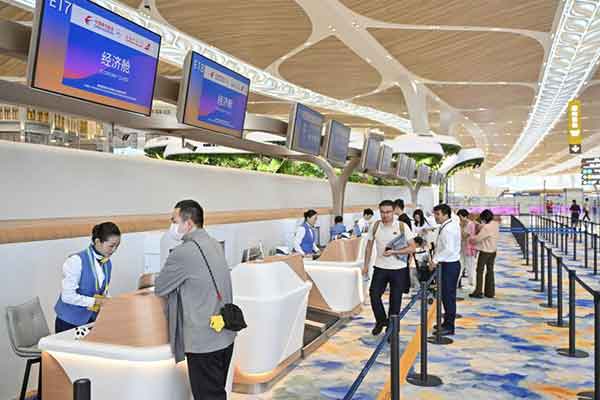
For passengers, the moment was historic. Those aboard the inaugural flight were celebrated as “lucky passengers,” receiving commemorative gifts. “It’s even more intelligent than I imagined,” said Ms. Li, a passenger on the first flight. “The check-in and baggage drop processes were seamless, and the terminal’s design is beautiful.”
This seamless experience was mirrored by the first inbound arrival, flight MU2219 from Lanzhou, which was greeted with the civil aviation industry’s highest honor: a “water salute” from ceremonial fire trucks. “Looking down from the air, the terminal’s ‘Flower Crown of the City of Rams’ design truly lives up to its name. It’s stunning!” remarked passenger Ms. Zhang.
This “Flower Crown” design is a deliberate architectural statement, integrating local motifs like the Baiyun Mountain and the Pearl River, reflecting Guangzhou’s identity as the “Flower City.” But beneath this aesthetic triumph lies the hard-edged strategic purpose.
The move from “two runways and one terminal” just a few years ago to the current “five runways and three terminals” provides the physical foundation for a quantum leap in hub capacity. For business, this translates directly into enhanced supply chain resilience and global access. The expanded infrastructure is a powerful magnet for international airlines, encouraging them to increase frequencies on critical routes and launch entirely new intercontinental services.
This year alone, Baiyun Airport has already seen the launch, resumption, or increased frequency of over 30 international routes. Critically, it has welcomed five new international carriers: Air Astana, VietJet Airlines, Uzbekistan Airways, Nepal Airlines, and Air Algérie. This influx of foreign operators is a tangible result of the new capacity and a core component of Guangzhou’s strategy to build a “12-hour global air travel circle,” solidifying its role as a core node on the “Air Silk Road.”
The Smart Hub: A New Benchmark in Operational Efficiency
For business leaders and logistics managers, the true significance of T3 lies not in its beauty, but in its digital brain. The terminal is a showcase of “smart technology” integrated with human-centric design, engineered to maximize throughput, minimize friction, and generate vast operational data.
The sheer scale is impressive:
- Check-In: 199 counters (a flexible mix of fully self-service, convertible, and fully-staffed).
- Self-Service: 60 kiosks and 59 self-service baggage drop units.
- Operations: 87 jet bridges and 7,193 public address system speakers.
However, the game-changing innovations are in the process. T3’s security screening, a traditional bottleneck in any major airport, has been redesigned. The terminal employs a “centralized security screening + RFID smart tray return” system. This means trays are tracked via RFID, automatically returned, and sterilized, optimizing flow.
Furthermore, its 21 dual-door self-verification gates can process a passenger’s identity check in six seconds, with a misidentification rate below 0.1%. This system precisely binds each passenger to their tray and their baggage, creating a secure, orderly, and, most importantly, fast process. For an airport, time is the ultimate commodity. Shaving minutes off passenger processing time allows for tighter connections and higher asset utilization, directly impacting airline profitability and hub attractiveness.
This efficiency extends beyond the terminal walls. The integrated Ground Transportation Center (GTC) is the multi-modal heart of the operation. It seamlessly fuses the airport with highways, high-speed rail, urban public transit, and air travel. With 2,800 parking spaces, it enables a frictionless “fly-and-ride” experience. For the region’s manufacturing and e-commerce giants, this integration is critical. It means high-value cargo landed at T3 can be on a high-speed train or truck to its final destination within the GBA in hours, not days, creating a seamless air-to-ground logistics chain.
A Digital Twin: Why T3’s Construction Is a Global Case Study
Beyond the passenger-facing technology, T3’s construction and design have set two industry-defining precedents, making it a global case study for future infrastructure projects.
First, T3 is the first large-scale hub airport terminal in China to fully apply Building Information Modeling (BIM) for smart construction. This is far more than a 3D blueprint. Baiyun Airport pioneered a comprehensive management system covering all personnel, all areas, all disciplines, and the entire lifecycle of the project.
This BIM-based approach allowed for unprecedented coordination during the building phase, minimizing waste, clashes, and delays. Its success was validated on the world stage when the project won the final grand prize in the Global Construction category at the buildingSMART International openBIM Awards on September 24, 2025.
Second, T3 is China’s first terminal to achieve paperless archives. This is the true realization of the “digital twin” concept. All building information—from the location of every electrical conduit to the service history of every air conditioning unit—is stored in electronic data packages that combine “spatial data + facility/equipment information.”
The long-term business implications for this are staggering. This digital twin provides precise, real-time data for operations, management, and maintenance. When a component needs servicing, the system doesn’t just send an alert; it can provide the exact part number, its location, its maintenance history, and even order the replacement, dramatically reducing downtime and operational expenditure (OPEX). This shift from reactive to predictive maintenance is a holy grail for operators of complex, 24/7 facilities.
The New Front in the GBA “Airport Cluster” War
The opening of T3 is a strategic salvo in the intense, high-stakes competition among the GBA’s aviation hubs. The GBA, an economic powerhouse with a GDP rivaling that of many G7 nations, is served by a cluster of world-class airports, including Hong Kong (HKG), Shenzhen (SZX), and Macau (MFM).
With its “five runways and three terminals,” Baiyun has now eclipsed Hong Kong’s three-runway system in pure physical scale. This is a direct challenge for the title of the region’s primary aviation gateway.
While the GBA’s official policy is one of “synergistic development and complementary positioning,” the reality is one of fierce competition for lucrative intercontinental routes, high-value cargo, and transfer passengers.
- Hong Kong has traditionally been the region’s premier international and financial hub.
- Shenzhen has risen as the “Silicon Valley” of China, specializing in tech and domestic connectivity.
- Guangzhou, as the provincial capital and a historic trade and manufacturing center, is now positioning itself as the comprehensive logistics and transportation core of the entire GBA.
T3 is the physical manifestation of this ambition. By offering more slots, faster turnarounds, and superior “smart” technology, Baiyun is making a compelling case to international airlines that Guangzhou is the most efficient and strategic entry point into Southern China.
The Outlook: A New Engine for Global Trade
The commissioning of Terminal 3 is far more than a local ribbon-cutting. It is a pivotal moment in the recalibration of global aviation and logistics networks. For business professionals, investors, and supply chain managers, the message is clear: Guangzhou is no longer just a major Chinese airport; it is aggressively positioning itself as a dominant global megahub.
By integrating cutting-edge “smart” technology, a digital twin framework, and a multi-modal transport core, Baiyun Airport has created a highly efficient and resilient engine for trade and travel. This “quantum leap” in capacity, underpinned by a clear strategy to expand its global network, will send economic ripples far beyond the GBA, offering new opportunities for connectivity, investment, and growth for decades to come.
#Guangzhou #BaiyunAirport #Terminal3 #Aviation #BusinessNews #China #GBA #Logistics #SupplyChain #SmartCity #DigitalTwin #BIM #C919 #Economics #Infrastructure #Travel