
In a strategic move set to redefine urban management, Singapore’s Nuvola is launching its “Dynamic Digital Twin” platform in Thailand, targeting the nation’s ambitious 105 Smart City initiative. The company promises to move beyond passive monitoring, offering a solution that can actively control, automate, and simulate future scenarios, unlocking massive efficiencies and safety improvements for Thailand’s public and private sectors.
Thailand is in the midst of a profound national transformation. Guided by the Digital Economy Promotion Agency (DEPA), the country is aggressively pursuing its national Smart City strategy, aiming to establish 105 smart cities by the year 2027. This ambitious plan is not merely a blueprint; it is a well-funded reality.
As of today, 37 cities across 16 provinces have already been officially designated, attracting a staggering 30.9 billion Baht (approx. $840 million USD) in private sector investment. This influx of capital signals immense confidence in Thailand’s digital transition.
However, this rapid development presents a new, complex challenge. The critical issue is no longer just creation but management. As billions are poured into complex infrastructure—from smart grids and transit systems to connected buildings and data centers—the question becomes: How do you efficiently, safely, and sustainably operate these intricate urban ecosystems?
This is the multi-billion-dollar problem that Nuvola, a leading technology firm from Singapore, aims to solve. The company is entering the Thai market with a solution it believes is the missing link: a “living” digital twin that provides not just data, but intelligence and control.
A Strategic Vision: Why Thailand is the “Perfect Market”
For Nuvola, the move into Thailand is a calculated, strategic decision. According to Felix Tan, CEO & Managing Director, Nuvola Media, Thailand stands out as a premier market in the region due to its clear, top-down governmental commitment.
“Thailand is a crucial market for us,” Mr. Tan explained during a recent presentation. “It is the only country in ASEAN that has such a clear and committed Smart City strategy. The Thai government and DEPA are driving to create over 100 smart cities by 2027.”
This clear roadmap provides the certainty and scale that tech innovators dream of. “This is precisely why we believe there is a huge opportunity for us to share our solutions with both the public sector and private developers, helping them achieve the government’s goals,” Tan added.
Nuvola plans to deploy its three core technology pillars to support this goal:
- Dynamic Digital Twin
- Simulation Engine
- Advanced Video Analytics
Redefining the Digital Twin: From Static Model to Living Brain
The term “Digital Twin” has become a ubiquitous buzzword, often referring to little more than a static 3D model of a building. Nuvola is quick to differentiate its offering, branding it as a “Dynamic Digital Twin.”
“Our Digital Twin is dynamic and interactive,” Mr. Tan emphasized. “I’ve seen other Digital Twins in the market, and they are often just static images. Nothing changes. Ours, however, changes when the data changes.”
At its core, Nuvola’s Dynamic Digital Twin is a highly detailed, one-to-one digital replica of a physical asset—be it a building, a factory, a data center, or an entire city district. This replica is not isolated; it is inextricably linked to the real world through a vast network of IoT sensors, data feeds, and existing management systems.
When something changes in the physical world, its “twin” reflects that change in real-time. But Nuvola’s platform takes this a crucial step further.
The ‘Dynamic’ Difference: From Monitoring to Automated Control
The true power of Nuvola’s system lies in its ability to close the loop—moving from passive monitoring to active, automated control.
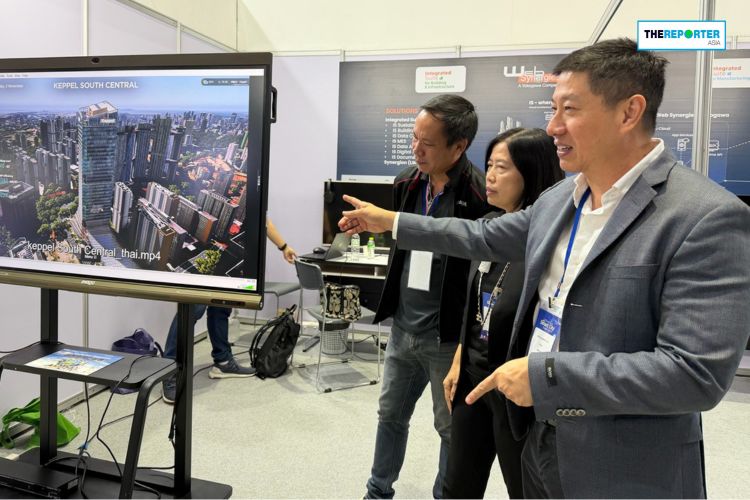
Mr. Tan demonstrated this capability using the Keppel building in Singapore, a prime client. The Digital Twin dashboard displayed live sustainability data, including carbon emissions. More impressively, it showed a “heat map” of the building’s energy consumption.
“The system uses sensors to detect density. It knows ‘there are many people in this zone’ or ‘this zone is empty,'” Tan explained. “Based on this real-time data, the AI doesn’t just send an alert. It automatically issues a command to adjust the air-conditioning in that specific zone.”
This is the essence of a “Dynamic” twin. “We can monitor the temperature, and the system automatically changes the settings from there,” he said. This autonomous action translates into profound operational efficiency. For a large, 20-24 story commercial building, the entire facility’s core systems could be monitored and managed by just two people, as the platform automates routine adjustments.
This “control” feature is a key differentiator. Demonstrating a Smart Factory module for a client in Japan, Mr. Tan pointed to a high-temperature, dangerous “Heat Treatment Plant” zone. “We can monitor the furnace in real-time. But more importantly, I can switch off the furnace light from here, in the control room. I don’t need to send someone in.”
He stated this claim bluntly: “This is the difference from other brands. Other brands cannot do this. Only we can.”
This capability is further enhanced by overlaying real-time CCTV footage directly onto the Digital Twin model, allowing a manager to compare the live video feed of an assembly line with its digital counterpart, side-by-side, verifying operations second-by-second.
The Simulation Engine: De-Risking the Future
Perhaps the most powerful tool for Thailand’s developers and city planners is Nuvola’s integrated Simulation Engine. This component answers the critical question: “What if…?”
“In today’s complex development environment, if you do not simulate, you can only guess,” Mr. Tan noted. “Simulation helps our clients understand, plan, and design processes based on data-driven outcomes, not guesswork.”
This moves the platform from being purely operational to deeply strategic. He provided two compelling examples:
- Evacuation Planning: For a new MRT station or high-rise, developers can simulate an emergency, such as an earthquake or fire. “The simulation doesn’t just give you a number. It graphically shows you where people will run, and where ‘bottlenecks’ or high-density chokepoints will occur,” Tan described. “If the simulation shows an evacuation time of 20 minutes, the planners can then ask, ‘How do we get this down to 10?’ They can then digitally remodel exits, change signage, or redesign flow, and re-run the simulation until they achieve the 10-minute goal. Then they go to construction.” This predictive analytic approach saves enormous capital and, more importantly, ensures public safety before a single brick is laid.
- Urban Flood Planning: For a city like Bangkok, the simulation engine can be a game-changer. “Planners can simulate a ‘perfect storm’ scenario,” Tan proposed. “What happens if we have heavy rain, a high sea tide, and 50% of our water pumps fail? The system will show which roads will flood, how that will impact traffic, and what the cascading failures will be. Without this, you are just guessing.”
The Hard ROI: “Smarter, Faster, Safer” Business Cases
For C-suite executives, the ultimate question is the return on investment (ROI). Nuvola’s platform is designed to deliver tangible results across three verticals: Smarter, Faster, and Safer.
The most concrete evidence comes from their client, CapitaLand, a major real estate giant.
“By using our Digital Twin, CapitaLand saves 10% on air-conditioning costs and 19% on lighting costs annually,” Mr. Tan revealed. This isn’t just a one-time saving; it’s a recurring operational efficiency. The system achieves this by using Indoor Air Quality (IAQ) sensors to monitor CO2 levels (a proxy for occupancy) and even external weather sensors. “When the system detects it’s raining and the ambient air is cooler, the Cooling Tower automatically powers down, saving energy.”
Other use cases demonstrate the platform’s versatility:
- Data Centers: Where power and heat are critical, the Digital Twin provides an “X-Ray” view, showing hidden pipes, sprinklers, and electrical systems. Heat maps instantly identify hotspots. “The system says, ‘Oh, there is a problem here, it’s too hot,’ and can point directly to the specific server PC that may be failing, allowing maintenance to fix it immediately.”
- Bus Depots: Using CCTV and AI, the system monitors passenger queues. “It counts how many people are waiting. If the queue becomes too dense, it automatically signals the depot to dispatch more buses,” reducing wait times and improving service.
Solving Thailand’s Integration Headache: No “Rip and Replace”
A major barrier to adopting new technology in established businesses is the fear of “fragmentation.” Many Thai organizations, from universities to industrial parks, have invested in various “smart” technologies over the years, but these systems often operate in silos.
“When I met with officials from Chiang Mai University last year, they told me they have smart technology to track license plates and separate smart technology to manage river water levels,” Mr. Tan said. “Both are smart, but they don’t talk to each other. They operate independently.”
Nuvola’s platform is designed to solve this exact problem. It acts as a “system of systems” or an integration layer. “With our solution, we can pull data from all of their existing, disparate systems and bring them together. This gives everyone a unified, holistic view, not just their own small piece.”
Crucially, this does not require a costly “rip and replace” strategy—a message that will resonate with Thai business leaders managing legacy assets.
“Our solution can use existing equipment and new equipment,” Tan affirmed. “We worked with a university that had old buildings and new buildings. Normally, the systems from these two eras cannot communicate. Our Digital Twin can talk to both the old and the new, and we can control both simultaneously.”
AI and Video Analytics: The Final Layer of Intelligence
The final pillar of Nuvola’s offering is its powerful AI-driven Video Analytics. This technology enhances both security and operational safety.
Examples include:
- Smart Security: AI analyzes feeds from security guard body cams to automatically detect and flag suspicious individuals.
- Transit Safety: In Singapore’s train system, an AI system monitors the driver. “If the driver yawns three times in one minute, the system flags it. They must change the driver immediately for safety,” Tan explained.
All these incidents and alerts are reported and logged on the central Digital Twin dashboard, giving management complete situational awareness.
“Everything we do is to help clients work smarter, work faster, save energy, and save manpower. Everything,” Mr. Tan concluded.
Nuvola’s entry into Thailand is not just another product launch. It is a timely arrival of a technology perfectly aligned with the nation’s strategic goals. As Thailand races to build 105 Smart Cities, it will need more than concrete and fiber optics; it will need an intelligent operating system to manage it all. Nuvola is betting it can provide the “intellect” and “control” necessary to turn Thailand’s ambitious blueprints into sustainable, efficient, and truly smart realities.
#Nuvola #NuvolaMedia #DigitalTwin #SmartCity #FelixTan #DynamicDigitalTwin #SimulationEngine #VideoAnalytics #DEPA #Sustainability #Thailand40 #SmartFactory #SmartCitiesThailand