
Thailand is executing a sophisticated economic maneuver that transforms a sporting event into a multi-layered national asset. As global ticket sales for the PT Grand Prix of Thailand 2026 launch on November 11, the international business community is observing a masterclass in economic strategy.
Far from being a simple entry pass, the 2026 MotoGP ticket is being positioned as a collectible physical asset, the cornerstone of a comprehensive Experience Economy model, and a powerful conduit for global Soft Power, set to inject massive value into the Thai economy.
The Strategic Coup: Why the 2026 Season Opener is an Economic Game-Changer
In the world of premier global sports, not all events are created equal. Thailand’s greatest strategic victory for the 2026 season was not just securing the race, but securing the Season Opener.
Scheduled for February 27 – March 1, 2026, preceded by the official Pre-Season Test (February 21-22) at the Chang International Circuit in Buriram, this “pole position” on the racing calendar is a profound economic lever.
Unlike a mid-season race, the Season Opener commands the undivided attention of the motorsport world. It is the single moment when all 800 million global viewers, every media outlet, and all corporate sponsors are laser-focused on one location. Every narrative for the new season, every new team livery, and every new rider dynamic is unveiled in Thailand.
This grants the organizers, led by the Sports Authority of Thailand (SAT) under the Ministry of Tourism and Sports, an unparalleled platform. The global spotlight is not just on the track but on the host nation, providing a unique, high-concentration opportunity to project a calculated national image. This “first-mover advantage” in the annual media cycle is the foundation upon which Thailand’s entire economic strategy for the event is built. The pressure is immense, but the potential return on investment is astronomical.
Deconstructing the “Experience Economy”: A “More Than A Race” Model
The core of the ThaiGP’s domestic economic strategy lies in its “More Than A Race” philosophy. As articulated by Dr. Kongsak Yodmanee, Governor of the SAT, Thailand is not merely selling a three-day race; it is curating a multi-sensory “motorsport festival.”
This is a textbook execution of the Experience Economy, a model where consumers pay for memorable events and feelings rather than just goods or services. In an era where consumer desire has shifted from “having things” to “having memories,” the ThaiGP 2026 model is designed to maximize revenue by expanding the very definition of the event.
The strategy moves far beyond traditional “gate revenue” and merchandise sales, architecting a complete ecosystem of value:
- High-Value Entertainment Integration: The inclusion of top-tier concerts, dynamic Muay Thai exhibitions, and local cultural performances are not peripheral add-ons. They are core components designed to broaden the event’s demographic appeal. This strategy attracts attendees who may not be motorsport purists, such as families, music fans, and cultural tourists, thereby significantly expanding the total addressable market and increasing on-site spending.
- Manufacturing Emotional Value (Exclusive Access): Activities like the Pit Walk, Hero Walk, and Rider Fan Parade are strategically designed to create high-impact, emotionally resonant experiences. This “exclusive access” fosters a deep, personal connection between the fan and the event, translating directly into powerful brand loyalty. This loyalty is a stable, long-term asset, making attendees more likely to return annually and less price-sensitive, as they are paying for an experience that cannot be replicated.
- Harnessing User-Generated Content (UGC): The vibrant atmosphere, the fan zones, and the sheer spectacle of the event are engineered to be “Instagrammable.” This encourages attendees to become a massive, cost-free marketing engine. Every photo and video shared on social media (User-Generated Content) is an authentic endorsement that builds viral hype and reduces future customer acquisition costs.
By creating this 360-degree experience, the ThaiGP ensures that the ticket’s value is not just in watching the race, but in participating in a cultural moment.
The “Memory Capsule”: Forging a New Physical Asset Class
While the world pivots to digital assets and NFTs, Thailand is executing a brilliantly tangible and contrarian strategy: elevating the physical event ticket into a Physical Collectible Asset.
This is perhaps the most innovative aspect of the 2026 economic model. The organizers recognized that in a digital-first world, a physical object imbued with “story” and “art” holds a unique and growing value. The ThaiGP 2026 ticket is being meticulously crafted as a “memory capsule.”
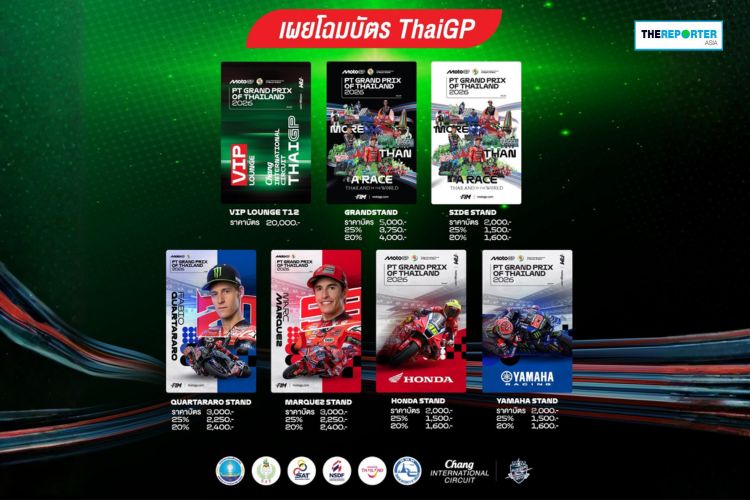
The design team has intentionally bypassed standard graphic design, opting for sophisticated Contemporary Art and Collage techniques. This is not just branding; it is artistic curation. Each ticket is a piece of art that tells a story, weaving together crucial elements:
- The Competition: Images of superstars like Marc Marquez and Fabio Quartararo, alongside the championship trophy, representing the pinnacle of the sport.
- The Experience: Visual cues of the coveted “money-can’t-buy” moments, such as the Pit Walk and Hero Walk.
- The Culture: The powerful integration of Muay Thai, the Thai national flag, and other local cultural symbols, grounding the global event in a uniquely Thai identity.
As Dr. Kongsak noted, the “ThaiGP ticket has a design charm with its own ‘storyline’ that has won the hearts of fans worldwide, becoming a precious collectible.”
This strategy generates a powerful two-tiered economic impact:
- Primary Market (Immediate Revenue): By positioning the ticket as a “Limited Edition” collectible, the SAT creates powerful FOMO (Fear Of Missing Out). This drives an immediate, massive surge in initial sales. Crucially, this tactic attracts not only race fans but also “collectors” who may not even attend the event. This secures substantial, front-loaded revenue for the organizers, optimizing cash flow months in advance of the event.
- Secondary Market (Long-Term Brand Equity): This is the long-term strategic genius. After the event concludes, the ticket begins its second life. It will be traded, sold, and displayed in a secondary market for collectors, similar to rare vinyl records, art prints, or sneakers. This creates a self-perpetuating cycle of desire and discussion around the “ThaiGP” brand, building its Brand Equity far beyond the race weekend. The ticket becomes a timeless marketing tool that appreciates in value, both financially and culturally.
“Thailand to The World”: The 800-Million-Viewer Soft Power Engine
If the “Experience Economy” is the micro-economic engine, the “Thailand to The World” concept is the macro-economic payload. The MotoGP’s 800-million-strong global audience represents an unparalleled target market for Thailand’s national branding and Soft Power initiative.
Soft Power—the ability to attract and persuade through culture and values—is a cornerstone of modern national economic strategy. The ThaiGP 2026 is the “first door” to this global audience.
The event’s Key Visuals and the ticket design itself, which prominently feature Muay Thai and local culture, are the vanguard of this campaign. However, the true masterstroke will be in the live broadcast.
Imagine the global feed: high-speed motorcycle racing interspersed with high-definition, beautifully produced segments on the cultural richness of Buriram, the explosive energy of a Muay Thai Wai Kru, and the welcoming smiles of the Thai people. This is not a jarring 30-second tourism advertisement; it is a seamless, authentic integration of Thai culture into a high-adrenaline entertainment product.
The intended economic outcomes from this macro-strategy are clear and transformative:
- Diversified Tourism: It inspires a massive new wave of tourism, not just to traditional hubs, but specifically to the host province of Buriram, showcasing it as a world-class destination.
- Cultural Export: It elevates the global brand of “Muay Thai,” driving interest in the sport, its related fitness industries, and its philosophical roots, creating new export opportunities.
- Foreign Investment: It powerfully reinforces Thailand’s image as a “World Event Hub.” Successfully executing an event of this magnitude signals to the world that Thailand possesses the infrastructure (Chang International Circuit), logistics, technology, and human capital to manage any world-class event, from major summits to global tech expos and international concerts.
Conclusion: A New Blueprint for the Creative Economy
The PT Grand Prix of Thailand 2026 is far more than a race. It is a comprehensive, multi-faceted Creative Economy Model. The Sports Authority of Thailand is demonstrating how to leverage a single event to generate multiple, cascading revenue streams.
They are transforming a simple ticket into a financial asset, an on-site event into an unforgettable experience, and a global broadcast into a potent soft power tool. As the starting lights prepare to go out in Buriram, Thailand is already winning, providing a global blueprint for how to turn passion into profit and national pride into a measurable economic force.
Event & Ticket Details
For fans, collectors, and business observers, the official ticket sale for the “PT Grand Prix of Thailand 2026” will commence simultaneously worldwide on:
- Date: November 11, 2025
- Time: 14:00 (2:00 PM) (GMT+7) onwards
Purchase Channels:
- In-Person: Counter Service All Ticket at all 7-Eleven branches nationwide in Thailand.
- Online: www.allticket.com
For more details, follow the Chang Circuit Buriram Facebook fan page or contact Line ID: @changcircuit.
#MotoGP #ThaiGP #MotoGP2026 #PTGrandPrixOfThailand #ThailandEconomy #CreativeEconomy #SoftPower #ExperienceEconomy #SportsTourism #Buriram #ChangCircuit #SAT #EconomicStrategy #BrandEquity #Collectible