

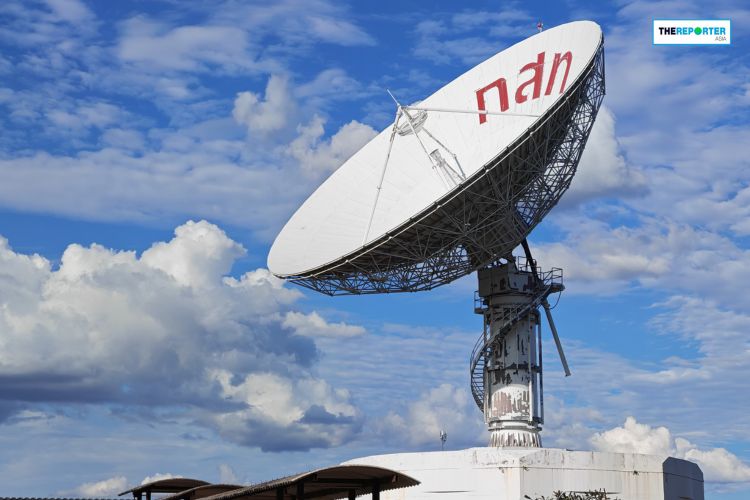
Amidst the intensifying competition in Thailand’s telecommunications sector and the rapid shifts in global technology, National Telecom Public Company Limited (NT) has made a historic maneuver, fully entering the “Space Economy.”
Bangkok – On December 12, 2025, at the Sirindhorn Satellite Station in Ubon Ratchathani, NT officially unveiled “NT nexConnect.” This launch represents far more than a new product introduction; it serves as a declaration of vision to transform the nation’s infrastructure toward Low Earth Orbit (LEO) satellite technology. By forging a strategic alliance with global giant Eutelsat OneWeb, NT aims to position Thailand as the definitive satellite hub for the ASEAN region, targeting revenue of one billion baht within five years.
Strategic Transformation: From Network Operator to Space Economy Player
The selection of the Sirindhorn Satellite Station as the venue for “NT SATCOM…Connect to the NEXT” is a strategic statement. NT is showcasing this facility’s capability as a Satellite Network Portal (SNP) Gateway—a complete gateway for LEO satellite connectivity.
This station is not merely a signal receiver; it is a critical strategic node connecting the constellation of over 600 OneWeb satellites orbiting the globe to terrestrial networks.
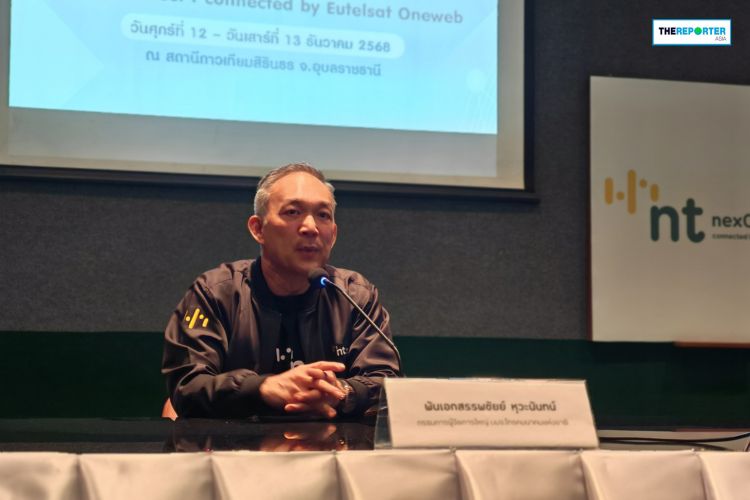
Colonel Sanphachai Huvanandana, President of NT, highlighted that this marks the first official launch of LEO services in Thailand, a process requiring complex regulatory approvals for Landing Rights. The significance of the Sirindhorn Gateway extends beyond Thailand’s borders. It is engineered to serve as a regional connectivity hub, linking signals to neighboring countries in Southeast and East Asia, including the Philippines, Cambodia, Laos, Myanmar, Taiwan, South Korea, and parts of Indonesia. This geographical coverage reinforces Thailand’s potential to become the true digital hub of the region.
The Technology Shift: Why LEO Matters
To understand the business value, one must look at the technological leap. Historically, the satellite industry relied on Geostationary Earth Orbit (GEO) satellites, which faced limitations regarding latency and speed.
The arrival of OneWeb’s LEO satellites, orbiting at an altitude of only 1,200 kilometers, resolves these legacy pain points. NT nexConnect offers low latency of approximately 70 milliseconds (Round trip). This technical specification is a game-changer for business applications, enabling the support of Real-time applications, large-scale IoT systems, and mission-critical data communication that was previously impossible with traditional satellite tech.
Market Positioning: Precision Targeting over Mass Market
A key differentiator in NT’s strategy is its clear market positioning. Unlike competitors such as SpaceX’s Starlink, which often targets the mass consumer market (B2C), NT and OneWeb have positioned NT nexConnect strictly for the Enterprise, Government (B2G), and Niche Markets.
As the Sole Distributor for Eutelsat OneWeb in Thailand, NT has segmented its target markets into high-value sectors where stability and security are paramount:
-
Energy and Maritime: Serving shipping logistics, maritime transport, and oil rigs. Major players like Chevron are already preparing to utilize the service.
-
Defense and Security: Providing secure communications for border patrol and remote operations.
-
Government and Public Service (USO): Connecting remote hospitals and supporting digital infrastructure development in underserved areas.
-
Communication on the Move: Solutions for land vehicles and emergency rescue missions.

Service Packages and Future Roadmap
NT nexConnect offers high-performance internet options including Fixed Land, Land Mobility, and Maritime solutions. Current packages range from speeds of 10/2 Mbps up to 100/20 Mbps. While these speeds are modest compared to fiber optics, they are revolutionary for remote enterprise operations, sufficient for smooth IoT data transfer and corporate applications in areas where fiber cannot reach.
NT executives view the current LEO technology as “Generation 1,” focusing primarily on Broadband. However, the roadmap for the next 4-5 years anticipates a shift toward Mobile-to-Satellite and advanced IoT integration. This evolution is expected to drastically reduce costs for disaster management, such as flood or wildfire monitoring, offering immense economic benefits to the state.
Financial Deep Dive: Investment, Revenue, and Growth
For investors and business analysts, the financial model behind this venture is critical. Citing data from Gartner, Inc., the demand for LEO satellite broadband is projected to generate global value of $14.8 billion by 2026, a 24.5% increase from the previous year. The market is expected to see over 20 LEO providers and 40,000 satellites in the near future, validating NT’s direction.
Revenue Streams: NT has structured its revenue into three pillars:
-
SNP Gateway Management: NT already earns approximately 20 million THB per month from managing the gateway for OneWeb.
-
Wholesale Capacity: Revenue from leasing large bandwidth or links to other providers.
-
Retail/End-user Services: Direct sales of NT nexConnect packages to enterprise and government clients.
Investment & Budgeting: The NT Board has approved a clear 5-year budget framework:
-
CAPEX (Capital Expenditure): Approximately 160-170 million THB earmarked for User Terminal equipment.
-
OPEX (Operational Expenditure): Approximately 800 million THB allocated for purchasing bandwidth capacity from OneWeb.
Commitment & Forecast: NT has a Minimum Commitment contract with OneWeb, requiring a minimum revenue generation of $2 million annually (approx. $10 million over 5 years). However, NT’s internal business plan is far more ambitious, targeting total revenue of 1,000 million THB within 5 years. Achieving this target would yield a significant profit margin for the state enterprise.
Conclusion: The New S-Curve
The launch of NT nexConnect and the partnership with OneWeb acts as the final jigsaw piece in Thailand’s telecommunications landscape, seamlessly integrating land, sea, and air connectivity.
While the initial revenue proportion may seem modest compared to NT’s core legacy businesses, the potential for growth represents a genuine New S-Curve. If NT can successfully leverage the Sirindhorn Gateway to serve the wider Asian region as planned, this venture will not only be a revenue generator but a pivotal infrastructure project that propels Thailand to the forefront of the global Space Economy.
#NT #NTnexConnect #OneWeb #Eutelsat #LEOSatellite #SpaceEconomy #ThailandBusiness #Telecom #DigitalHub #Broadband #EconomicNews