
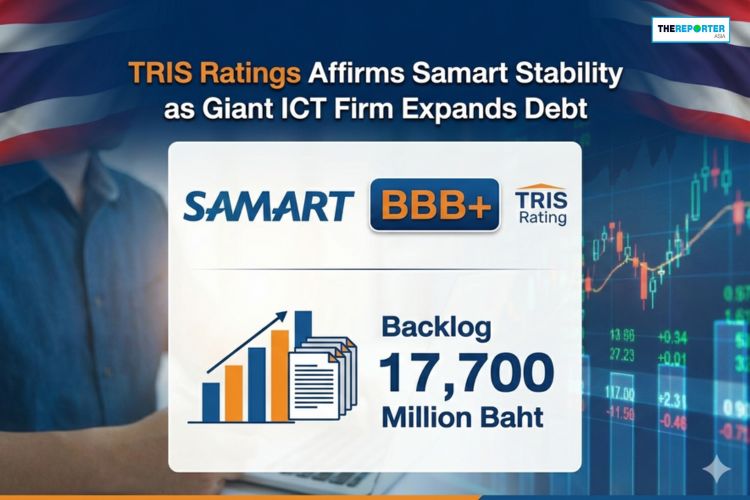
The financial landscape of Thailand’s technology sector witnessed a significant development this week as Samart Corporation PLC (SAMART) moved to strengthen its capital structure. On 19 January 2026, TRIS Rating officially assigned a “BBB” rating to the company’s latest proposal for senior unsecured debentures, which have now been upscaled to a total value of THB850 million. This strategic increase from the previously planned THB600 million highlights a bold step in the company’s financial management, reflecting a growing confidence in its ability to navigate the complex information and communication technology (ICT) market while maintaining a “Stable” outlook.
The decision to expand the issue size to THB850 million for these three-year debentures serves as a replacement for the earlier proposal announced in late 2025. According to the latest reports, SAMART intends to utilize the proceeds from this issuance primarily for debt refinancing and to bolster its working capital needs. By securing these funds, the company aims to optimize its debt profile and ensure it has the liquidity necessary to support its ongoing large-scale operations and upcoming technological initiatives in an increasingly competitive digital economy.
While the new issue has been rated at “BBB,” TRIS Rating has simultaneously affirmed SAMART’s issuer credit rating at a higher level of “BBB+”. The one-notch difference between the issuer rating and the specific debenture rating is a technical reflection of structural subordination. Because a significant portion of the group’s debt is held at the subsidiary level or tied to specific project loans, unsecured creditors at the parent company level are positioned differently in the priority hierarchy regarding asset claims.
Strategic Market Leadership and Public Sector Success
Samart Corporation continues to hold its ground as a dominant force in Thailand’s ICT industry, a position that is deeply rooted in its extensive track record of executing high-stakes public-sector projects. The company’s ability to secure and manage large-scale government contracts has provided it with a competitive edge that few peers can match. This established reputation is not merely a relic of the past but a living component of its business model, as evidenced by its robust project backlog, which stood at a staggering THB17.7 billion as of September 2025.
This massive backlog serves as a critical buffer, providing the company with solid revenue visibility for the near-term future. In the first nine months of 2025 alone, SAMART reported a total operating revenue of THB7.8 billion, a figure driven largely by the explosive growth within its digital ICT solutions business. By focusing on recurring revenue streams and digital transformation services, the company is successfully transitioning from a traditional project-based firm into a more sustainable and predictable technology powerhouse.
However, maintaining this market leadership requires constant vigilance against the intense competition that defines the modern ICT landscape. The industry is characterized by rapid technological shifts and a heavy reliance on government spending cycles, which can introduce volatility into annual revenues. To counter these inherent risks, SAMART has implemented effective cost-management strategies and focused on high-margin recurring income, which helped push its EBITDA to THB1.9 billion in the first three quarters of 2025, excluding one-time extraordinary items.
A Sound Financial Profile and Prudent Leverage Management
The financial health of Samart Corporation remains a cornerstone of its “BBB+” issuer rating, characterized by a low-debt capital structure that has improved significantly over recent periods. As of September 2025, the company’s adjusted debt was recorded at a modest THB2.5 billion. This lean debt profile resulted in a debt-to-EBITDA ratio of just 0.9 times, a metric that signals high financial flexibility and a strong capacity to meet its obligations even in fluctuating market conditions.
Looking ahead, analysts expect SAMART to maintain this disciplined approach to leverage. Projections for the next three years suggest that the company’s debt-to-EBITDA ratio will likely remain below the 1.5 times threshold, well within the safety zone for investment-grade issuers. This conservative fiscal management is vital as the company explores new growth initiatives that may require additional capital investment. The “Stable” outlook assigned by TRIS Rating is a testament to the belief that SAMART can balance its expansion goals with financial prudence.
Despite these strengths, the company must manage the “structural subordination” of its unsecured debt. Currently, approximately 74% of the group’s total debt consists of priority obligations, including subsidiary-level loans and secured project financing. This exceeds the 50% threshold typically used by rating agencies to evaluate the disadvantage faced by unsecured creditors. While the overall debt level is low, this concentration of priority debt is the primary reason why the specific debenture rating is “BBB” while the corporate entity itself enjoys a “BBB+” status.
Navigating Industry Risks and Future Sensitivities
While the current outlook for Samart is positive, the technology sector is never without its challenges. The company’s heavy involvement in public sector projects means its performance is closely tied to government budgets and the timing of national infrastructure rollouts. Any significant delays in project auctions or shifts in government policy could impact the realization of the THB17.7 billion backlog. Furthermore, the intense competition from both local and international ICT providers puts constant pressure on profit margins.
TRIS Rating has outlined clear boundaries for SAMART’s credit future, noting that the ratings could be revised downward if operating performance were to deteriorate significantly. A key trigger for a potential downgrade would be a debt-financed investment that causes the debt-to-EBITDA ratio to exceed 3.5 times for an extended period. This highlights the importance of the company’s current strategy to keep leverage low while slowly building its recurring income base to mitigate the “lumpiness” of project-related cash flows.
Conversely, while the outlook is stable, a rating upgrade is considered unlikely in the medium term as the company continues to navigate its current debt structure and market risks. The focus for stakeholders in 2026 will be on how effectively SAMART utilizes the new THB850 million in funding to drive its digital ICT solutions and whether it can maintain its lean leverage metrics. For now, the combination of a massive backlog and a disciplined balance sheet suggests that SAMART is well-positioned to remain a titan in Thailand’s technological evolution.
#SamartCorporation, #TRISRating, #ICTBusiness, #ThaiEconomy, #Debentures, #CorporateFinance, #TechNews2026, #InvestmentThailand