


The digital landscape of Southeast Asia is witnessing a seismic shift as major telecommunications players transition from passive service providers to active guardians of national security. In a landmark operation that underscores the power of advanced network analytics, True Corporation has spearheaded a high-stakes crackdown on illegal cross-border internet relays.
This operation, centered in the strategically sensitive Mae Sot district, marks a significant victory in the ongoing war against call center scam networks that have long plagued the region’s economy and digital trust. By leveraging cutting-edge surveillance technology, the initiative has not only dismantled a physical hub of criminality but has also set a new global benchmark for corporate responsibility in the digital age.
The sophisticated operation reached its climax on March 5, 2026, when a joint force comprising True Corporation, the Anti-Online Scam Center (ACSC) under the Central Investigation Bureau (CIB), and the Office of the National Broadcasting and Telecommunications Commission (NBTC) descended upon a suspicious site in Tak province. This wasn’t merely a random inspection; it was the result of a meticulously planned intelligence-gathering phase driven by artificial intelligence and data-driven network monitoring. The target was a facility in the Mae Tao subdistrict, positioned precariously close to the Thailand-Myanmar border along the Moei River, a known hotspot for grey-zone activities.
For the international business community, this move signals Thailand’s unwavering commitment to a “Clean Network” policy. As cybercrime becomes more organized and technologically advanced, the collaboration between private telco giants and state law enforcement provides a blueprint for regional security. This operation highlights the increasing necessity for cross-border cooperation and the integration of AI in infrastructure management—a trend that offers fertile ground for international tech partners specializing in cybersecurity and forensic data analytics. The message is clear: Thailand’s digital borders are no longer porous, and the infrastructure supporting its economic growth is being shielded with military-grade precision.
The Dawn of AI-Driven Surveillance in Telecom Infrastructure
The genesis of this successful raid lies in the “invisible” layer of True Corporation’s network management. Unlike traditional law enforcement methods that rely heavily on physical informants, this investigation was triggered by “Network Analytics Technology,” which detected abnormal traffic patterns that deviated sharply from standard human behavior. True’s surveillance systems identified two corporate subscribers at a single location whose data consumption profiles raised immediate red flags. While the initial installation appeared routine, the subsequent shift in usage patterns provided the digital “smoking gun” needed to alert the authorities.
Data collected between February 22 and 25, 2026, revealed a staggering surge in internet traffic that remained at peak levels 24 hours a day. Standard office operations typically exhibit a “heartbeat” pattern—high usage during business hours and significant idle periods at night. However, the Mae Sot location showed virtually no idle time, indicating that the high-speed circuits were being utilized by automated systems or high-intensity relay nodes. This continuous high-load utilization, coupled with the site’s geographic proximity to the Moei River, suggested that Thai internet connectivity was being siphoned across the border into Myanmar to fuel illicit activities.
This proactive approach aligns Thailand’s telecommunications sector with global standards like those seen in the European Union and North America, where “duty of care” for ISPs is becoming a regulatory staple. For foreign investors and technology partners, this creates an opening for the deployment of advanced Deep Packet Inspection (DPI) tools and AI-led anomaly detection software. The success of True’s internal monitoring demonstrates that the next generation of telecommunications revenue won’t just come from selling bandwidth, but from the high-value security and integrity services that protect the ecosystem from systemic risks.
Dismantling the Shadow Relay: Technical and Physical Evidence
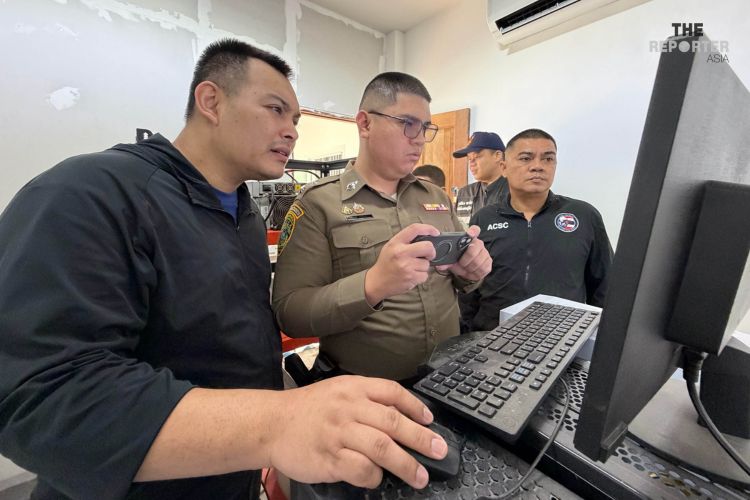
When the joint task force, including representatives from the CIB’s Technology Crime Division and the NBTC’s Telecommunication Enforcement Bureau, finally entered the suspected premises, the physical reality matched the digital evidence. The building, which had been under surveillance for lacking regular occupants, was found to be little more than a hollow shell designed to house high-tech machinery. Inside, investigators discovered large network equipment racks that had been extensively modified. These modifications included the integration of specialized gateway devices and network management tools that were not part of any standard service provider package.
The technical configuration of the seized equipment confirmed that the facility had been converted into an illegal internet relay node. By receiving high-speed signals from within Thailand and re-transmitting them across the Moei River, the operators were essentially providing a “digital lifeline” to call center scam networks operating in areas outside of Thai jurisdiction. This setup allowed scammers to utilize Thai-based internet footprints, making their fraudulent activities harder to track and more convincing to victims who might see local network origins. Following the search, the illegal equipment was seized, and the network circuits were immediately terminated to sever the link.
From a policy and regulatory perspective, this case serves as a stern warning to any entity—domestic or foreign—operating near Thailand’s borders. The NBTC has made it clear that geographic proximity to frontiers is now considered a high-risk factor that triggers enhanced regulatory scrutiny. For international firms looking to establish border-area logistics or data facilities, strict adherence to network installation regulations is non-negotiable. The collaboration between Pol. Lt. Col. Trin Leelanuch of the CIB and Mr. Suteera Puengtham of the NBTC illustrates a unified front where technical evidence from a private provider leads directly to criminal prosecution.
Strategic Implications for the Thai Economy and Foreign Partners
The economic fallout from call center scams is measured in billions of baht, affecting not just individual savings but the overall confidence in Thailand’s digital economy. True Corporation’s Chief Regulatory and Government Relations Officer, Mr. Chakkrit Urairat, emphasized that this case is a prime example of how technology can reduce public risk from online crimes. By actively monitoring and reporting suspicious usage, True is protecting the integrity of the national telecom infrastructure, which is a prerequisite for attracting high-value foreign direct investment in the tech sector.
Beyond the raid, the company is doubling down on its “CyberSafe” initiatives, which include AI-driven risk assessment for SIM card registration and free cybersecurity services for its millions of subscribers. These services, which block malicious links and alert users to scam calls without the need for additional apps, represent a significant move toward consumer-centric security. This creates a vibrant marketplace for global cybersecurity firms to partner with Thai telcos, offering everything from real-time threat intelligence feeds to advanced biometric verification systems for SIM registration.
The vibrancy of Thailand’s telecommunications industry is currently defined by this synergy between aggressive enforcement and technological innovation. For the global community, the Mae Sot operation is a signal that Thailand is an “active” participant in the global fight against cybercrime, rather than just a passive victim. The ongoing pursuit of suspects and the tightening of regulatory measures ensure that the industry remains robust, transparent, and ready for the next wave of digital transformation. This environment provides a secure foundation for international networking events and trade shows to showcase Thailand as a regional hub for secure digital infrastructure.
#Cybersecurity, #TrueCorp, #NBTC, #CIB, #AntiScam, #MaeSot, #DigitalEconomy, #TelecomLaw, #TechInnovation, #ThailandBusiness2026