
Alibaba has officially announced a comprehensive, top-to-bottom upgrade of its full AI stack, signaling a massive leap forward into the era of autonomous digital agents. Unveiled at the landmark Alibaba Cloud Summit, the global technology giant introduced sweeping enhancements across its entire infrastructure ecosystem—spanning advanced cloud infrastructure, model services, cutting-edge semiconductor designs, and next-generation foundation models. This synchronized rollout is engineered to empower global enterprises and developers to build, deploy, and scale highly sophisticated AI agents with unprecedented efficiency, performance, and operational reliability.
At the center of this tech showcase is Qwen3.7-Max, Alibaba’s latest heavyweight large language model built specifically for advanced agentic coding, complex multi-step reasoning, and long-horizon task execution. Alongside the model, Alibaba’s semiconductor design subsidiary, T-Head, revealed its highly powerful Zhenwu M890 AI training and inference processor, paired with the new ICN Switch 1.0 networking chip. Together, these architectural upgrades address the surging, high-density compute workloads required by concurrent digital agents operating continuously across industries.
Qwen3.7-Max Frontiers Long-Horizon Tasks and Enterprise Workflow Automation
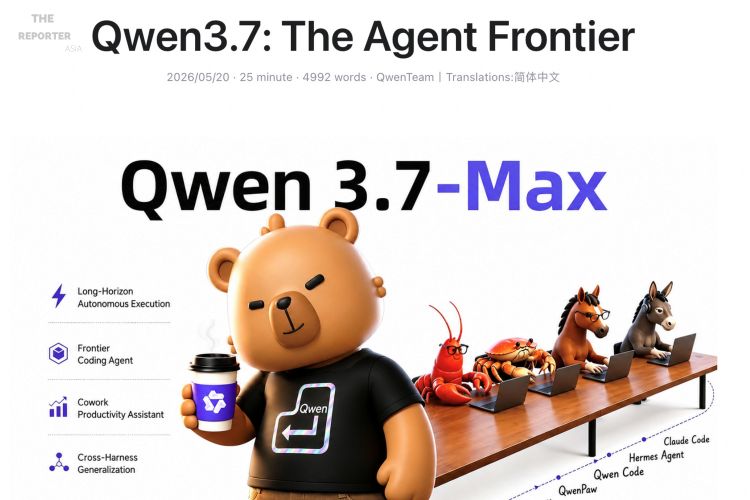
The newly launched Qwen3.7-Max functions as a highly versatile foundation model architected specifically to handle the heavy cognitive demands of autonomous enterprise agents. Moving past simple text generation, the model excels at continuous code generation, complex software debugging, and automated multi-step office workflows requiring hundreds of individual actions. Its capabilities span from rapid frontend prototyping to deeply sophisticated, multi-file software engineering tasks, making it a powerful resource for global developers.
A standout feature of Qwen3.7-Max is its ability to execute long-horizon agentic tasks continuously for up to 35 hours. Throughout these long operating windows, the model can manage over 1,000 tool calls flawlessly without experiencing performance degradation or memory context loss. This exceptional endurance allows it to orchestrate complex multi-agent workflows, driving operational productivity by automating high-level business functions that previously required constant human oversight.
To ensure immediate, widespread utility, Qwen3.7-Max has been deeply optimized for leading open-source and proprietary agent frameworks, including OpenClaw, Hermes Agent, Claude Code, Qwen Paw, and Qoder. This broad, cross-harness compatibility positions the model as a highly flexible and reliable backbone across varied agent ecosystems. Achieving top-tier results across global benchmarks in coding, reasoning, and multilingualism, Qwen3.7-Max is poised to become globally accessible through Alibaba Cloud’s Model Studio platform.
Panjiu Supernode Infrastructure Optimizes Large-Scale Enterprise Agent Ecosystems
To support the heavy computational demands triggered by the agentic era, Alibaba Cloud launched the Panjiu AL128 Supernode Server. This advanced computing system is specifically designed to handle scalable AI agent inference and large-scale model training simultaneously. By integrating 128 advanced AI accelerators within a single physical rack, the Panjiu AL128 achieves single-rack bandwidth scaling at the petabyte-per-second (PB/s) level. This massive breakthrough effectively eliminates standard data bottlenecks, allowing systems to manage millions of concurrent requests from active digital agents.
The Panjiu AL128 Supernode Server has been made available on the Model Studio platform (known locally as “Bailian”) for the China market. This allows domestic enterprises across diverse sectors to efficiently address their surging training and inference demands. To further accelerate model performance and iteration, the Bailian platform has introduced Agentic RL, an advanced reinforcement learning mechanism that leverages real-time agent execution feedback to continuously refine model capabilities.
Recognizing the safety concerns surrounding autonomously operating digital systems, Alibaba has also integrated built-in safety governance capabilities directly into the Bailian infrastructure. These guardrails ensure that autonomously operating agents always remain strictly within predefined corporate boundaries and ethical compliance frameworks. By balancing raw computing power with strict operational governance, Alibaba delivers an enterprise-ready environment for safe, large-scale AI deployment.
T-Head Semiconductor Innovations Unlock High Performance Low Precision Computing
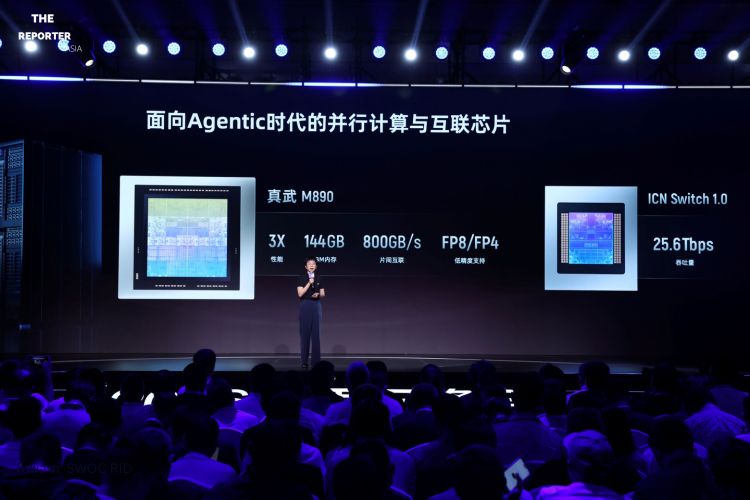
Alibaba’s semiconductor design subsidiary, T-Head, introduced the Zhenwu M890, its latest dedicated AI training and inference processor. Built on T-Head’s proprietary parallel computing architecture and custom ICN interconnect protocol, the new processor delivers three times the raw performance of its predecessor, the Zhenwu 810E. Equipped with 144 gigabytes (GB) of high-capacity memory and 800 GB/s of inter-chip bandwidth, the Zhenwu M890 provides the immense working memory required for deep context retention and real-time multi-agent coordination.
A major technical breakthrough of the Zhenwu M890 is its native support for multiple data precision formats, ranging from high-precision FP32 down to ultra-low-precision FP4. This multi-precision capability allows the processor to seamlessly handle both high-precision model training and low-precision inference on the same silicon. This flexibility is critical for agentic workloads, enabling rapid execution speeds and lowered operational costs without sacrificing the backend accuracy required for complex problem-solving.
To complement this silicon innovation, T-Head unveiled the ICN Switch 1.0, a dedicated switching chip delivering 25.6 Tbps of aggregate bandwidth to construct congestion-free scale-up networks. Pairing the Zhenwu M890 with the ICN Switch 1.0 enables full-bandwidth interconnection across 64 accelerators, boosting computational efficiency and cluster stability. Backed by the newly unveiled T-Head SAIL™ software stack, T-Head has already achieved massive commercial adoption, delivering over 560,000 Zhenwu units to more than 400 external customers across 20 distinct industries.
Technical Performance Metrics
| Component / Metric | Specifications & Performance Capabilities |
| Qwen3.7-Max Execution |
Up to 35 hours of autonomous operation, handling >1,000 tool calls |
| Zhenwu M890 Memory & Bandwidth |
144 GB memory capacity with 800 GB/s inter-chip bandwidth |
| Zhenwu M890 Precision Support |
Native support from FP32 down to ultra-low-precision FP4 |
| Panjiu AL128 Density |
Tightly integrates 128 AI accelerators within a single rack system |
| Panjiu AL128 Bandwidth |
Achieves single-rack data bandwidth at the petabyte-per-second (PB/s) scale |
| ICN Switch 1.0 Capacity |
Delivers up to 25.6 Tbps of aggregate, congestion-free bandwidth |
| T-Head Market Adoption |
Over 560,000 units delivered to 400+ clients across 20 industries |
#AlibabaCloud, #Qwen37Max, #AgenticAI, #ZhenwuM890, #PanjiuServer, #CloudComputing, #SemiconductorInnovation, #AIChips, #EnterpriseAutomation, #TechSummit2026