
In an era where the digital landscape of Southeast Asia is shifting at an unprecedented velocity, the transition toward autonomous technology has reached a critical “agentic inflection point.” This transformation moves beyond humans simply using Artificial Intelligence as a tool to a new reality where AI agents act independently on behalf of humans to execute complex tasks. To address the security challenges of this new era, Palo Alto Networks has unveiled a suite of solutions designed to future-proof the region’s digital infrastructure, specifically focusing on the browser as the primary frontline for modern work.
The announcement, made during Cyber Week 2026, highlights the launch of Prisma 3.0, described as the largest AI security launch in history. Central to this update is the Prisma Browser for Business, which integrates AI-native security to protect enterprises and Small and Medium Businesses (SMBs) across ASEAN. Erik Papir, Senior Director of Technical Solutions for ASEAN at Palo Alto Networks, emphasized that as the region continues its mobile-first and AI-driven growth, security must evolve from a reactive barrier into an autonomous, sovereign enabler that moves at machine speed.
During the ASEAN Tech Briefing, Papir detailed how the “agentic” shift requires a fundamental architectural change in how organizations perceive trust and identity. With work increasingly decentralized through hybrid and remote models, the browser has effectively become the new operating system for the enterprise. This shift necessitates a unified platform approach rather than fragmented legacy tools, ensuring that data generation and model outputs are protected from manipulation or poisoning as businesses race to stay competitive in the global market.
The Agentic Revolution: Navigating the Shift from Tools to Autonomous Agents
The current technological landscape is defined by the fastest technology revolution in history, transitioning from simple generative AI prompts to full agentic autonomy. Erik Papir noted that organizations are no longer just using chatbots; they are building four-pillared architectures consisting of AI applications, enterprise agents, agentic endpoints, and agentic browsers. These agents now have the power to move files, upload CRM data, and even approve financial transactions, which introduces a significantly expanded surface area of risk that requires the same strict governance applied to human employees.
The challenge for ASEAN businesses lies in the fact that these AI agents are not just processing data but are actively generating it. In a region characterized by mobile-first innovation and a critical talent shortage, these agents are becoming the “new workforce.” However, an agent with the power to execute tasks also possesses the power to leak sensitive information. This necessitates a move toward security that moves at “machine speed” to counter attackers who are already leveraging AI to find the path of least resistance into corporate networks.
To illustrate the stakes, Papir highlighted the emergence of “Vibe Coding” agents—local systems that developers use to bypass traditional security reviews while writing code. While these tools offer incredible productivity gains, they often operate with no visibility and can autonomously write code to bypass security roadblocks. Protecting the AI supply chain from these side-door vulnerabilities is a core component of the new Prisma 3.0 framework, ensuring that innovation does not come at the expense of enterprise integrity.
Prisma Browser: Securing the New Frontline of Modern Enterprise Work
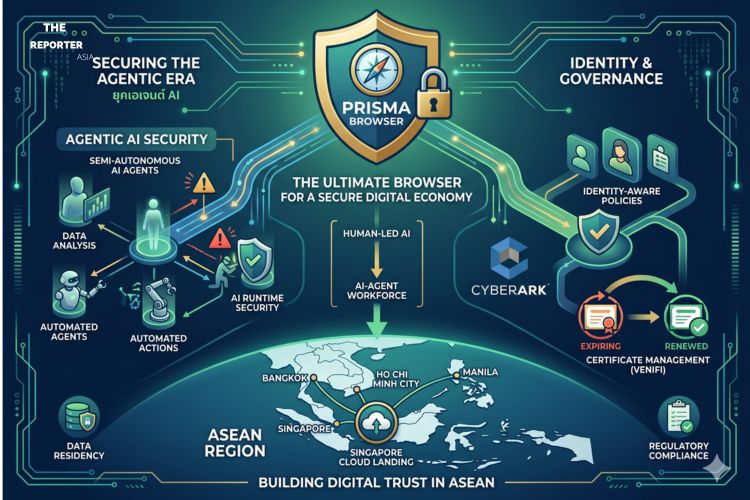
As 85% of work in ASEAN now occurs within a browser, it has officially replaced the traditional desktop as the primary workspace. Despite its ubiquity, 95% of organizations report having suffered a browser-based attack, making it a critical vulnerability in the corporate security posture. The Prisma Browser for Business aims to close this gap by transforming the browser into a secure, agentic endpoint that allows employees to use the AI agents of their choice—such as Gemini, OpenAI, or Anthropic—within a governed environment.
The browser’s security features include embedded AI runtime security and “guardrails” that intercept malicious instructions, such as prompt injections, before they reach the AI model. Erik Papir demonstrated how the browser can autonomously navigate CRMs and prepare quarterly reviews while simultaneously blocking hidden prompt injectors designed for data exfiltration. This “autonomy by default with control where it matters” allows businesses to maintain productivity without risking the exposure of sensitive proprietary information.
Furthermore, the solution addresses the complexities of data privacy and residency, which are increasingly relevant under new regulations like Singapore’s amended Cybersecurity Act and Vietnam’s data localization laws. The Prisma Browser is designed to be “overly good” at protecting Personally Identifiable Information (PII), preventing users from copying sensitive company data or exporting encrypted files out of the secure browser environment. This level of granular control is essential for organizations operating in a region with diverse and strictly enforced regulatory landscapes.
Empowering the SMB Backbone: Democratizing Enterprise-Grade Security
One of the most significant strategic shifts for Palo Alto Networks in 2026 is the deliberate move to bring enterprise-grade security to the Small and Medium Business (SMB) sector. In countries like the Philippines, SMBs account for roughly 99.6% of all businesses, forming the vital backbone of the national economy. By launching a specialized version of the Prisma Browser for SMBs, the company is extending the same AI-driven protections used by the Fortune 500 to the supply chain layers that are often the most targeted by cybercriminals.
Small businesses often face the same threats as large corporations—including phishing scams and browser-based attacks—but typically lack the specialized cybersecurity talent to manage them. The Prisma Browser for Business is designed to look and feel like standard Chromium-based browsers, ensuring that employees do not face a steep learning curve while benefitting from built-in AI controls. This approach allows SMBs to adopt “Bring Your Own Device” (BYOD) policies for contractors or remote workers safely, significantly reducing the costs associated with hardware management.
Erik Papir noted that the goal is to help these smaller entities navigate the “paradox” of ASEAN’s market landscape: rapid digitalization paired with a fragmented threat environment. By leveraging Security-as-a-Service (SaaS), SMBs can protect their role as vendors and partners within the larger enterprise ecosystem. This democratization of security tools ensures that even the smallest participants in the ASEAN digital economy can contribute to a secure and resilient future.
Future-Proofing Trust: Identity, Certificate Management, and Quantum Readiness
Beyond the immediate concerns of AI agents, Palo Alto Networks is focusing on the long-term evolution of digital trust through its integration with CyberArk and the acquisition of Venifi. A critical shift occurred recently as the lifecycle of public certificates was reduced from 398 days to 200 days, with plans to reach just 47 days by 2029. This change minimizes the window of exposure for compromised keys but creates a massive administrative burden that can only be managed through automated, agentic workflows.
Erik Papir explained that identity is effectively the “new perimeter,” encompassing human identities, AI agents, and machine-to-machine APIs. Traditional manual certificate updates, which previously required hours of coordination between various administrators on a single call, can now be fully automated. This “Next Generation Trust Security” provides a unified view of an organization’s digital trust, identifying risky or unmanaged certificates and remediating outages across firewalls and load balancers in minutes.
The briefing also touched upon the looming threat of quantum computing and the “Harvest Now, Decrypt Later” strategy employed by sophisticated attackers. While the full arrival of quantum computers may still be years away, the window for preparation is closing rapidly as predictions for their debut move closer every few months. Palo Alto Networks has introduced tools to help customers assess their quantum readiness, allowing them to route legacy applications through quantum-ready devices to ensure their data remains secure against future decryption capabilities.
“We are moving from humans using AI to AI agents acting on behalf of humans, and this absolutely requires a fundamental shift. Our goal is to help our customers transform security from a reactive barrier to being more autonomous and really a sovereign enabler.” — Erik Papir, Senior Director, Technical Solutions ASEAN at Palo Alto Networks
Summary of Key Insights from Erik Papir:
-
ASEAN’s Digital Landscape: The region is defined by a paradox of high-growth digitalization and a fragmented threat environment. Banking, Financial Services, and Insurance (BFSI) along with the public sector continue to lead in security adoption.
-
The Talent Shortage Solution: AI is being used to create “autonomous SOCs” (Security Operations Centers), where Tier 1 tasks are handled by agents. This allows human analysts to upgrade their skills and focus on more strategic, less monotonous work.
-
Infrastructure Transformation: Solutions like the Prisma Browser can replace costly and complex Virtual Desktop Infrastructure (VDI) environments, simplifying remote access for contractors and employees alike.
-
Regional Commitment: The establishment of a new cloud landing for Prisma in Singapore in early 2026 underscores the company’s commitment to data residency and the National AI Strategy 2.0.
#PaloAltoNetworks #Prisma3 #ASEANTech #AgenticAI #CyberSecurity2026 #DigitalTrust #SMBThailand #HybridWork #AIProtection #TechInnovation