
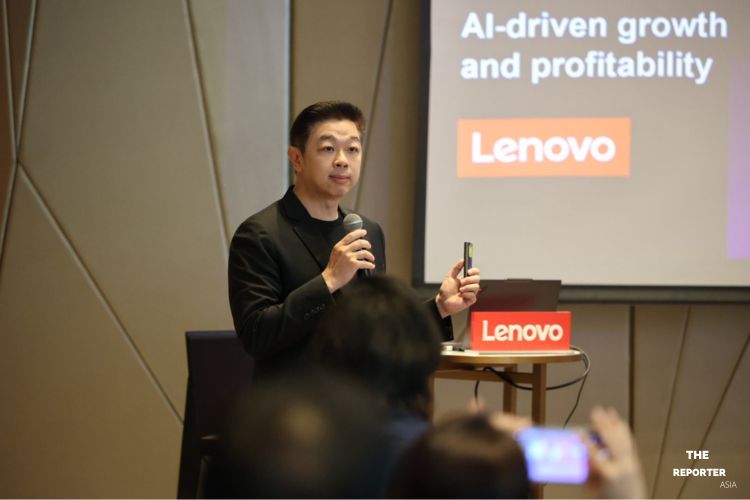
Lenovo unveiled a visionary roadmap that transitions AI from simple experimentation to tangible, high-impact implementation across both consumer and enterprise sectors. By integrating sophisticated “Agentic AI” into its core architecture, Lenovo is not merely selling hardware but is instead providing a seamless, sentient ecosystem that adapts to human intent and organizational logic.
This strategic pivot comes at a moment of unprecedented financial strength for the tech giant, which recently reported a record-breaking quarterly revenue of $22 billion, representing an 18% year-on-year increase. In Thailand specifically, Lenovo has achieved a historic 35% market share, maintaining its number one position for 12 consecutive quarters. This dominance provides the necessary capital and market confidence for Lenovo to invest over $1 billion annually in AI research and development, ensuring its “Pocket to Cloud” portfolio remains at the cutting edge of the industry .
The core of Lenovo’s new philosophy lies in the realization that AI must be personal, proactive, and pervasive. As the world moves beyond traditional chatbots, Lenovo is introducing system-level intelligence that operates across devices without the need for manual invocation or app-switching. This “Personal AI Super Agent” approach aims to elevate human potential by drawing from unique user languages, habits, and memories to boost creativity and sharpen intuition.
The Financial Powerhouse and the ROI of Innovation
Lenovo’s recent performance is a testament to its resilience and strategic foresight in an era of economic volatility. The company’s net profit surged by 36% year-on-year, driven largely by the massive adoption of AI-related products, which saw a staggering 72% growth in sales. This financial robustness is anchored by a diverse business model where every segment is thriving: the PC division grew by 14%, enterprise infrastructure by 32%, and solutions and services by 18%.
According to the 2026 CIO Playbook, a research study involving 920 CIOs across the Asia-Pacific region, there is a fundamental change in how organizations view AI investment. In 2025, many firms were in an experimental phase, but in 2026, the focus has shifted entirely to measurable outcomes and Return on Investment (ROI). Approximately 88% of CIOs now demand immediate results from their AI deployments, expecting a return of at least $2.85 for every dollar spent.
Lenovo is uniquely positioned to meet this demand by offering end-to-end solutions that simplify the transition to AI. The company has evolved from a hardware vendor into a consultancy-driven service provider, offering “TruScale” as-a-service models that allow businesses to scale their infrastructure without heavy upfront costs . This approach has been particularly successful in Thailand, where the “Device as a Service” (DaaS) and leasing sectors have seen triple-digit growth over the past two years.
Lenovo Qira: Redefining the Personal AI Experience
At the heart of Lenovo’s consumer innovation is “Lenovo Qira,” a Personal Ambient Intelligence designed to function as a single, consistent intelligence across PCs, tablets, smartphones, and wearables . Unlike traditional chatbots that require active engagement, Qira is embedded at the system level, meaning it understands the user’s context and is always present to provide support with permission . It marks a departure from app-based interactions to a “Presence-Action-Perception” model where the AI anticipates needs before they are even voiced .
Qira’s functionality is built on a fused knowledge base that combines user interactions and documents with a core commitment to privacy. It can orchestrate complex tasks across multiple applications, such as drafting emails based on local documents and scheduling meetings across different platforms, all while operating offline to ensure maximum security . This ability to work without a constant internet connection is a major differentiator, providing a 100% secure environment for sensitive personal and professional data.
During the briefing, the capabilities of Qira were demonstrated through innovative AI wearables, such as concept glasses that can “see” what the user sees and provide real-time information or meeting summaries. These devices do not just capture data; they analyze interpersonal dynamics, such as summarizing a heated debate in a meeting and automatically setting follow-up appointments based on the conclusion. This level of integration represents the transition toward “Agent-Native” devices, which Lenovo expects will constitute 50% of its product portfolio in the near future .
Enterprise Agentic AI and the Rise of the Digital Twin
For the enterprise sector, Lenovo has launched the next phase of its Hybrid AI Advantage™ through “Lenovo Agentic AI” and the “Lenovo xIQ” platform . This suite of tools is designed to help organizations create, deploy, and manage AI agents at scale, transforming businesses into “self-learning, self-reinventing entities”. By utilizing proprietary data and specific decision logic, companies can now go beyond simple workflow optimization to achieve true organizational intelligence.
The Lenovo xIQ platform is categorized into three critical domains: the Agent Platform for rapid, no-code agent creation; the Digital Workplace Platform for boosting employee productivity; and the Hybrid Cloud Platform for optimizing multi-cloud operations . The Digital Workplace solution alone has shown the potential to improve user experience by 30% while reducing IT support costs by an equal margin. This is achieved through proactive issue detection and automated remediation, allowing IT teams to resolve up to 40% of problems before the user even notices them.
Lenovo’s vision for the enterprise culminates in the “Enterprise AI Twin,” a digital mirror of an organization that allows for risk-free testing and optimization. In the healthcare sector, for instance, this technology allows for the simulation of chemotherapy effects on a “digital twin” of a patient, helping doctors determine the best course of treatment without risking the patient’s physical health . This move toward “AI Compute” as the new standard for business operations underscores Lenovo’s role as a provider of the critical infrastructure required for the next industrial revolution.
Navigating Supply Chain Constraints and Economic Headwinds
Despite the optimistic outlook on AI, the technology sector faces significant challenges, particularly regarding global supply chain shortages. Lenovo executives noted that there is currently a severe shortage of critical components, including memory (DDR RAM), SSDs, and CPUs, which has led to a significant increase in production costs. In some cases, the price of memory has skyrocketed so dramatically that it has become a more lucrative investment than gold, with specific components jumping from 2,000 baht to over 32,000 baht in less than a year .
These shortages have forced Lenovo and other industry players to adjust their pricing strategies monthly. PC prices have seen an average increase of 30%, while server costs have in some instances tripled due to the scarcity of high-performance components. However, Lenovo’s massive scale and volume-purchase power have allowed it to maintain a competitive edge and secure more supply than its rivals, helping it retain its market leadership despite these “headwinds”.
Interestingly, the rising costs have not dampened demand; instead, they have accelerated it in some sectors. Consumers and mid-sized organizations are rushing to upgrade their hardware now, fearing even higher prices in the future . This “buy now” mentality is further driven by the end of life for older operating systems like Windows 10, which forces a refresh cycle that many users are opting to fulfill with new, AI-capable PCs to ensure long-term compatibility and performance .
Sustainability and the Future of Hybrid Infrastructure
As Lenovo expands its AI capabilities, it remains deeply committed to its “Net Zero” goals for 2050. The company is implementing several initiatives to reduce its environmental footprint, such as the “Neptune Liquid Cooling” technology for servers . This innovation allows data centers to operate with significantly fewer units—reducing a 400-server setup to just 100—while increasing performance by 30% and drastically cutting heat output and power consumption .
In Thailand, institutions like Khon Kaen University are already participating in Lenovo’s carbon offset programs and utilizing sustainable procurement options . Lenovo offers organizations the ability to choose 100% recycled materials, eco-friendly shipping methods, and consolidated packaging to minimize waste. These efforts are part of a broader strategy to ensure that the AI revolution is not just powerful, but also responsible and sustainable.
Ultimately, Lenovo’s strategy for 2026 and beyond is built on the concept of “Hybrid AI,” which balances the speed of the cloud with the security and privacy of on-premise infrastructure. By providing tools that work seamlessly across these environments, Lenovo is addressing the primary concerns of modern CIOs: data security, privacy, and governance. As the official technology partner for global events like the FIFA World Cup and Formula 1, Lenovo is demonstrating that its AI infrastructure is ready to handle the world’s most demanding data challenges.
For each of us, AI will boost our creativity, sharpen our intuition, and inspire our imagination, because it now draws from our unique language, habits, experiences, and memories. This is a fundamental shift towards augmenting, elevating, and maximizing human potential. For a business, the transformation is even more profound: AI is going beyond process management and workflow optimization. It now empowers organizations to use proprietary data generated from their own operations and apply their own decision logic to become a self-learning, self-reinventing entity.
#Lenovo #AgenticAI #HybridAI #LenovoQira #AIPC #DigitalTransformation #EconomicTrends2026 #TechInnovation #SustainableTech #ThailandTech