
Thailand’s rapid AI adoption highlights an urgent shift toward human agency and Owned Intelligence as organizations strive to convert high usage into lasting strategic growth.
The Frontier Workforce Surge Across Thailand
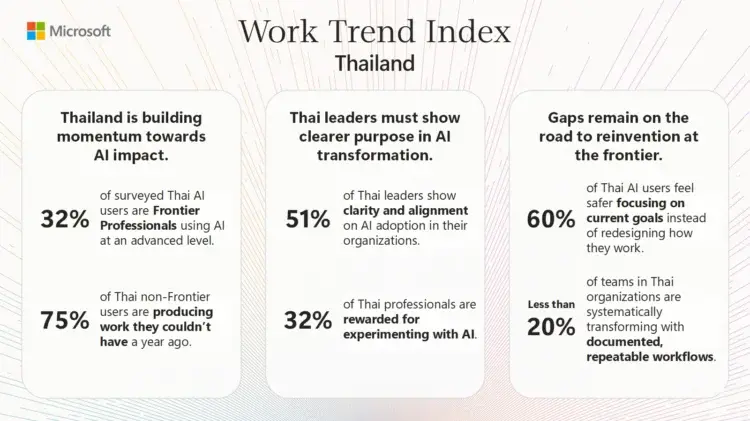
Thailand has rapidly emerged as a standout force in the regional technology landscape, significantly outstripping global benchmarks for advanced digital integration. According to the latest findings from the Microsoft Work Trend Index 2026, an impressive 32% of surveyed Thai workers are categorized as “Frontier Professionals”—advanced users who leverage artificial intelligence to execute complex tasks and innovate in their daily operations. This represents double the global average of 16%, establishing Thailand as a leading hub for grassroots technological enthusiasm. The comprehensive study combines behavioral productivity signals from Microsoft 365 with extensive global survey data spanning 20,000 users across 10 markets, offering a detailed look at how artificial intelligence is reshaping the modern workplace.
The enthusiasm among Thai employees reflects a fundamental shift in how professionals interact with digital tools, evolving from simple search operations to true cognitive collaboration. A remarkable 89% of local workers now use AI-generated outputs as a foundational launching pad to refine their ideas and spark creative thinking. Furthermore, 86% of Thai Frontier Professionals report that artificial intelligence has empowered them to produce complex deliverables that were entirely out of reach just one year ago. This rapid adoption demonstrates that the Thai workforce is ready and eager to incorporate next-generation productivity tools directly into their everyday activities.
Despite these impressive individual milestones, critical skill gaps remain when comparing Thailand to its Southeast Asian neighbors. Local professionals still require deeper cultivation in critical thinking and quality control mindsets to effectively evaluate high-level AI outputs. Only 53% of Thai workers recognize output quality control as an increasingly vital skill—placing the country fifth out of six regional peers, behind Indonesia and Vietnam at 60%. Similarly, just 45% of local respondents deem critical thinking essential when collaborating with advanced systems, ranking below regional leaders like the Philippines at 65% and Indonesia at 62%.
Overcoming the Organizational Transformation Paradox
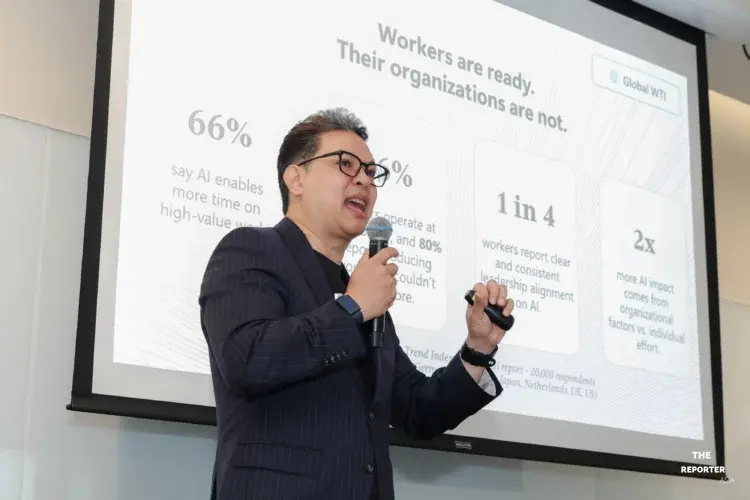
While individual enthusiasm in Thailand runs exceptionally high, most organizations struggle with a structural disconnect that prevents individual usage from scaling into institutional capabilities. Research indicates that organizational factors—including leadership vision, corporate culture, and structured talent development—exert twice the influence on overall AI success compared to isolated individual efforts. In Thailand, a stark contrast exists between ambitious top-level communication and practical, day-to-day organizational execution. While 51% of Thai employees report that their business leaders communicate a clear vision for technology adoption, only one-third of local leaders actively reward employees for experimenting without demanding immediate short-term returns.
This structural friction gives rise to what researchers call the “Transformation Paradox”. Although an overwhelming 85% of Thai workers express anxiety about falling behind without AI—far exceeding the global average of 65%—a full 60% feel safer clinging to their current routines and goals rather than redesigning their workflows. Employees fear the professional risks associated with altering legacy business processes in the absence of structured, well-documented guidance from management. Consequently, valuable frontline breakthroughs remain isolated, preventing businesses from evolving into dynamic, self-improving entities.
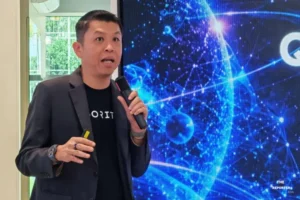
To resolve this paradox, Microsoft recommends restructuring organizations around the core concept of “Human Agency” through the deployment of autonomous AI agents. Under this collaborative operational model, specialized intelligent agents take on routine operational execution under human supervision, freeing employees to focus on critical analysis, strategic direction, and quality control. As Dhanawat Suthumpun, Managing Director of Microsoft Thailand and Emerging Markets, emphasized regarding this strategic shift:
“Thai workers are open to and ready to experiment with AI. Today, the key challenge for Thai organizations is not merely encouraging employees to use AI to boost daily productivity but leveraging AI as an opportunity to rethink and redesign workflows across the organization. Leaders must play a crucial role in determining which processes should be transformed, while bringing technology, experts, and employees together to create a new collaborative model that combines human potential with AI capabilities. When an organization can successfully transform fragmented knowledge and best practices into ‘Owned Intelligence’ that reflects their unique expertise and proprietary know-how, it becomes a strategic asset that others cannot easily replicate and serves as a vital foundation for sustainable growth in the future.”
Converting Individual Success into Owned Intelligence
The ultimate goal for forward-thinking businesses is converting individual digital fluency into proprietary organizational capability, termed “Owned Intelligence”. Currently, 8 out of 10 Thai managers actively encourage their teams to experiment with technological redesign, yet only 2 out of 10 systematically document these successes into standardized, repeatable workflows. Without formal documentation, innovative best practices remain trapped within individual departments rather than enriching the broader enterprise. Building Owned Intelligence requires converting scattered employee insights into secure, central enterprise assets that fuel long-term competitive advantage.
To facilitate this crucial evolution, the report establishes a comprehensive three-tiered roadmap spanning employees, business leaders, and enterprise architects. At the workforce level, organizations must accelerate training in critical thinking and systematic review while fostering a culture of daily experimentation. Leaders must elevate employee motivation by embedding technology transformation directly into formal job descriptions and allocating adequate time and capital for skills expansion. Finally, organizations must observe changing workflow patterns to redesign core business operations into adaptive “Learning Systems” grounded in robust safety, data transparency, and digital governance.
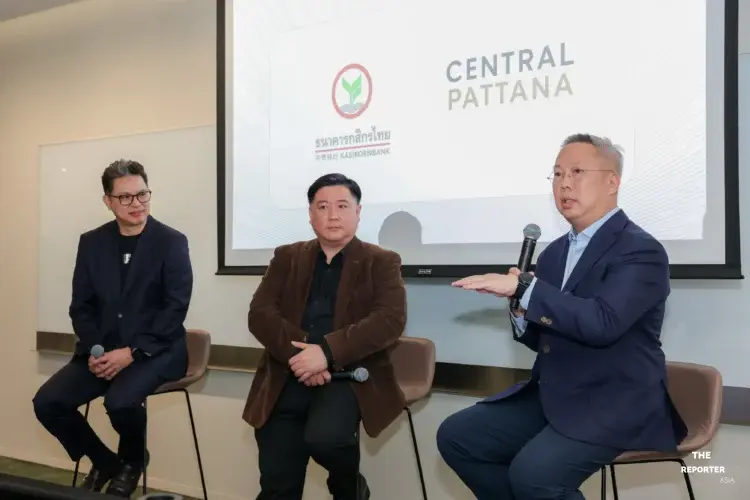
Leading Thai institutions are actively applying these concepts across their corporate structures to drive meaningful organizational growth. Kasikornbank Public Company Limited (KBank) has embraced this approach by establishing a dual-pillar enterprise strategy centered on personal empowerment and scalable organizational intelligence. Outlining how the bank aligns tools with enterprise capabilities, Dr. Tiravat Assavapokee, Executive Vice President of Kasikornbank, noted:
“KBank’s AI strategy is built on two mutually reinforcing pillars: empowering every employee with self-service AI tools to work smarter, and scaling organizational capabilities. This includes internal knowledge management, intelligent recommendations, and operational intelligence to elevate experiences for both our employees and customers at scale.”
Aligning Human Potential with Enterprise Growth
As organizations navigate this transition toward becoming true “Frontier Firms,” maintaining human-centric operational frameworks remains critical. Technology serves to amplify human potential rather than replace genuine judgment, strategic leadership, and creative problem-solving. Successful transformations balance automated background processing with accountable human oversight, ensuring that strategic direction remains firmly guided by human experience. This balanced approach allows companies to scale operations rapidly while maintaining high standards of quality control and operational integrity.
Major commercial leaders are proving that technological integration works best when centered directly on employee enablement. Central Pattana Public Company Limited (CPN) has structured its corporate evolution around this synergy, ensuring that operational technology enhances rather than dictates leadership decisions. Highlighting the central role of human governance in digital evolution, Akkarin Phureesitr, Chief People Officer of Central Pattana Public Company Limited, explained:
“The future of work is people and AI growing together. At Central Pattana, our people are shifting from doers to thinkers and decision-makers, with AI amplifying their potential. But matters of people must always be decided by people. This transformation begins with people and ends with people – and we’ll step into that future together.”
By harmonizing human potential with secure, enterprise-grade technology ecosystems, Thai companies can successfully navigate the complexities of the digital era. Moving past isolated experimentation allows organizations to capture individual innovation and build enduring Owned Intelligence. Supported by strategic guidance and clear organizational vision, Thailand’s high proportion of Frontier Professionals offers a strong foundation for sustainable growth, regional leadership, and digital competitiveness.
Tags: Microsoft Work Trend Index 2026, Thailand AI Adoption, Owned Intelligence, Human Agency, Frontier Professionals, Enterprise Digital Transformation, Business Strategy Thailand