

While Thailand’s workforce embraces artificial intelligence at record-breaking speeds, widespread structural disorganization threatens to stall real enterprise progress—a persistent operational bottleneck that Tokyo-listed Cybozu now intends to dismantle through frontline automation.
Bridging the Paradox Between AI Readiness and Foundation Data
Thailand has quietly emerged as an international frontrunner in digital technology adoption, registering the world’s second-highest workforce integration rate for artificial intelligence solutions. Local employees utilize generative interfaces and sophisticated algorithms at twice the global average rate, reflecting an extraordinary cultural willingness to pivot toward automated enterprise productivity. Yet beneath this remarkable consumer-level enthusiasm lies a deep structural dilemma across corporate systems, where fragmented workflows and legacy manual records severely handicap any sustained digital transformation initiatives.
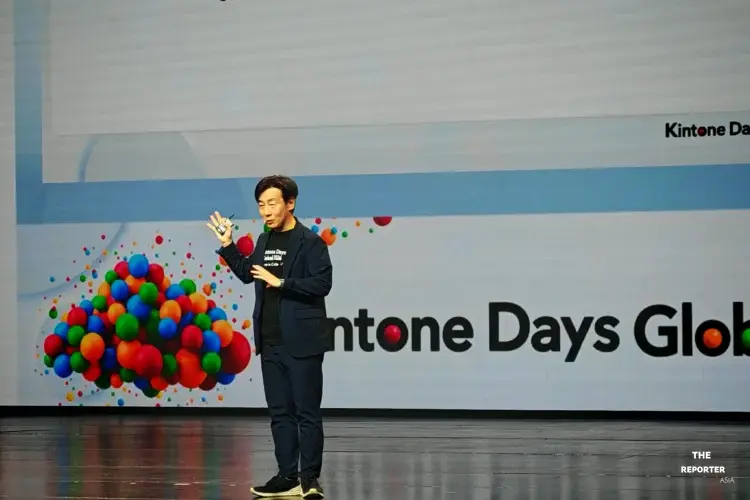
The central challenge came under rigorous examination at the Kintone Day Bangkok 2026 conference, held under the operating theme Future Proof Solution Your Way. Executives from Kintone Thailand, an operating subsidiary of Tokyo-listed enterprise software developer Cybozu Inc., detailed how enterprise artificial intelligence fails when deployed on disorganized architectures. Without structured repositories, generative models produce hallucinations or stall entirely, turning expensive computational investments into hollow novelties rather than true strategic growth engines.
Addressing corporate leaders and industry analysts at the forum, Mr. Namya Wayuparb, Managing Director of Kintone Thailand, highlighted this widening gap between technological expectation and operational reality. “The starting point for implementing artificial intelligence within an enterprise with maximum effectiveness is the ability to aggregate and process massive volumes of internal data collectively,” Mr. Namya Wayuparb explained.
“Before data reaches that advanced stage, however, an organization must achieve complete internal digitization, making our no-code platform the essential foundational infrastructure required to solve this baseline challenge.”
Democratizing Enterprise Architecture Through aPaaS No-Code Systems
Thailand’s enterprise landscape remains dominated by small and medium-sized enterprises, which collectively account for more than ninety-nine percent of all commercial entities operating within the national economy. These smaller enterprises serve as the primary engine for employment and domestic consumption, yet they struggle constantly against severe shortages of specialized software developers and technical engineers. Enterprise resource software historically priced out these growing businesses, forcing departments to manage critical supply chains, finances, and inventories through disconnected spreadsheets and physical folders.
To bridge this operational resource gap, Kintone positions its application platform as a service framework as an accessible operational bridge. The intuitive visual engine enables standard business workers across sales, accounting, and human resources to assemble enterprise-grade business applications via intuitive drag-and-drop mechanics. Frontline employees possess immediate domain mastery over their daily workflows, allowing them to construct customized customer relationship databases, inventory trackers, and approval pipelines in hours without writing computer code.
Emphasizing the foundational development philosophy of the company, Mr. Yoshihisa Aono, Chief Executive Officer of Cybozu Inc., pointed out why software simplicity dictates digital transformation success. “The single most decisive advantage of our enterprise solution is its inherent operational simplicity,” Mr. Yoshihisa Aono stated.
“Many corporations struggle with extreme operational complexity caused by purchasing disparate standalone software tools that leave frontline workers utterly confused, whereas centralizing business applications on an adaptable single database framework enables agile organizational management where every employee becomes their own system developer.”

Integrating Autonomous AI Agents Inside Enterprise Security Guardrails
The primary technical milestone unveiled during the conference centered on the regional rollout of Kintone AI, alongside its next-generation functional AI Agent component. Moving past passive prompt-and-response windows, the autonomous system interprets plain conversational human requests to independently organize operational forms, cross-check internal inventory data, and draft sales quotations. Furthermore, the autonomous agent synthesizes complex daily operational logs into multilingual briefing notes, facilitating smooth cross-border communication between domestic branch managers and foreign corporate executives at overseas parent headquarters.
Data governance and trade secret leakage remain major apprehensions preventing risk-averse enterprise boards from adopting public generative tools. Direct interactions with third-party foundation models expose corporate payrolls, supplier contracts, and client lists to potential data leaks and severe compliance infringements. The Kintone AI environment handles these vulnerabilities by enforcing granular, role-based permission controls, ensuring sensitive internal records remain sandboxed within enterprise firewalls before algorithmic interpretation occurs.
Illustrating this balance between algorithmic power and structured operational governance, Mr. Namya Wayuparb drew an analogy comparing computational models to high-powered transportation equipment. “A large language model is very much like a high-performance vehicle engine, yet an engine alone cannot transport passengers safely toward an intended destination,” Mr. Namya Wayuparb noted.
“Kintone functions as the protective body, structural chassis, and steering system that harnesses raw engine power, grounding advanced computation within actual workflows to ensure the enterprise advances securely and with unmistakable precision.”
Expanding Commercial Footprint Through Tier-One Partnership Networks
Kintone Thailand has outlined an aggressive commercial roadmap, setting an explicit target to scale its active client portfolio to one thousand enterprise organizations within three years, by the conclusion of 2028. The software provider spent the past six years methodically diversifying its regional user community across Southeast Asia, shifting from an initial Japanese corporate enclave to an evenly split customer profile where domestic Thai firms represent fifty percent of current deployments. This expansion makes Thailand the single largest active enterprise user market for Cybozu across the wider Asia-Pacific territory.
To accelerate its market penetration across key economic sectors, Kintone announced a formal Tier 1 commercial partnership with TWS Company Limited, a prominent enterprise systems integrator. The collaborative agreement focuses directly on delivering end-to-end implementation support, technical staff training, and bespoke system integration for industrial manufacturing operations, commercial services, tourism groups, and hospitality operators. By collaborating with an experienced systems integrator, Kintone ensures local companies overcome transition friction through tailored migration roadmaps and localized operational support.
Complementing this tier-one channel partnership, Kintone plans to double its local workforce this year while rolling out dedicated regional pricing structures set at sixteen dollars per user monthly, with an accessible minimum threshold of five users. By marrying affordable pricing frameworks with powerful no-code infrastructure and governed autonomous agents, the enterprise aims to guide Thailand’s small and medium-sized enterprises toward a competitive, secure, and digitally empowered future.
#Kintone #Cybozu #KintoneDayBangkok2026 #NoCode #AIAgent #DigitalTransformation #SMEThailand #TechNews #EnterpriseSoftware #TheReporterAsia