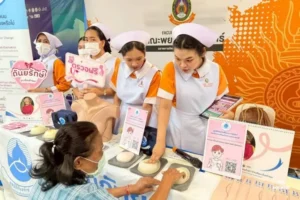


Thailand’s Department of Health, under the Ministry of Public Health, is preparing to launch PCC Connect, a digital preconception care initiative linking community health networks directly to hospitals, alongside cross-ministry welfare measures to address the country’s lowest birth rate in 75 years. The project, operating under the concept Every Birth Matters, will officially debut on November 26, 2026, at The Four Wings Hotel in Bangkok.
Addressing the Demographic Shift and Young Generation Mindset
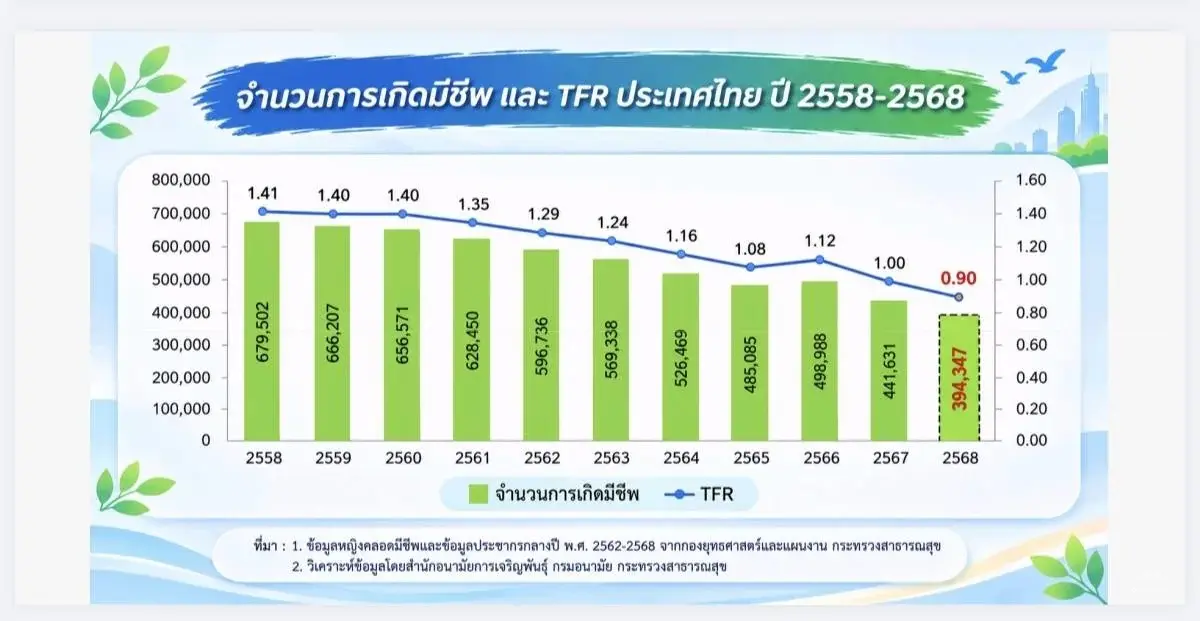
Thailand is facing a severe demographic transition toward an inverted population pyramid. Data analyzed by the Bureau of Reproductive Health shows that live births dropped steadily from 679,502 in 2015 to just 394,347 in 2025, marking a 75-year low. During the same period, the Total Fertility Rate (TFR) fell from 1.41 to 0.90, well below the replacement level and outpaced by annual deaths approaching 600,000.
Dr. Thiti Sawaengtham, Director-General of the Department of Health, explained during a press briefing that although 63% of Thai women of reproductive age (19–49 years) still wish to have children, the actual number of Thai-citizen newborns is even lower than the headline figure of roughly 370,000 to 390,000 because the count includes births to migrant workers in Thailand. He warned that if this trend persists for another 15 to 20 years, Thailand’s population could shrink by half, eroding the working-age base needed to drive Gross Domestic Product (GDP) and potentially forcing the retirement age up to 70 or 75—similar to Japan and Singapore—to offset rising healthcare costs for the elderly.
According to Dr. Thiti, the reluctance among younger generations stems primarily from a mindset shift driven by financial burdens, time constraints in child-rearing, and fears of career disruption that often force mothers to resign. Physical exhaustion from inadequate rest and exercise, combined with chronic stress, has further complicated conception and increased risks of miscarriage and premature birth.
Cross-Ministry Collaboration and Workplace Welfare Initiatives
To alleviate these socioeconomic pressures, the government is mobilizing an integrated cross-ministry effort. Sophon Saram, President of the National Assembly and Speaker of the House of Representatives, is serving as a key coordinator connecting the Ministry of Public Health, the Ministry of Interior, the Ministry of Social Development and Human Security (MSDHS), the Ministry of Education, and the Social Security Office. Together, these agencies are reviewing expanded child subsidies, tax deductions, and housing incentives for families with children.
Within its own facilities, the Department of Health is piloting workplace welfare models, including on-site daycare centers that enable parents to bring their children to work and nurse or feed them during lunch breaks without leaving their jobs. The department also operates a cold chain breast milk delivery program, allowing mothers working in Bangkok to pump and safely transport milk to their infants living in provinces such as Khon Kaen. Additionally, health officials are working with community and religious leaders in southern Thailand across Health Regions 11 and 12 to dispel misconceptions that iron and folic acid supplements cause excessive fetal growth and difficult deliveries.
Digital Integration with Mor Prom and Proactive Genetic Screening
Alongside economic support, PCC Connect establishes a seamless Preconception Care framework utilizing Village Health Volunteers (VHVs), Subdistrict Health Promoting Hospitals (SHPH), and primary care units as frontline touchpoints to identify and counsel couples planning a family. Services span fertility counseling, ovulation tracking, and assisted reproductive technologies.
Rather than introducing a standalone application, Dr. Thiti noted that PCC Connect integrates Personal Health Records directly into the Ministry of Public Health’s central Mor Prom platform. Protected by two-factor authentication and Personal Data Protection Act (PDPA) cybersecurity standards, the system transmits screening data from local clinics to destination hospitals to eliminate redundant blood tests. During the transition phase, the digital platform will operate in a hybrid model alongside the traditional maternal and child health handbook (Pink Book).
Couples enrolled in the program receive comprehensive screenings for chronic illnesses and genetic conditions, notably thalassemia carrier status—where two carrier parents face a 1-in-4 risk of having a child with the full disease—as well as Down syndrome risk assessments for older mothers, gestational diabetes management, and 2Q Plus mental health screenings. The initiative also incorporates precision medicine protocols, including BRCA1 and BRCA2 genetic cancer screenings, covered under the Universal Coverage Scheme, Social Security, and Civil Servant Medical Benefit Scheme.
12-Province Pilot and Long-Term Fertility Targets
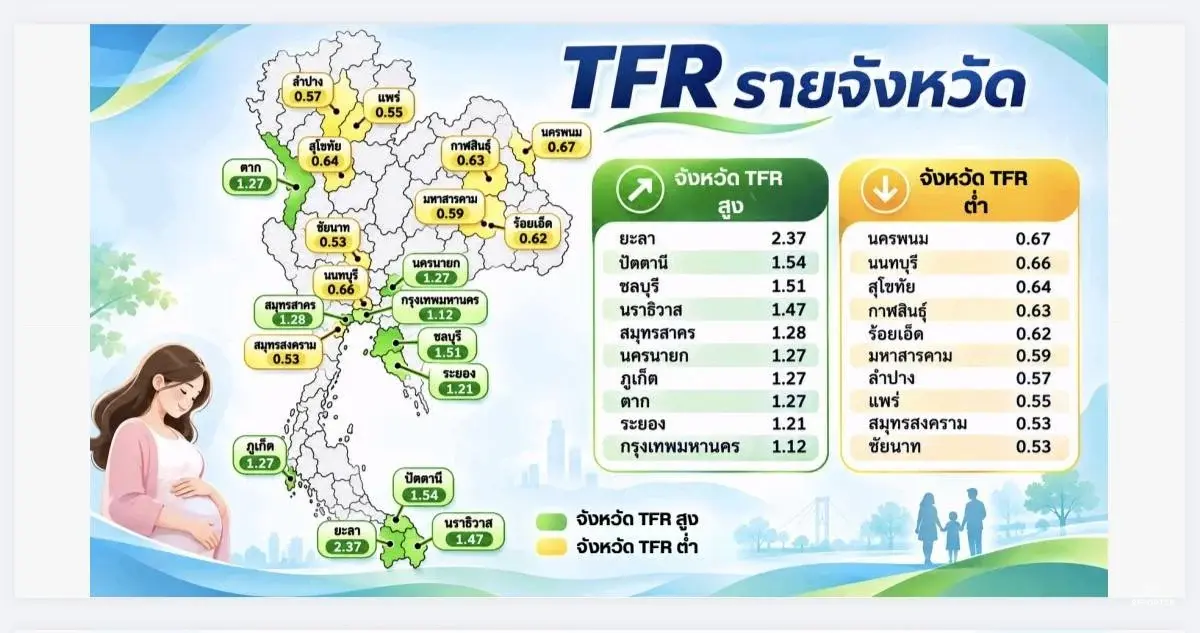
In its initial rollout, the Department of Health has selected 12 pilot provinces spanning all 12 health regions: Chiang Rai, Sukhothai, Kamphaeng Phet, Nakhon Nayok, Samut Songkhram, Chanthaburi, Kalasin, Bueng Kan, Buriram, Yasothon, Nakhon Si Thammarat, and Trang. Selections prioritized readiness and demographic urgency, particularly in provinces like Samut Songkhram, which shares the nation’s lowest provincial TFR at 0.53 alongside Chainat, followed by Phrae (0.55), Lampang (0.57), and Maha Sarakham (0.59).
Dr. Pakorn Tungkasereerak, Deputy Director-General of the Department of Health, stated that the program targets four core outcomes: increasing couple enrollment in preconception care, reducing premature births, lowering the rate of newborns weighing under 2,500 grams, and minimizing congenital disabilities. The long-term objective is to raise Thailand’s TFR to between 1.5 and 2.0. While broader demographic shifts will require 5 to 10 years to materialize, officials expect higher proactive screening participation within the first 1 to 2 years following the November 26, 2026 launch.
#DepartmentOfHealth #PCCConnect #ThailandDemographics #PublicHealth #DigitalHealth #MaternalHealth #TheReporterAsia