

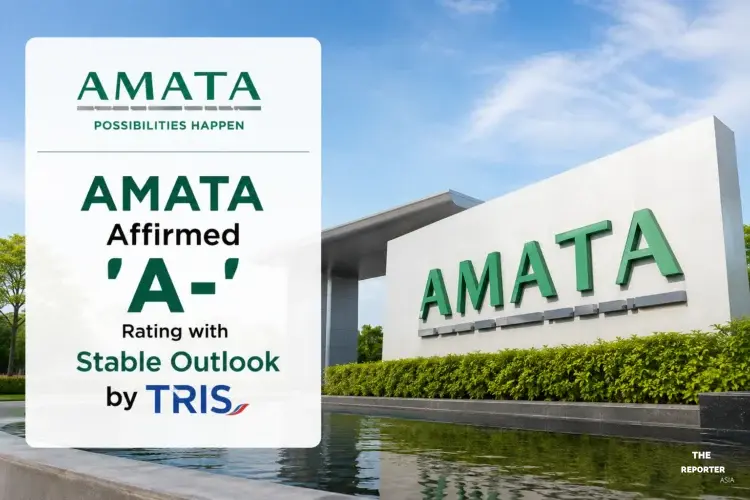
TRIS Rating affirms AMATA’s issuer credit rating at ‘A-‘ with a stable outlook, driven by strong land backlog and recurring income.
TRIS Rating has affirmed the issuer credit rating on Amata Corporation PLC (AMATA) and the ratings on its senior unsecured debentures at “A-” with a “Stable” rating outlook. The rating status reflects the company’s established position as a leading industrial estate developer in Thailand. Its overall credit profile continues to be supported by a substantial stream of recurring income from utility services, along with consistent dividend yields from its joint power plant investments.
The company benefits from high revenue visibility provided by its sizable backlog, which is expected to support earnings over the next few years. However, these business strengths remain partially offset by the cyclical nature of the industrial property sector, alongside regulatory risks tied to overseas operations and potential trade tariff uncertainties.
Strong Revenue Visibility Supported by Sizable Backlog
AMATA’s sizable backlog serves as a key driver for land sales revenue in Thailand, expanding to THB18 billion as of March 2026 from THB12 billion in 2023. Cancellation risks remain limited because sales are backed by customer deposits exceeding 50% of the total backlog value. This accumulation of orders is expected to lift annual land sales revenue in Thailand to THB8.2–THB9.6 billion between 2026 and 2028, outperforming the THB6.6–THB7.3 billion recorded in 2024–2025.
Domestic land demand in Thailand remains supported by structural drivers, such as supply chain diversification away from China and expanding investments in data centers and high-value electronics. Over the medium term, AMATA maintains prospects backed by land banks of nearly 12,000 rai in Eastern Economic Corridor (EEC) locations. Annual land sales in Thailand are projected at 860–950 rai per year during 2026–2028.
Utility and Power Investments Provide Stable Cash Flows
Recurring revenue from utility services acts as a primary cushion against cyclical slowdowns in industrial land demand, accounting for roughly 37% of total revenue over the past five years. Utility operations in Vietnam represent nearly 60% of total utility revenue, while Thailand utility revenues reached THB2.0 billion in 2025. Base-case projections estimate total recurring utility revenue to reach THB5.0–THB5.3 billion annually during 2026–2028.
Additionally, dividend income from joint venture investments in power generation—primarily partnered with B.Grimm Power Ltd.—provides a reliable source of cash flow. AMATA holds an equity capacity of 260 megawatts (MW) and maintains a 4% stake in the AMATA B.Grimm Power Plant Infrastructure Fund (ABPIF). Investments in the power sector are projected to yield dividend cash flows totaling THB500–THB600 million per year.
Moderate Leverage and Adequate Liquidity Profile
Leverage has expanded following land purchases, raising adjusted net debt to THB19.1 billion as of March 2026. However, earnings generation helped keep the net debt to EBITDA ratio at around 3 times in 2025 and early 2026. Capital expenditures and real estate investments are projected at THB11–THB12 billion annually for 2026–2027, focusing on new developments in Thailand, Vietnam, and Lao PDR, before scaling down to THB7 billion in 2028.
AMATA maintains an adequate liquidity position over the next 12 months, supported by THB3.6 billion in cash and short-term investments, THB12 billion in undrawn bank facilities, and expected funds from operations (FFO) of THB4.4 billion. Consolidated debt stood at THB20.4 billion as of March 2026. The company’s interest-bearing debt to equity ratio of 0.6 times remains well within its debenture covenant limit of 2.5 times.
#AMATA #TRISRating #CreditRating #IndustrialEstate #RealEstate #ThailandBusiness