


Moving decisively past experimental novelties, Thailand’s premier digital infrastructure operator is aligning industry titans, public institutions, and grassroots innovators to convert artificial intelligence into an engine of high-value economic productivity.
Pivoting From Digital Access to Sustainable Capability
Across Southeast Asia, the conversation surrounding emerging technology is undergoing a permanent structural correction. The frantic race to adopt generative consumer applications is maturing into a rigorous economic discipline centered on bottom-line returns, operational resilience, and workforce sovereignty. For an emerging market like Thailand, the central question is no longer whether modern enterprises can deploy commercial algorithmic tools, but how domestic institutions can orchestrate these technologies to produce measurable competitive differentiation on the international stage.
This strategic pivot took center stage at the official opening of AIS ACADEMY for THAIs 2026, convened under the banner of MASTERING AI BEYOND BORDERS at Samyan Mitrtown Hall. Organized by AIS Academy, the flagship national forum assembled policy leaders, enterprise decision-makers, and prominent technology developers to architect a unified roadmap for systemic digital readiness. The initiative directly targets the structural bottleneck hindering regional adoption: translating fragmented technical curiosity into quantifiable commercial and social dividends.
Framing this imperative, Ms. Kantima Lerlertyuttitham, Deputy Chief Executive Officer and Chief Corporate Officer at AIS, articulated the operator’s long-range governance posture within modern industry. “AIS believes that sustainable organizational growth can only be achieved when it progresses alongside Thai society, the economy, and the people,” Ms. Kantima stated. “Our goal is not simply to provide access to AI or teach people how to use AI tools, but to enable them to understand AI, apply it effectively, achieve tangible outcomes, and turn it into new opportunities. Thailand is now moving from AI Access to AI Capability, while technology continues to evolve beyond Generative AI toward its next stages, including AGI.”
Strategic Pillars for Holistic Enterprise Transformation
Achieving enterprise-wide readiness requires a deliberate departure from isolated technological pilots that generate public relations value without improving operational margins. The forum underscored that corporate modernization must originate from clearly articulated business bottlenecks rather than speculative vendor deployments. Corporate infrastructure, data governance standards, and institutional talent pipelines must be calibrated concurrently so that machine intelligence integrates into core transaction flows rather than idling at organizational peripheries.
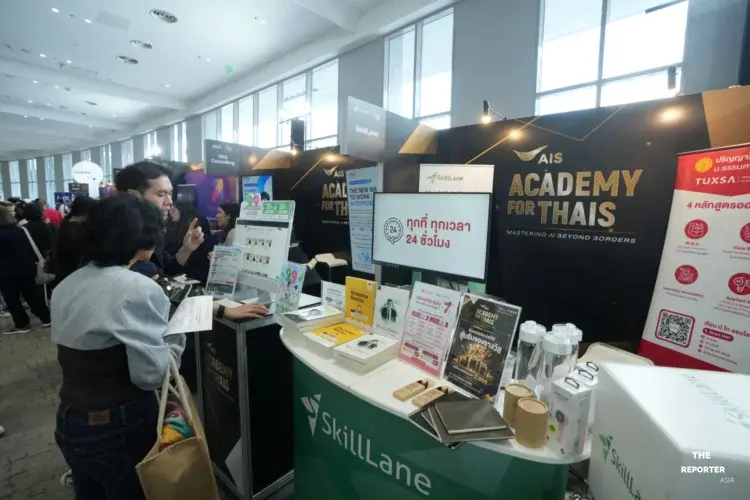
The gathering laid out three structural shifts designed to break conventional organizational inertia across the domestic ecosystem. The first mandate demands an institutional pivot from individual software utilization to unified enterprise reinvention, establishing rigorous baseline outcomes across core workflows. The second requires transitioning from rote operational training to cultivating foundational cognitive competencies, including empirical inquiry, quantitative reasoning, and ethical technological oversight. Finally, the framework calls for dismantling corporate silos to build a shared national infrastructure where public, academic, and industrial sectors pool intelligence to expand economic participation.
In detailing this systemic approach, Ms. Kantima emphasized that institutional relevance depends on converting conceptual ideas into field execution. “AIS Academy’s role goes beyond organizing events or sharing knowledge,” she observed. “We connect people facing real challenges with knowledge, technology, and partner networks that can help translate learning into action. This event has therefore been designed to address national readiness, organizational readiness, and individual skills, while providing opportunities for participants to learn, experiment, and explore real-world examples of how AI can deliver meaningful results.”
Grassroots Engineering and the Future of Education
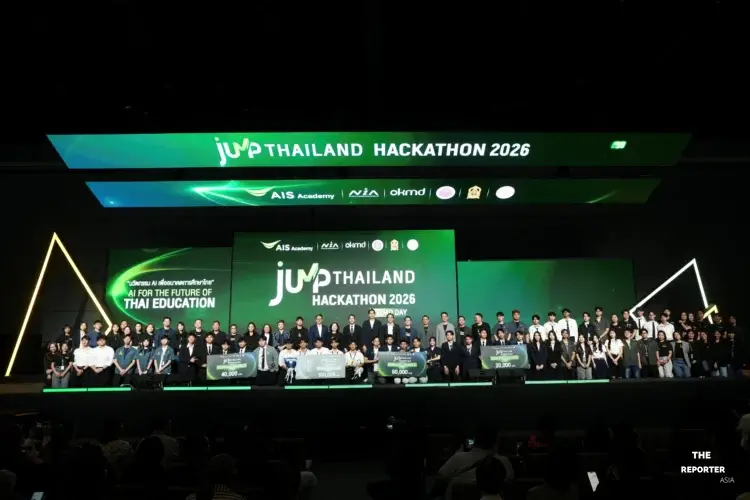
The practical viability of these ecosystem linkages was demonstrated through the conclusion of the JUMP Thailand Hackathon 2026, which anchored the opening proceedings. Centered on the operational theme AI for the Future of Thai Education: Artificial Intelligence for the Future of Thai Education, the open innovation platform drew 2,504 participants across 603 competitive entries from 67 academic institutions throughout the kingdom. Ten finalist teams advanced to the high-stakes pitching stage, presenting production-ready software prototypes engineered to alleviate systemic instructional deficits and resolve daily classroom friction.
Securing the championship title was Team MAMO from Prince of Songkla University, recognized for developing Wathasin, an adaptive artificial intelligence speech coach designed to refine pedagogical and rhetorical communication. The first runner-up honors were awarded to Team Rub Mao Kor Rueng, also representing Prince of Songkla University, for their tactile accessibility device BrailleBox. The second runner-up position went to Team MR. BOBO, a multi-institutional engineering alliance between Chulalongkorn University and King Mongkut’s University of Technology North Bangkok, which introduced DEAFIN Education to empower hearing-impaired learners. Demonstrating strong community resonance, Team TLDR from Khon Kaen University captured the Popular Vote Award for LearnLy, an interactive digital platform aimed at democratizing personalized study pathways.
These academic breakthroughs reveal that youth-driven engineering can directly solve complex social problems when supported by scalable industrial networks. Rather than remaining isolated laboratory projects, these student solutions illustrate how applied algorithms can democratize educational resources, streamline institutional teaching administration, and close persistent equity gaps across regional borders. The hackathon affirmed that early investments in localized software development supply the human capital necessary to protect domestic technological sovereignty against monolithic overseas providers.
Architecting National and Urban Digital Ecosystems
The opening day expanded into the Thailand AI Readiness plenary stage, where senior administrative officials and enterprise executives analyzed institutional preparedness across urban landscapes. Dialogues investigated how artificial intelligence reconfigures metropolitan civic administration, logistics routing, public service delivery, and professional employment models. The panels made clear that smart city planning cannot rely solely on importing foreign turnkey systems; it requires localized operational data and adaptive legal frameworks capable of supporting continuous structural modernization.
These deliberations emphasized that Thailand’s long-term economic competitiveness requires moving beyond mere platform consumption. Transforming into an autonomous digital creator requires establishing common data standards, reducing vendor lock-in across critical public infrastructure, and building scalable domestic platforms. Municipal leaders and enterprise architects examined how local utilities and regional hubs can deploy automated decision models responsibly, ensuring that regional communities benefit equally from technological advancement rather than concentrating digital gains in the capital.
The discussions consistently returned to the foundational requirement of human readiness within the national operational ecosystem. “What the country urgently needs is therefore not only advanced infrastructure and tools, but also people who are ready to learn, adapt, ask the right questions, make data-driven decisions, collaborate with AI, and use technology responsibly,” Ms. Kantima pointed out. “The readiness of our people is the starting point for the readiness of our nation.”
Accelerating Commercial Adoption for Small Enterprises
The summit’s second-day agenda established actionable roadmaps through the specialized AI Ready Business and AI Ready Skills presentation tracks. Tailored to unpack complex operational economics, these sessions delivered empirical corporate case studies illustrating how automated intelligence drives operational margins, reduces supply-chain friction, and surfaces latent commercial demand. Crucially, the programming dismantled the common misconception that advanced machine systems remain the exclusive domain of multinational enterprises with massive capital expenditure budgets.
Dedicated sessions focused on small and medium-sized enterprises, identifying accessible entry points for smaller businesses seeking productivity gains without unsustainable upfront hardware investments. Industry specialists demonstrated how scalable digital models allow local suppliers to streamline inventory forecasting, automate customer support, and refine cash flow management. By demonstrating measurable returns on investment across basic commercial functions, the tracks provided practical playbooks for traditional businesses facing competitive disruption.
The broader macroeconomic consequence is that technological democratization serves as a primary hedge against operational obsolescence. When regional supply chains integrate algorithmic tools to monitor demand spikes and eliminate waste, aggregate national productivity increases exponentially. Equipping smaller market participants with accessible tools prevents structural market consolidation, ensuring that foundational domestic businesses continue to anchor employment while climbing regional value chains.
Cultivating Enduring Human Capital for the Age of AGI
Complementing commercial frameworks, the enterprise agenda addressed the looming arrival of Artificial General Intelligence and its disruption of white-collar labour markets. Speakers noted that specialized technical proficiencies lose market premium quickly as automation codes itself, elevating the value of durable human capabilities such as systematic reasoning, creative synthesis, and ethical judgment. To thrive in an automated economy, professionals must move past basic prompt writing to master complex systems thinking and cross-disciplinary problem definition.
This educational methodology was brought to life across more than 20 interactive Workshop and Masterclass sessions, paired with hands-on AI Interactive Experiences developed alongside international technical partners. Moving deliberately away from passive presentations, these practical laboratories immersed participants directly in rapid workflow prototyping, predictive analytics configuration, and applied computer vision workflows. Attendees tested live deployment environments, learning to identify data drift, mitigate algorithmic bias, and calculate the actual operational cost of live production deployments.
Summarizing this long-term societal objective, Ms. Kantima highlighted the balance between competitive drive and inclusive social progress. “Our goal is not merely to help Thai people keep pace with AI, but to equip them to use AI to generate tangible results and unlock new opportunities,” Ms. Kantima emphasized. “When people are ready, organizations are ready, and every sector moves forward together, Thailand will not simply follow technological change. The country will be able to harness AI as a driving force for economic growth, social progress, and a stronger, more sustainable future.”
Industrial Infrastructure as an Engine for National Growth
The overarching conference strategy directly mirrors the commercial evolution of AIS as it expands from a legacy telecommunications operator into a cognitive technology enterprise. Backing this operational model is the company’s enterprise connectivity foundation, which includes 1,460 MHz of telecommunications spectrum and a mobile subscriber base reaching 47.1 million accounts across an intelligent 5G network. Complemented by 5.3 million broadband connections under the AIS 3BB FIBRE3 network, this infrastructure serves a combined operational footprint of 53.9 million customer relationships across enterprise, retail, and digital financial ecosystems.
This extensive network capacity demonstrates that large-scale technological adoption relies fundamentally on underlying physical connectivity. Without resilient, low-latency telecommunications conduits and edge-computing infrastructure, enterprise machine learning models cannot ingest data streams or deliver low-latency services to end consumers. By anchoring algorithmic software deployments directly to carrier-grade infrastructure, corporate networks generate the stability required for continuous automation across commercial trade corridors.
The event concluded its open-door sessions on 11–12 September 2026, offering public access across all masterclasses to maximize the dissemination of technical expertise. By mobilizing its strategic partnerships and opening industrial pipelines to developers, universities, and corporate leaders, the initiative establishes an enduring operational framework. Thailand’s economic future will not be determined by passive technological consumption, but by the country’s institutional discipline in deploying artificial intelligence to solve its most complex industrial challenges.
#AISAcademy #AISACADEMYforTHAIs2026 #MasteringAIBeyondBorders #JUMPThailandHackathon2026 #ThailandDigitalEconomy #AITransformation #CognitiveTech #EdTechThailand